Organic search

SEO Challenges in 2026: A Guide to the Climb

SEO Challenges in 2026: A Guide to the Climb

SEO Challenges in 2026: A Guide to the Climb

Daniel Rojo

11 min

Daniel Rojo

11 min

Contents

No headings found

Nobody who has climbed a real mountain describes it as a straight walk up. The summit is hidden from the trailhead. The terrain that looks simple from below turns technical the moment you're on it. The weather turns without asking. And the people you're roped to have to trust each other completely, because the whole party moves at the speed of its slowest, most nervous member. SEO is that climb. If it were a gentle stroll, everyone would already be at the top, which the mountain does not permit.

This guide maps the climb as it exists in 2026, and the terrain has changed more in the last two years than in the previous ten. It's written to be useful whether you're an in-house marketer defending a budget, an agency guiding clients up the slope, or a business owner trying to understand why the ascent you're paying for is so hard to measure. We've split the route into four stretches: the human challenges of the rope team, which strand more expeditions than any cliff; the classic technical and strategic terrain that never got easier; the new challenges that appeared when the mountain itself started moving; and how we approach the whole route at Flowboost.

Part 1: The rope team (the challenges nobody puts in the brochure)

Metaphorical cartoon of an SEO specialist helping a client climb to the top, as if they were mountaineers

Ask an experienced climber what most often ends an expedition, and few will point at the rock. They'll talk about a party that lost trust, moved at the wrong pace, or stopped communicating on the ridge. SEO is the same. It's slow, technical, and hard to attribute, which is a perfect recipe for the person doing the climbing and the person funding it to fall out of step. These are the challenges that live in the rope between them.

The trust problem: an industry with a credibility hangover

SEO carries baggage. Almost every business owner has a story about an agency that promised the summit, took a monthly retainer, sent back a blurry photo of base camp, and delivered nothing measurable. That history means many SEO relationships start roped to a stranger the client has every reason to distrust, where the specialist has to prove they're not the last guide who left the party stranded before any real climbing can begin. This is usually the first challenge of any engagement, and no clever audit solves it. Honest expectations early, specifics about what happens and when, and a willingness to say "I don't know yet" instead of pointing confidently at a peak you can't see: that is what earns the rope.

The timeline problem: the summit is slow, and everyone wants it fast

This is the challenge behind the search "hard phase SEO," and it's real. Progress compounds over months, not days. Content has to be crawled, indexed, and earn its footing; authority accrues gradually; a change made today may not show its full effect until next quarter. Meanwhile the people funding the climb are used to paid channels, where you switch on spend and see traffic by the afternoon. The mismatch is structural. The client isn't wrong to want the summit sooner, and the specialist isn't wrong that mountains don't hurry. Managing that tension, by agreeing what each camp on the way up looks like at 30, 60, and 90 days rather than only pointing at the peak, is a core skill, not an afterthought.

The attribution and reporting problem: proving a climb you can't fully see

SEO has never been fully measurable, and the fog is thickening. Some of a campaign's value shows up as branded searches, direct visits, or a mention in an AI answer that never sends a click but still shapes a buying decision. Reporting honestly through that fog is a genuine challenge: lean too hard on rankings and you're measuring vanity; lean only on last-click conversions and you erase half of what the climb actually achieved. The discipline is to report on a blend, tie the work to business outcomes wherever possible, and resist dressing up the view. A report that only ever shows clear skies is usually hiding weather.

The communication problem: two people speaking different languages on the same ridge

A lot of SEO friction is really a translation failure. The specialist talks in canonicals, crawl budget, and entity coverage; the client hears wind and wants to know whether the phone will ring. Bridging that gap, explaining the why in the client's language without either dumbing it down or burying them in jargon, is a skill many technically brilliant SEOs never develop, and its absence quietly ends good climbs. Clear, regular communication is not a soft extra roped on top of the real work; for the relationship, it often is the real work.

SEO objections: the pushback you'll hear, and what's behind it

Anyone selling or defending SEO hears the same objections, and each one is a rational fear wearing a blunt question:

"It's too slow" is really "I can't afford to wait and see nothing." 

"We tried it and it didn't work" is really "I've been left on a mountain before." 

"Can't we just run ads?" is really "I want predictable ground under my feet." 

"How do I know it's even working?" is really "I can't see where we are." 

Treating objections as fears to understand rather than arguments to win is what separates a defensive pitch from a real conversation. The answer to most of them isn't a counter-argument; it's honesty, evidence, and a realistic view of the route.

Part 2: The terrain that never got easier
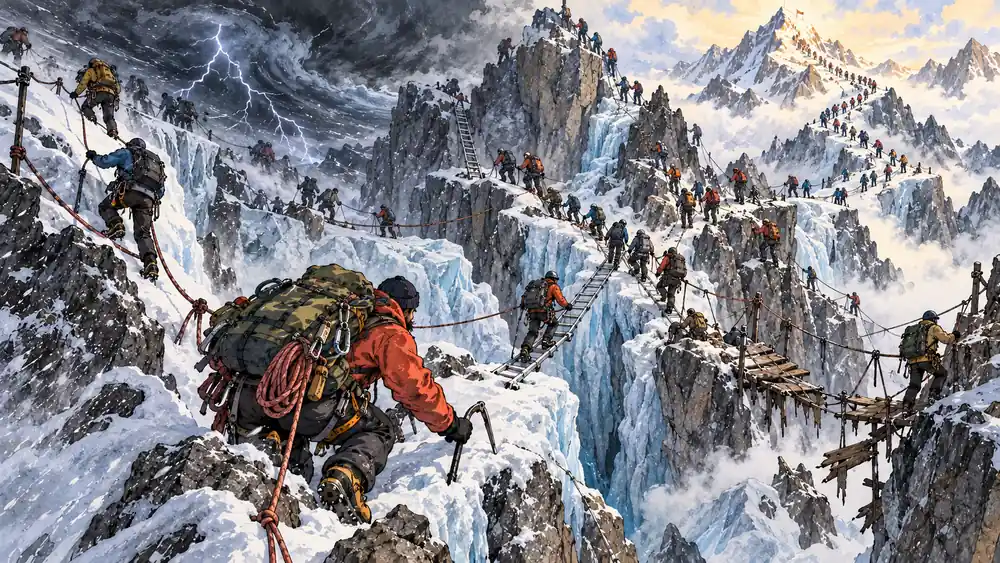
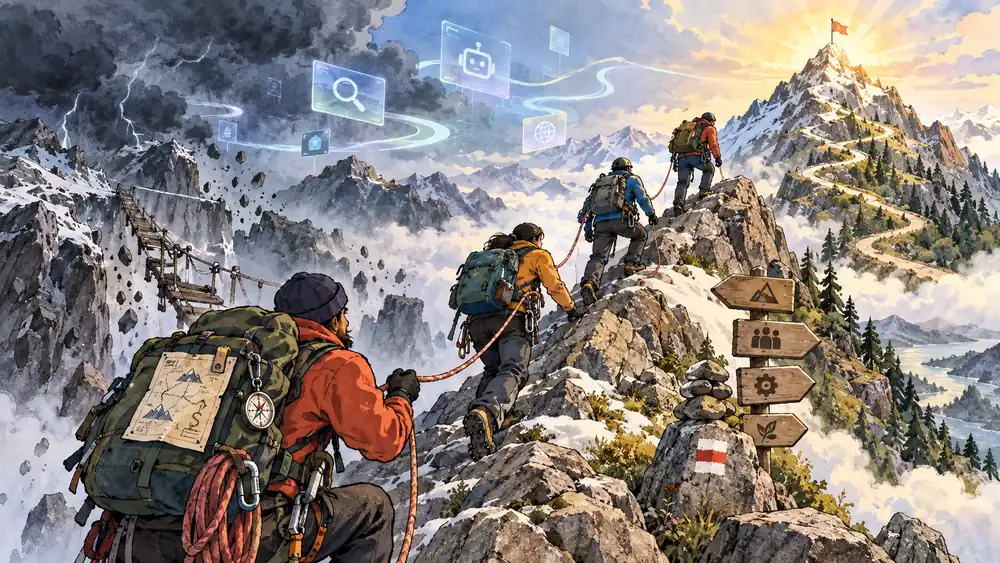
Metaphorical cartoon of SEO specialists trying to climb the SERPs, which have become treacherous terrain

The rope-team challenges are made heavier by the fact that the climbing itself is genuinely hard. Beneath every client conversation sits technical and strategic terrain that has defined SEO for years. The new AI challenges in Part 3 didn't replace this ground; they stacked fresh obstacles on top of it.

Rising competition and content saturation

Almost every valuable route is now crowded with more, and better-equipped, climbers than ever, and the sheer volume of published content has exploded, not least because generative tools made producing it trivial. The challenge is no longer simply to set off; it's to arrive with something that earns its place on a crowded face, which raises the bar for quality, originality, and real expertise rather than lowering it.

Technical complexity: the terrain that looks simple until you're on it

Modern sites are complicated, and the technical foundation of SEO has grown to match. Site speed and Core Web Vitals, JavaScript rendering, crawl efficiency, structured data, and clean architecture all affect performance, and any one of them can quietly hold a site back. Problems such as orphan pages and redirect chains are the hidden crevasses of the route: easy to walk straight into and disproportionately damaging. This is exactly why technical SEO stays a specialist challenge rather than a checklist anyone can run.

Storms: algorithm volatility and the loss of certainty

Then there's the weather. Google changes constantly, and a core update can roll in like a storm and reshape a site's visibility overnight, with little warning and less explanation. The deeper challenge isn't any single storm; it's climbing productively knowing another can always arrive, where best practice is inferred from the clouds rather than forecast, and today's safe path may be gone next season. Telling a real storm from ordinary changing weather matters too: distinguishing a genuine Google penalty from routine algorithmic re-scoring is part of the same skill, and getting it wrong sends teams battening down for a storm that was never coming.
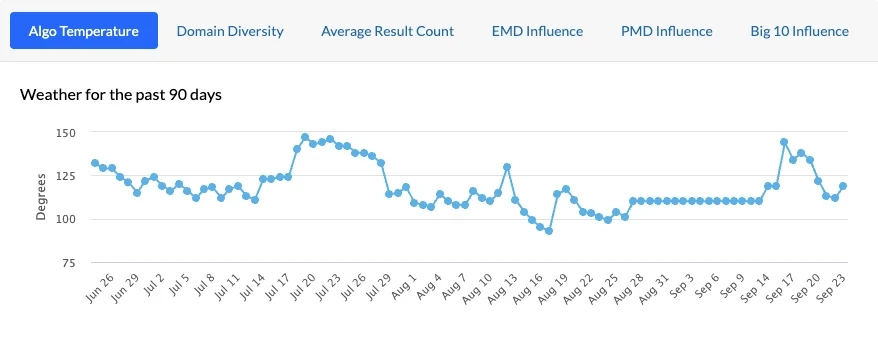
Moz weather graph

You can use the MozCast report to see turbulence in the Google algorithm over the previous day (or see the 90-day history below). 

Proving ROI against paid channels

Because the climb is slow and imperfectly measurable, it's forever compared unfavourably with paid channels that report a tidy cost-per-acquisition by lunchtime, like a helicopter that drops you at the summit for a fee and lifts off the moment you stop paying. 

SEO builds a route you own rather than renting the ride, and its value includes demand and visibility last-click reporting never sees, is a persistent strategic challenge, not a one-off slide.

Part 3: When the mountain started moving

Metaphorical cartoon of SEO specialists jumping from one piece of ground to another one, after the changes on the SERPs

Now the ground shifts, literally. For most of SEO's history the mountain at least stayed put: hard to climb, but the same shape each morning. Over the last two years, generative AI in search has changed that. The old implicit promise of SEO was simple: reach the top and you'll get the view, the click, the visit. The summit is still there, but the mountain has rearranged itself around it, and everything downstream of that promise has become a challenge to solve.

Zero-click search: reaching the top and finding no view

The central change is that a large and growing share of searches now end without anyone clicking through to a website, because the answer is delivered right there on the results page. Estimates of exactly how large vary a lot between studies and by query type, but the direction is unmistakable, and it predates AI: featured snippets and knowledge panels began the erosion, and AI answers accelerated it sharply. The challenge this creates is existential for anyone who measured SEO purely in sessions: you can be more visible on the mountain than ever and bring back fewer visitors than before, at the same time.

AI Overviews and answer engines: one synthesised answer instead of ten paths up

Google's AI Overviews, its AI Mode, and standalone answer engines like ChatGPT, Perplexity, and Gemini increasingly summarise, compare, and recommend before a user ever sets foot on your site. That moves the goalposts to a different ledge. Ranking in the traditional results is no longer enough; the new challenge is to become a source these systems trust enough to cite, because a citation inside an AI answer may now carry the visibility a top ranking used to. Some studies suggest the clicks that do survive an AI answer tend to be higher-intent, which is real consolation, but it demands a shift from climbing for volume to climbing for qualified visibility.

The rise of GEO and AEO as new disciplines

Out of the reshaped landscape, new disciplines have crystallised: Generative Engine Optimisation (GEO) and Answer Engine Optimisation (AEO), the craft of optimising to be understood and cited by AI systems rather than only ranked by a search engine. The challenge is that these don't replace SEO so much as open a second face on the same mountain, expanding the skill set required and the number of routes to be measured at once. Practical questions like how to rank on ChatGPT are now part of the brief, not a curiosity.

Measurement in a multi-surface world

When your brand can appear in a traditional ranking, an AI Overview, a chatbot answer, and a knowledge panel, all for the same query, the old map is useless. The challenge is no longer reading a single position; it's charting your visibility across several surfaces that click-based analytics were never drawn to capture. This is why brand search demand, citation tracking, and share of voice in AI answers are becoming as important as the rankings report, and why measurement itself is now one of the harder problems on the mountain.

AI-generated content and the quality bar

Generative tools let anyone produce plausible content at scale, flooding the slopes with climbers who look the part, which forces search engines to lean harder on trust and expertise to tell the prepared from the merely present. The challenge cuts both ways: teams are tempted to mass-produce content that search engines are increasingly built to discount, while the genuine path forward, demonstrable expertise and real value, becomes both more important and harder to fake. Volume was never the way up; now it's actively dangerous.

Part 4: How clients can tell the climb is going well
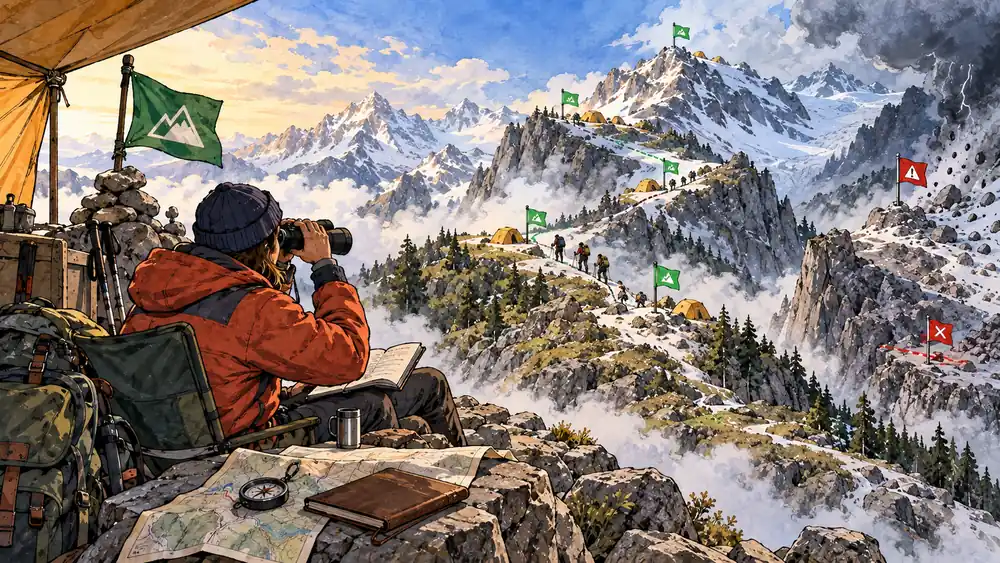
Metaphorical cartoon of a client looking at their SEO specialists, trying to climb to the top

Everything so far has been the view from the rope. But if you're the one funding the expedition rather than climbing it, you face a harder version of the trust problem: SEO is slow and technical, so how do you judge whether your specialist is making real progress or just keeping you warm at base camp? You can't audit the work yourself. What you can do is read the signals, and know which questions separate a good guide from a plausible one.

Signs your SEO is actually working

Real progress rarely announces itself with a sudden flood of traffic. It looks more like steady, believable movement in the right direction. A few signs that the climb is genuinely underway:

  1. You're seeing gradual gains across a spread of keywords and pages rather than one vanity term

  2. Impressions and visibility are trending up even in months when traffic is flat, which is often the first footprint of progress

  3. The quality of traffic is improving, not just the quantity, with more of the right people arriving

  4. Your specialist can point to specific work done and explain why it should matter. Slow but explainable beats fast but mysterious every time.

Red flags worth watching for

Some warning signs are worth taking seriously, because they tend to travel together with disappointment. 

  1. Be wary of guaranteed number-one rankings, since nobody controls Google and the promise itself is the tell. 

  2. Be wary of reports that only ever show green, or that lead with rankings for obscure terms nobody searches, which is vanity dressed as progress. 

  3. Be wary of a specialist who can't explain what they did in language you understand, or who goes quiet for long stretches and resurfaces only to invoice. 

  4. Be cautious of anyone still selling the old promise of pure traffic volume without ever mentioning AI search, zero-click, or visibility, because that's a guide describing a mountain that has already changed shape.

Questions that reveal a good SEO

You don't need to be technical to ask the questions that matter; you just need to ask ones that are hard to fake:

  • What should I realistically expect at 30, 60, and 90 days? 

  • How will we measure success beyond rankings, and how does that tie to my actual business goals? 

  • How are you accounting for AI Overviews and zero-click search in the strategy? 

  • What have you done this month, and why does it matter? 

  • What would make you tell me to stop spending on SEO? 

A specialist who answers these in plain language, with realistic rather than flattering answers, and who is comfortable naming the limits of what SEO can do, is showing you the honesty that the whole climb depends on. The evasive or uniformly rosy answer is itself the answer.

Part 5: How we climb it at Flowboost

Metaphorical cartoon of the Flowboost team explaining the climbing route to a client

Naming the challenges is the easy part; the useful question is how you actually move up the mountain. Our approach at Flowboost has been shaped by the hard-won lesson that the rope-team problems in Part 1 strand more expeditions than any cliff in Part 2, so we treat them with equal seriousness.

On trust and expectations, we'd rather lose a pitch than win it by pointing at a summit we can't promise to reach. That means being explicit early about what SEO can and can't do, and on what timeline, so the party sets off from realism rather than a rankings guarantee that strands everyone halfway. On the timeline problem, we define what each camp looks like on the way up instead of asking clients to wait in the dark for a single far-off peak, because visible early progress is what makes a slow climb bearable and fundable.

On reporting and communication, we report on business outcomes and a blend of signals rather than one flattering photo, and we explain the reasoning in plain language, because a client who understands why we're taking a particular route can stay roped in through the quiet, viewless stretches. And on the moving mountain, we treat GEO as the natural evolution of SEO, charting visibility across surfaces and optimising to be cited, not just ranked, while never letting go of the technical and content fundamentals the whole climb still rests on.

None of this makes SEO easy, and it isn't meant to. The point isn't to flatten the mountain, which no one can do, but to be honest about the terrain and competent on it. On ground this uncertain, that honesty is itself a competitive advantage.

If you're partway up one of these challenges, whether it's a traffic drop you can't explain, a case for SEO you need to make internally, or working out what AI search means for your brand, that's exactly the kind of climb we like. Take a look at how we approach organic search, or talk to us about where you're standing on the mountain.

Daniel Rojo

Meet Wolfy

Triple your productivity with Wolfy, the dedicated Google Ads agent.

Talk to an expert

Contents

No headings found

Nobody who has climbed a real mountain describes it as a straight walk up. The summit is hidden from the trailhead. The terrain that looks simple from below turns technical the moment you're on it. The weather turns without asking. And the people you're roped to have to trust each other completely, because the whole party moves at the speed of its slowest, most nervous member. SEO is that climb. If it were a gentle stroll, everyone would already be at the top, which the mountain does not permit.

This guide maps the climb as it exists in 2026, and the terrain has changed more in the last two years than in the previous ten. It's written to be useful whether you're an in-house marketer defending a budget, an agency guiding clients up the slope, or a business owner trying to understand why the ascent you're paying for is so hard to measure. We've split the route into four stretches: the human challenges of the rope team, which strand more expeditions than any cliff; the classic technical and strategic terrain that never got easier; the new challenges that appeared when the mountain itself started moving; and how we approach the whole route at Flowboost.

Part 1: The rope team (the challenges nobody puts in the brochure)

Metaphorical cartoon of an SEO specialist helping a client climb to the top, as if they were mountaineers

Ask an experienced climber what most often ends an expedition, and few will point at the rock. They'll talk about a party that lost trust, moved at the wrong pace, or stopped communicating on the ridge. SEO is the same. It's slow, technical, and hard to attribute, which is a perfect recipe for the person doing the climbing and the person funding it to fall out of step. These are the challenges that live in the rope between them.

The trust problem: an industry with a credibility hangover

SEO carries baggage. Almost every business owner has a story about an agency that promised the summit, took a monthly retainer, sent back a blurry photo of base camp, and delivered nothing measurable. That history means many SEO relationships start roped to a stranger the client has every reason to distrust, where the specialist has to prove they're not the last guide who left the party stranded before any real climbing can begin. This is usually the first challenge of any engagement, and no clever audit solves it. Honest expectations early, specifics about what happens and when, and a willingness to say "I don't know yet" instead of pointing confidently at a peak you can't see: that is what earns the rope.

The timeline problem: the summit is slow, and everyone wants it fast

This is the challenge behind the search "hard phase SEO," and it's real. Progress compounds over months, not days. Content has to be crawled, indexed, and earn its footing; authority accrues gradually; a change made today may not show its full effect until next quarter. Meanwhile the people funding the climb are used to paid channels, where you switch on spend and see traffic by the afternoon. The mismatch is structural. The client isn't wrong to want the summit sooner, and the specialist isn't wrong that mountains don't hurry. Managing that tension, by agreeing what each camp on the way up looks like at 30, 60, and 90 days rather than only pointing at the peak, is a core skill, not an afterthought.

The attribution and reporting problem: proving a climb you can't fully see

SEO has never been fully measurable, and the fog is thickening. Some of a campaign's value shows up as branded searches, direct visits, or a mention in an AI answer that never sends a click but still shapes a buying decision. Reporting honestly through that fog is a genuine challenge: lean too hard on rankings and you're measuring vanity; lean only on last-click conversions and you erase half of what the climb actually achieved. The discipline is to report on a blend, tie the work to business outcomes wherever possible, and resist dressing up the view. A report that only ever shows clear skies is usually hiding weather.

The communication problem: two people speaking different languages on the same ridge

A lot of SEO friction is really a translation failure. The specialist talks in canonicals, crawl budget, and entity coverage; the client hears wind and wants to know whether the phone will ring. Bridging that gap, explaining the why in the client's language without either dumbing it down or burying them in jargon, is a skill many technically brilliant SEOs never develop, and its absence quietly ends good climbs. Clear, regular communication is not a soft extra roped on top of the real work; for the relationship, it often is the real work.

SEO objections: the pushback you'll hear, and what's behind it

Anyone selling or defending SEO hears the same objections, and each one is a rational fear wearing a blunt question:

"It's too slow" is really "I can't afford to wait and see nothing." 

"We tried it and it didn't work" is really "I've been left on a mountain before." 

"Can't we just run ads?" is really "I want predictable ground under my feet." 

"How do I know it's even working?" is really "I can't see where we are." 

Treating objections as fears to understand rather than arguments to win is what separates a defensive pitch from a real conversation. The answer to most of them isn't a counter-argument; it's honesty, evidence, and a realistic view of the route.

Part 2: The terrain that never got easier

Metaphorical cartoon of SEO specialists trying to climb the SERPs, which have become treacherous terrain

The rope-team challenges are made heavier by the fact that the climbing itself is genuinely hard. Beneath every client conversation sits technical and strategic terrain that has defined SEO for years. The new AI challenges in Part 3 didn't replace this ground; they stacked fresh obstacles on top of it.

Rising competition and content saturation

Almost every valuable route is now crowded with more, and better-equipped, climbers than ever, and the sheer volume of published content has exploded, not least because generative tools made producing it trivial. The challenge is no longer simply to set off; it's to arrive with something that earns its place on a crowded face, which raises the bar for quality, originality, and real expertise rather than lowering it.

Technical complexity: the terrain that looks simple until you're on it

Modern sites are complicated, and the technical foundation of SEO has grown to match. Site speed and Core Web Vitals, JavaScript rendering, crawl efficiency, structured data, and clean architecture all affect performance, and any one of them can quietly hold a site back. Problems such as orphan pages and redirect chains are the hidden crevasses of the route: easy to walk straight into and disproportionately damaging. This is exactly why technical SEO stays a specialist challenge rather than a checklist anyone can run.

Storms: algorithm volatility and the loss of certainty

Then there's the weather. Google changes constantly, and a core update can roll in like a storm and reshape a site's visibility overnight, with little warning and less explanation. The deeper challenge isn't any single storm; it's climbing productively knowing another can always arrive, where best practice is inferred from the clouds rather than forecast, and today's safe path may be gone next season. Telling a real storm from ordinary changing weather matters too: distinguishing a genuine Google penalty from routine algorithmic re-scoring is part of the same skill, and getting it wrong sends teams battening down for a storm that was never coming.

Moz weather graph

You can use the MozCast report to see turbulence in the Google algorithm over the previous day (or see the 90-day history below). 

Proving ROI against paid channels

Because the climb is slow and imperfectly measurable, it's forever compared unfavourably with paid channels that report a tidy cost-per-acquisition by lunchtime, like a helicopter that drops you at the summit for a fee and lifts off the moment you stop paying. 

SEO builds a route you own rather than renting the ride, and its value includes demand and visibility last-click reporting never sees, is a persistent strategic challenge, not a one-off slide.

Part 3: When the mountain started moving

Metaphorical cartoon of SEO specialists jumping from one piece of ground to another one, after the changes on the SERPs

Now the ground shifts, literally. For most of SEO's history the mountain at least stayed put: hard to climb, but the same shape each morning. Over the last two years, generative AI in search has changed that. The old implicit promise of SEO was simple: reach the top and you'll get the view, the click, the visit. The summit is still there, but the mountain has rearranged itself around it, and everything downstream of that promise has become a challenge to solve.

Zero-click search: reaching the top and finding no view

The central change is that a large and growing share of searches now end without anyone clicking through to a website, because the answer is delivered right there on the results page. Estimates of exactly how large vary a lot between studies and by query type, but the direction is unmistakable, and it predates AI: featured snippets and knowledge panels began the erosion, and AI answers accelerated it sharply. The challenge this creates is existential for anyone who measured SEO purely in sessions: you can be more visible on the mountain than ever and bring back fewer visitors than before, at the same time.

AI Overviews and answer engines: one synthesised answer instead of ten paths up

Google's AI Overviews, its AI Mode, and standalone answer engines like ChatGPT, Perplexity, and Gemini increasingly summarise, compare, and recommend before a user ever sets foot on your site. That moves the goalposts to a different ledge. Ranking in the traditional results is no longer enough; the new challenge is to become a source these systems trust enough to cite, because a citation inside an AI answer may now carry the visibility a top ranking used to. Some studies suggest the clicks that do survive an AI answer tend to be higher-intent, which is real consolation, but it demands a shift from climbing for volume to climbing for qualified visibility.

The rise of GEO and AEO as new disciplines

Out of the reshaped landscape, new disciplines have crystallised: Generative Engine Optimisation (GEO) and Answer Engine Optimisation (AEO), the craft of optimising to be understood and cited by AI systems rather than only ranked by a search engine. The challenge is that these don't replace SEO so much as open a second face on the same mountain, expanding the skill set required and the number of routes to be measured at once. Practical questions like how to rank on ChatGPT are now part of the brief, not a curiosity.

Measurement in a multi-surface world

When your brand can appear in a traditional ranking, an AI Overview, a chatbot answer, and a knowledge panel, all for the same query, the old map is useless. The challenge is no longer reading a single position; it's charting your visibility across several surfaces that click-based analytics were never drawn to capture. This is why brand search demand, citation tracking, and share of voice in AI answers are becoming as important as the rankings report, and why measurement itself is now one of the harder problems on the mountain.

AI-generated content and the quality bar

Generative tools let anyone produce plausible content at scale, flooding the slopes with climbers who look the part, which forces search engines to lean harder on trust and expertise to tell the prepared from the merely present. The challenge cuts both ways: teams are tempted to mass-produce content that search engines are increasingly built to discount, while the genuine path forward, demonstrable expertise and real value, becomes both more important and harder to fake. Volume was never the way up; now it's actively dangerous.

Part 4: How clients can tell the climb is going well

Metaphorical cartoon of a client looking at their SEO specialists, trying to climb to the top

Everything so far has been the view from the rope. But if you're the one funding the expedition rather than climbing it, you face a harder version of the trust problem: SEO is slow and technical, so how do you judge whether your specialist is making real progress or just keeping you warm at base camp? You can't audit the work yourself. What you can do is read the signals, and know which questions separate a good guide from a plausible one.

Signs your SEO is actually working

Real progress rarely announces itself with a sudden flood of traffic. It looks more like steady, believable movement in the right direction. A few signs that the climb is genuinely underway:

  1. You're seeing gradual gains across a spread of keywords and pages rather than one vanity term

  2. Impressions and visibility are trending up even in months when traffic is flat, which is often the first footprint of progress

  3. The quality of traffic is improving, not just the quantity, with more of the right people arriving

  4. Your specialist can point to specific work done and explain why it should matter. Slow but explainable beats fast but mysterious every time.

Red flags worth watching for

Some warning signs are worth taking seriously, because they tend to travel together with disappointment. 

  1. Be wary of guaranteed number-one rankings, since nobody controls Google and the promise itself is the tell. 

  2. Be wary of reports that only ever show green, or that lead with rankings for obscure terms nobody searches, which is vanity dressed as progress. 

  3. Be wary of a specialist who can't explain what they did in language you understand, or who goes quiet for long stretches and resurfaces only to invoice. 

  4. Be cautious of anyone still selling the old promise of pure traffic volume without ever mentioning AI search, zero-click, or visibility, because that's a guide describing a mountain that has already changed shape.

Questions that reveal a good SEO

You don't need to be technical to ask the questions that matter; you just need to ask ones that are hard to fake:

  • What should I realistically expect at 30, 60, and 90 days? 

  • How will we measure success beyond rankings, and how does that tie to my actual business goals? 

  • How are you accounting for AI Overviews and zero-click search in the strategy? 

  • What have you done this month, and why does it matter? 

  • What would make you tell me to stop spending on SEO? 

A specialist who answers these in plain language, with realistic rather than flattering answers, and who is comfortable naming the limits of what SEO can do, is showing you the honesty that the whole climb depends on. The evasive or uniformly rosy answer is itself the answer.

Part 5: How we climb it at Flowboost

Metaphorical cartoon of the Flowboost team explaining the climbing route to a client

Naming the challenges is the easy part; the useful question is how you actually move up the mountain. Our approach at Flowboost has been shaped by the hard-won lesson that the rope-team problems in Part 1 strand more expeditions than any cliff in Part 2, so we treat them with equal seriousness.

On trust and expectations, we'd rather lose a pitch than win it by pointing at a summit we can't promise to reach. That means being explicit early about what SEO can and can't do, and on what timeline, so the party sets off from realism rather than a rankings guarantee that strands everyone halfway. On the timeline problem, we define what each camp looks like on the way up instead of asking clients to wait in the dark for a single far-off peak, because visible early progress is what makes a slow climb bearable and fundable.

On reporting and communication, we report on business outcomes and a blend of signals rather than one flattering photo, and we explain the reasoning in plain language, because a client who understands why we're taking a particular route can stay roped in through the quiet, viewless stretches. And on the moving mountain, we treat GEO as the natural evolution of SEO, charting visibility across surfaces and optimising to be cited, not just ranked, while never letting go of the technical and content fundamentals the whole climb still rests on.

None of this makes SEO easy, and it isn't meant to. The point isn't to flatten the mountain, which no one can do, but to be honest about the terrain and competent on it. On ground this uncertain, that honesty is itself a competitive advantage.

If you're partway up one of these challenges, whether it's a traffic drop you can't explain, a case for SEO you need to make internally, or working out what AI search means for your brand, that's exactly the kind of climb we like. Take a look at how we approach organic search, or talk to us about where you're standing on the mountain.

Daniel Rojo

Meet Wolfy

Triple your productivity with Wolfy, the dedicated Google Ads agent.

Talk to an expert

Frequently asked questions

Frequently asked questions

What is the biggest challenge in SEO right now?

For most teams in 2026 it's the shift to zero-click and AI-driven search: content can be more visible than ever while sending less direct traffic, which breaks traditional, click-based ways of measuring success. Alongside that, the long-standing relationship challenges of trust, timelines, and clear reporting remain the ones that most often decide whether an SEO project reaches the summit or not.

Why does SEO take so long to show results?

What are common objections to SEO, and how do you answer them?

Has AI made SEO obsolete?

What SEO challenges are specific to service companies?