Search Engine Marketing (SEO)

The farmers market test: what Google's March 2026 core update is actually rewarding

Four losers for every winner. The first major Google core update of 2026 is complete. The pattern of who gained and who lost is not what most businesses expected.
It is Saturday morning and the market is packed. Two hundred stalls, most of them selling the same tomatoes. Same size, same plastic tray, same supplier three towns over. You've walked past these stalls a hundred times.
Then there is the one in the corner. A variety you don't recognise. The vendor tells you where it grew, what made this summer different, why it won't be back next week. You buy it. You come back. You tell someone.
Google just became that customer. And it stopped buying the bulk tomatoes.
For two years, everyone believed AI had solved the content problem. Infinite supply, zero effort, full shelves by Tuesday. And for a while, the results looked convincing.
But Google has always been the customer who takes a bite before buying. The March 2026 core update is proof it has learned to taste the difference.
What is a Google core update, and why does this one matter?
Google adjusts its search algorithm constantly, making thousands of small changes throughout the year. A core update is different. It is a significant, deliberate recalibration of how the entire system evaluates and ranks content: a change in what the algorithm considers worthy of a prominent position in the results.
Think of it like a market manager reorganising the stalls every few months. Some vendors get the front row. Others get moved to the back. The products did not change overnight. The criteria for assessment did.
The March 2026 core update rolled out over 12 days, completing on April 8th. It was Google's first major ranking update of 2026, and independent analysis by SISTRIX in the German market puts its scale into sharp relief.

That is not a routine adjustment. That is a meaningful recalibration, and the pattern of who gained and who lost points clearly to what changed.
Data: SISTRIX
Apply this yourself Open Google Search Console and go to the Performance report. Filter the date range to March 27 through April 14 and compare it to the equivalent period the month before. Any pages showing a significant drop in clicks or average position have been assessed differently under the new criteria. That is your starting point. |
|---|
The new test: what Google is actually measuring now
For years, the question Google asked about every page was roughly: is this content relevant and trustworthy? That question has not gone away. But a second, more specific one has been added to the process. It changes the entire game.
The new question is: does this page add anything that does not already exist?
Based on SISTRIX research and the analyses we have conducted at Flowboost for our own clients, we can say that information gain appears to be a primary ranking signal. Google is now explicitly evaluating how much genuinely new information a page contributes compared to content that already ranks for the same query. A page that covers a topic competently but adds nothing beyond what the top five results already say—just in slightly different words—is no longer treated the same as a page that brings something new to the conversation.
"Google is no longer asking whether your content covers the topic. It is asking whether your content covers it differently."
This is not about word count, structure, or keyword density. It is about whether your page has a genuine reason to exist beyond filling a keyword gap.
The clearest evidence came in a pattern that repeated across multiple categories. In Germany. According to SIXTRIX research (including major dictionary and conjugation tools) experienced near-simultaneous drops of between 7% and 30%. These sites all operate in similar ways: providing utility content that is also produced by hundreds of competitors in nearly identical formats. Seven vendors at the market all selling the exact same dictionary. When the market manager reorganised, she did not need all seven of them in the front row.
Apply this yourself Search for your most important keyword and open the top five results. Read each one. Then open your own page. Write down one thing your page contains that none of the others do: a specific client result, a data point you gathered yourself, an opinion formed through direct experience. If you cannot find it, that is your most important content task this week. |
|---|
The wholesale problem: why bulk content is losing shelf space
The past two years produced a wave of content that all came from the same place. AI tools trained on the same datasets, generating answers to the same questions, arranged in similar structures. Some of it was published at enormous scale. The stall count multiplied fast.
The problem is structural. Every stall sourced from the same wholesaler. No matter how well the produce was arranged, it was fundamentally the same product. And Google can now identify the pattern.
The nuance here matters. The March update is not a blanket penalty on AI-assisted content. The distinction is between AI used as a production tool and AI used as a replacement for SEO expertise.
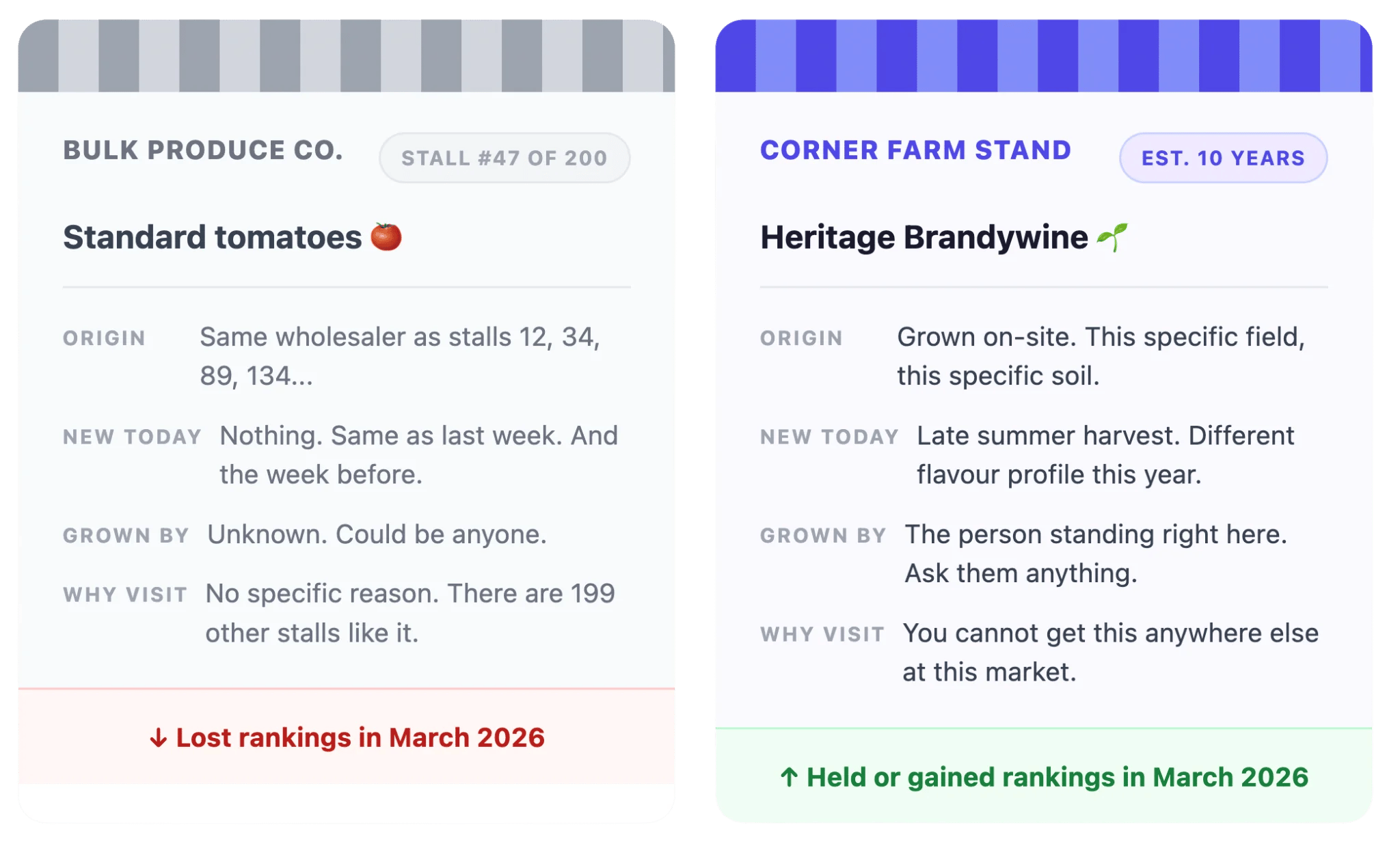
Recipe sites provide a useful illustration. During the update, smaller recipe portals lost between 18% and 29% of their visibility. Germany's largest established recipe platform, with genuine editorial depth and a community producing original content, remained stable. Same category, very different outcome. The market did not stop wanting recipes. It stopped wanting the version that every other stall already carries.
The same pattern held for the biggest winners. A major audiobook platform gained 172% in visibility. Official brand and government sites gained between 5% and 12%. These are not content farms. They are sources with something specific to offer that is difficult to replicate anywhere else.
Your terroir: what Google is rewarding
Terroir is the winemaking concept that describes everything unique to a specific plot of land: the soil composition, the rainfall, the slope, the decades of cultivation. Two vineyards planted a mile apart can produce wines that taste completely different because of it. You cannot import terroir. You cannot replicate it. It is the product of a specific place and specific accumulated experience.
This is what the March update rewards.
EEAT (Experience, Expertise, Authoritativeness, and Trustworthiness) has been part of Google's quality framework for years. The March update tightened its application significantly. Recent industry data shows that 73% of pages currently in top-ranking positions carry verifiable author credentials: named authors with professional profiles, demonstrable track records, or clear subject matter expertise. Anonymously authored content lost ground, particularly on health, finance, and legal topics where the quality of advice carries real consequences.
But terroir extends well beyond a LinkedIn profile. It is the things you know because you have done the work:
The campaign that worked unexpectedly well, and the specific reason why
The industry assumption you have seen disproved in practice
The question clients always ask in the first meeting that nobody else writes about
The pattern you noticed across fifty projects that no dataset has captured
None of that can be produced at scale from a shared dataset. None of it can be Googled, because you are the only source. That is your terroir. And that is what the market manager has started buying.
The niche advantage
The smaller your niche, the harder it is to fake expertise. And the easier it is to demonstrate it. A generalist site covering all of SEO competes with thousands of others. A site covering SEO specifically for independent hospitality businesses, written by someone who has run campaigns for hotels and restaurants for a decade, occupies terrain nobody else does. Specificity is a competitive advantage the March update just made significantly more visible.
Apply this yourself List three things you know about your industry that came directly from experience: not from research or reading, but from doing. Then check whether any of your existing content actually includes them. If not, the simplest EEAT improvement available to you right now is to find the right existing page and add a paragraph that only you could have written. |
|---|
Why this is good news for small businesses
The assumption has long been that Google favours large domains. More content, more backlinks, more history. Surely the bigger players win. The March update complicates that assumption in a meaningful way.
One clear takeaway from the update is that parasitic SEO is over. Domain authority no longer protects individual pages, and each page is now evaluated on its own content quality, information gain, and EEAT signals, regardless of how strong the overall domain is. This applies even to well-linked pages, while isolated pages are even more vulnerable due to a lack of contextual support. As a result, any page that doesn’t offer clear, unique value is more likely to lose visibility.
This changes the competitive landscape directly. A small business with genuine expertise in a specific niche now has a page that can compete with a much larger site's page, if the content is demonstrably more original and better informed. The market manager is not only looking at the size of the operation. She is looking at what is actually on the stall.
The businesses that have been investing in real content (case studies with actual results, perspectives shaped by direct professional experience, guides written from the inside rather than assembled from the outside) found that the March update moved in their direction. Not because they adapted to a new algorithm. Because they were already doing what the algorithm is now better at finding.
Showing up every Saturday: the compound effect
The farmers market vendor who builds a loyal customer base does not do it in a single week. They show up every Saturday. They bring something slightly different each time: a new variety, a note about the season, a reason to come back that was not there last week. Over months, the regular customers know their stall. Over years, new visitors are pointed there before they even reach the market themselves.
This is how sustainable SEO works. And it is exactly what the March update reinforces.
Consistent, original content investment builds authority that accumulates over time in ways a single burst of publishing cannot replicate. Each genuinely useful piece adds a small signal: a new keyword, a new inbound link, a new reason for Google to recognise the domain as a source worth trusting. The value does not reset. It compounds.
The March update accelerated the separation between sites that have been doing this consistently and sites that tried to shortcut it. Platforms that flooded their stalls with bulk produce over the past two years did not build the kind of trust that compounds. They built a large inventory of the same product. When the market manager's criteria changed, the inventory became a liability. For sites in exactly that situation, the next step is rarely more content. It is content pruning: a structured review of every indexed page to decide what stays, what gets merged, and what gets removed.
The answer is not to produce more. It is to produce differently. A consistent schedule of content that adds something new each time (original observations, updated data, evolving perspective) is the version of compound SEO the current algorithm rewards most clearly.
If you have already read our piece on building topical authority, this pattern will feel familiar. The content cluster model (a pillar page surrounded by cluster blogs that each go deep on a specific aspect of the subject) is designed precisely for this: a network where each piece adds something the others do not, and the whole structure grows more valuable with each addition.
Apply this yourself Pick one piece of existing content that has been performing but has not been updated in more than six months. Add one new element to it: a more recent statistic, a case example from the past year, a paragraph addressing a question that has become more common since it was first published. That is information gain in practice. You are not rewriting the page. You are giving the market manager a reason to come back to your stall. |
|---|
Three things to do this week
The March 2026 core update is complete. Rankings have settled. What happens next depends on decisions made now. The most useful ones do not require starting from scratch.
Check your performance data: Open Google Search Console and compare March 27 through April 14 against the same period the previous month. Note which pages gained and which dropped. Look for the pattern: pages that held or grew probably carry original content, specific examples, or verifiable expertise. Pages that dropped probably do not.
Add something only you know to one page: Pick the page with the most to gain. Find one paragraph where you can add a first-hand observation, a result from a real project, or a perspective that comes from direct experience. A single original paragraph on a strong existing page is a better use of an hour than a new piece of generic content.
Audit your information gain: For your five most important pages, do the competitor exercise from section two: open the top five ranking results and ask what your page has that none of them do. If you cannot find anything, that page is your next content project. Not a rewrite. An addition.
Apply this yourself If a page dropped significantly, do not rush to rewrite it. Start by understanding why. Read the pages now ranking above it. Look for what they have that yours does not. The answer is almost always something specific: a data point, a clearer explanation of a related concept, an example that makes the advice tangible. Match that, then exceed it. |
|---|
Conclusion
The market has always known what works. The vendor who shows up consistently, brings something worth talking about, and can tell you exactly where it grew and why it matters. That vendor builds a business that survives every reorganisation the market manager runs.
Google did not invent a new principle in March 2026. It built better tools for finding what was already true. The content that adds something new, comes from genuine expertise, and serves a specific need has always been what search was designed to surface. The update simply made the gap between that content and everything else more visible. Your expertise is your terroir. You have been accumulating it through every project, every client, every question you answered because nobody else in the room knew the answer. The only thing left to do is bring it to market.


Frequently asked questions
Explore other blogs






Rotterdam
Bierstraat 123 C
Valencia Carrer del Prof. Beltrán Báguena 5


Flowboost 2026 ~ All rights reserved.