Tools

AI linkbuilding & AI backlinks in 2026

AI linkbuilding & AI backlinks in 2026

AI linkbuilding & AI backlinks in 2026

By

Daniel Rojo

13 minutes

Daniel Rojo

13 minutes

Contents

No headings found

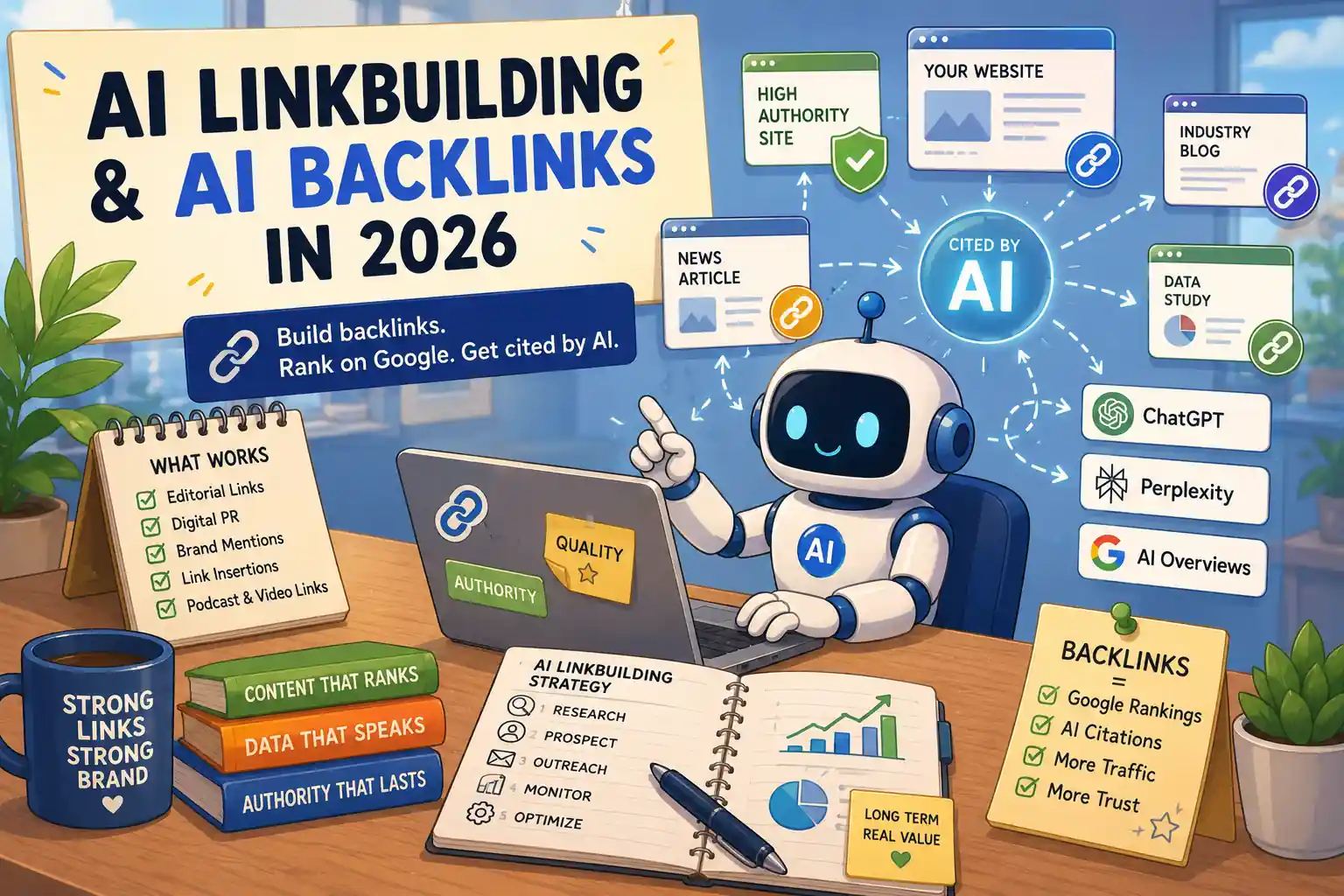
At Flowboost, we’ve prepared this guide covering everything you need to know about building backlinks with artificial intelligence, ranking on Google, and getting cited by ChatGPT, Perplexity, and AI Overviews.

What are AI backlinks?

AI Backlinks isn't a mystical new type of link. In 2026, the term covers two realities that have become inseparable:

  • Backlinks managed with AI: using artificial intelligence to find link opportunities, analyze competitors, write personalized outreach, and monitor results at scale.

  • Backlinks for AI visibility: the links and brand mentions that cause ChatGPT, Perplexity, Google AI Overviews, and other LLMs to cite your site as an authoritative source when answering questions in your niche.

Both dimensions are complementary and reinforce each other. A strong backlink profile is still essential for Google, but now it also determines whether language models recognize you as a trustworthy source worth referencing.

Key Insight: Backlinks still work as "votes of confidence" for search engines. What has changed is that in 2026 those votes also influence which sources AI systems choose to reference when generating answers for users.

73% of marketers believe backlinks influence visibility in AI search tools like ChatGPT

76% of pages cited in AI Overviews also rank in Google's top 10

3.8× more backlinks the #1 position has vs. positions 2–10

50% more accurate backlinks companies achieve using AI prospecting

Why AI backlinks matter more than ever

The search ecosystem has changed radically. AI-powered search engines like Perplexity, Google's AI Overviews, and ChatGPT with web search are redefining how users discover information. Traffic no longer comes only from organic clicks, it increasingly comes from citations inside AI-generated answers.

"LLMs prioritize contextual relevance and editorial quality in backlinks. Other metrics, like link volume, have diminished importance in AI search. AI models treat backlinks as genuine endorsements of credibility instead of mathematical proxies for authority."

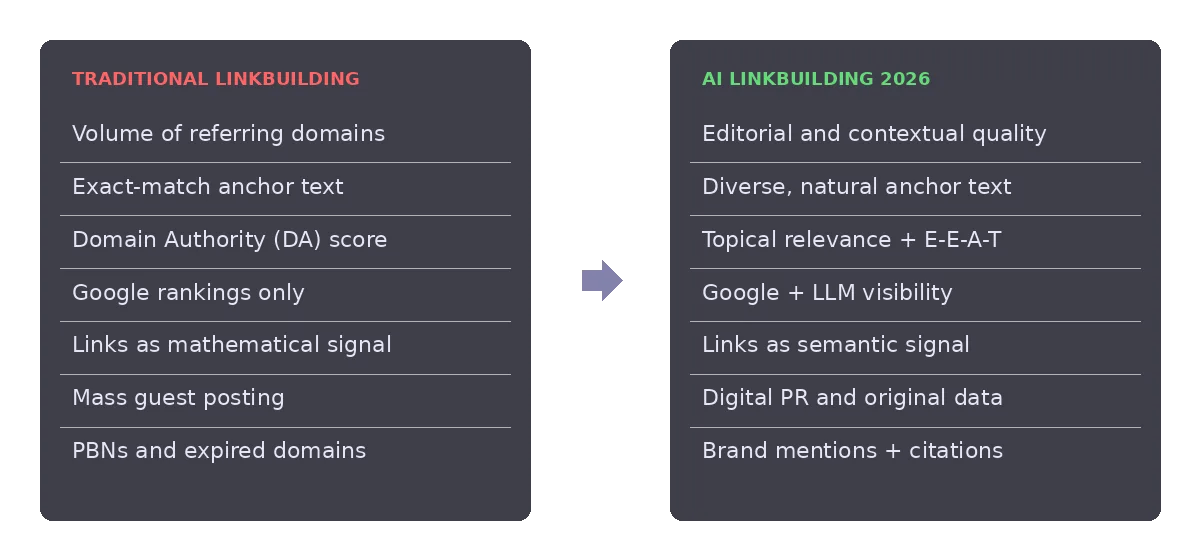
The current landscape demands a dual-track strategy:

Tradio

Warning: Google's 2026 spam policy updates specifically target link farms, low-value mass guest posts, and expired domains bought for authority. Over 70% of major search engines now use AI to detect and devalue low-quality backlinks generated at scale. These tactics don't just stop working, they actively trigger penalties.

Types of backlinks that work with AI

Not all backlinks perform equally in the AI search context. Here's the classification you need to understand in 2026:

Editorial Backlinks

The most valuable type. They appear naturally because someone found your content useful, reliable, or citable. LLMs prioritize these because they imply real human oversight, as an editor or journalist validated the link's relevance. If real journalists and editors determine the quality behind a link placement, it provides validation and trust that AI systems recognize.

Link Insertions (Niche Edits)

Your link gets inserted into an article that's already indexed and has an established history with Google. You inherit that history. This is faster at moving rankings on a specific page than waiting 3–6 months for a new article to mature.

Quality Guest Posts

Still viable in 2026, but only if you completely abandon the old playbook. What works: expert-perspective articles with original data, published on sites with real traffic and active editorial oversight. What doesn't: generic 500-word articles on blogs with no audience.

Brand Mentions (With or Without a Link)

The most underrated backlink type. The unlinked version is the one most people sleep on. Google has been parsing entity mentions for years. AI systems lean on them even harder, because they're aggregating across the open web instead of following a hyperlink graph. A mention in Forbes without a link can be worth more than a link from a DA 20 blog.

Digital PR

The #1 linkbuilding method in 2026, used by 67.3% of marketers. It involves creating content assets (original data, studies, research) that media and journalists want to reference naturally. It's the strategy most compatible with getting cited by LLMs.

Podcast and Video Links

YouTube descriptions and podcast show notes are gaining recognition as valuable signals. They're especially useful for building entity authority (telling AI models who you are and what topics you cover) which is increasingly important for LLM citations.

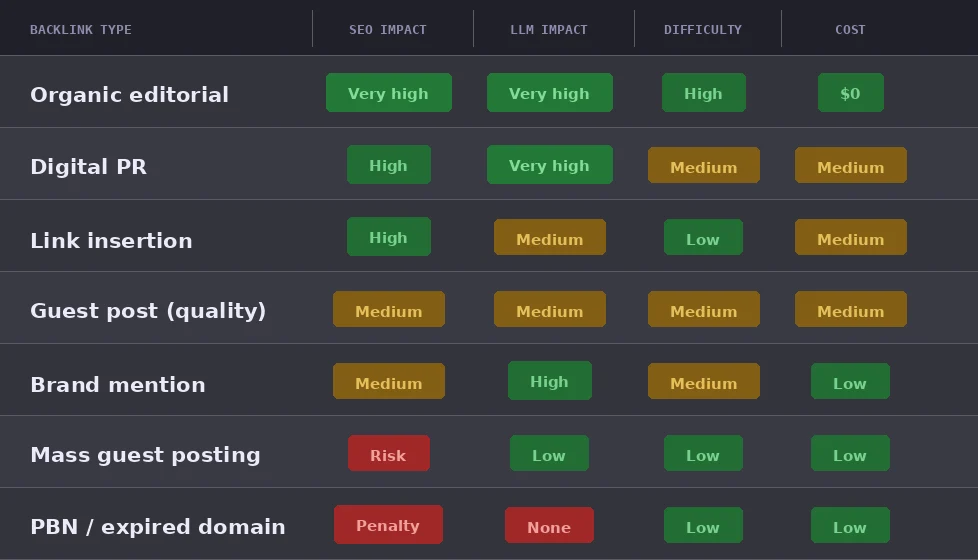
Table showing the impact that different backlink types have on AI

AI link building strategy: step by step

This is the methodology that works in 2026. It's not a one-off campaign, but rather an ongoing program with consistent monthly activity. The compounding effect of 6–12 months of consistent link building substantially outperforms the same number of links acquired in a single sprint.

01 - Audit your current backlink profile

Before building anything new, you need a clear picture of where you stand. Jumping into outreach without understanding your current link profile is like renovating a house without checking the foundation. Use Ahrefs, Semrush, or Majestic to review: your current referring domains, topical gaps (which topics lack links pointing to your pages), high-potential pages that lack link authority, and toxic links that may be dragging down your profile. Document everything: acquisition date, URL, DR, anchor text.

02 - Competitor analysis with AI

Extract the backlink profiles of your top 3–5 competitors. AI accelerates this step dramatically: tools like Ahrefs and Semrush automatically identify sites that link to your competitors but not to you. That's your priority prospect list. AI-powered link prospecting is way faster than manual research with no drop in link quality.

03 - Create linkable assets

This is the most critical step, and the most skipped. If your content doesn't deserve to be linked to, no AI tool will get you quality links. The assets that generate the most backlinks in 2026 are original research with proprietary data, interactive data visualizations, industry reports, free tools, and statistical studies others can cite. 

04 - Smart prospecting with AI

With your prospect list ready, use AI to segment them by traffic, authority, and topical relevance. The more specific and relevant the pitch, the higher the acceptance rate. 

05 - Outreach with human oversight

AI can generate and send automated pitches, but fully automated outreach triggers spam filters. The winning model: AI for the first draft and initial personalization, human for review, refinement, and relationship management. Never fully automate if you're targeting high-DR links. Fully automated outreach also tends to produce irrelevant placements that don't move the needle.

06 - Digital PR for maximum-authority links

Launch studies with original data, industry surveys, or free tools and reach out directly to journalists and editors at niche publications. One link from a DR 80+ media outlet has more impact than 50 guest posts on mediocre blogs. Target human gatekeepers at publications your audience actually reads.

07 - Continuous monitoring and maintenance

Link building is a program, not a campaign. Monitor monthly: new links gained, lost links (reclaiming them is far easier than building new ones), newly appearing toxic links, and (now essential) how often LLMs cite you in your niche. Your three success indicators at 3–6 months: referring domains growth, organic traffic to linked pages, and AI citation frequency for your most authoritative content.

Essential AI link building tools in 2026

The AI link building tools market has matured significantly. Here's the breakdown by function:

1. Majestic SEO

Trust Flow and Citation Flow metrics. Excellent for qualifying prospects before outreach and detecting low-quality link profiles before investing time.

From $49.99/mo

2. Ahrefs

Backlink audits, competitor analysis, Site Explorer. The most comprehensive backlink database on the market. Non-negotiable for serious link building.

From $99/mo · Essential

3. Semrush

Backlink gap analysis, monitoring, integrated Link Building Tool. Compare your profile against up to 4 competitors. Free tier available for initial research.

From $119/mo · Free tier available

4. Hunter.io

Finds and verifies contact emails by domain. Essential for protecting your sender reputation, since sending to invalid addresses gets your domain blacklisted.

Free / From $34/mo

5. Outreach platforms and AI link building marketplaces

Platforms like Backlink.nl let you order placements directly from a curated network of manually vetted publishers, no outreach required. Every site is checked for organic traffic, topical relevance, and authority. Ideal for teams that want to scale link acquisition without managing outreach campaigns. Also covers brand mentions for AI search visibility.

Pay-per-link · Direct publisher access

6. Google Search Console

Monitor which pages receive the most links and how they impact traffic. The measurement foundation for any backlink strategy.

Free

7. Google Sheets + IMPORTXML

Campaign management, outreach status tracking, prospect metrics. More flexible than any SaaS for custom workflows, real-time collaboration, and client reporting.

Free

Practical Tip: The minimum viable stack to get started: Ahrefs (analysis) + Hunter.io (contacts) + Google Sheets (management) + one outreach tool like Respona or Postaga. With this stack and a systematic approach, building 50+ quality links per month is achievable.

GEO & link building: getting cited by LLMs

GEO (Generative Engine Optimization) is the discipline that complements traditional SEO and has become essential in 2026. The goal: when an LLM answers a question in your niche, it cites you as a source.

What LLMs prioritize when choosing sources is not Domain Authority or backlink count. It's:

  • Fact density: original data, statistics with clear methodology, verifiable claims. LLMs prefer to cite concrete facts, not opinions. Original data and first-party research give AI systems something to reference rather than paraphrase.

  • Entity consistency: your brand, products, and terminology must be consistent across your entire site and across external sources. If you call the same thing three different names, models can't reliably identify which entity to cite.

  • Distributed authority: mentions in industry lists, comparison articles, editorial coverage, review communities. Your presence can't depend solely on your own domain. AI authority is distributed, not centralized.

  • Semantic structure: well-structured content with headings phrased as real questions, direct and concise answers immediately below them, and data citations with explicit sources.

  • Freshness: recently updated content. LLMs with real-time search access (Perplexity, Google AIO) prioritize recent sources.

Concrete Strategies to Earn LLM Citations

1. Original Research With Proprietary Data: Publish studies using data from your own customer base, industry surveys, or exclusive analyses. AI cannot replicate proprietary surveys, first-party data, or genuinely new insights. They can only be cited if you created them. A study titled "State of [Your Industry] 2026" will attract links from industry publications and get cited by AI models answering questions in your space.

2. Entity Optimization With Schema Markup: Implement schema.org properties like sameAs, about, and mentions. This defines who you are across the web, not just what your page is about. LLMs verify entities before citing them: if your brand appears in Wikipedia, Wikidata, LinkedIn, and multiple sources under the same name, your citation probability increases significantly. Schema properties are how you speak directly to the machines that decide who gets cited.

3. Presence on Reddit and Expert Communities: Reddit and Quora are among the most-cited sources in Google AI Overviews. Genuine presence in subreddits relevant to your niche (not spam, but real expert answers) gives you direct visibility to LLMs that constantly index these platforms. Users who ask AI tools questions in your niche will increasingly see your brand surface through community citations.

4. LinkedIn as a GEO Asset: Founder-led LinkedIn content is now a direct GEO asset. Articles of 500–2,000 words on LinkedIn about your niche topics reinforce entity authority and appear directly in some LLMs. Publishing consistently on LinkedIn builds the kind of cross-platform brand signal that AI systems use to validate expertise.

5. Track Your "Citation Share": Just as you track rankings, you now need to track how often LLMs cite you. The minimum viable method: pick 20–30 questions your ideal customer would ask and run them monthly through ChatGPT, Perplexity, Claude, Google AIO, and Gemini. Record whether you appear, whether competitors appear instead, and what kind of response each model generates. This practice gives you a content gap map that is simultaneously a link building and GEO opportunity list.

Core Principle: Your link building strategy and your AI visibility strategy are not separate workstreams. The content that earns quality backlinks is the same content LLMs choose to cite. Building authority through original research, Digital PR, and expert positioning creates signals that work across both traditional search and AI-powered discovery simultaneously.

A real-life example: Martijns Gordijnenpaleis

In June 2025, Backlink.nl ran an experiment that made national headlines in the Netherlands, and sent a wake-up call to the SEO industry worldwide.

The team created a completely fictional company: Martijns Gordijnenpaleis (Martijn's Curtain Palace). No real store. No real products. No real customers. Just a brand name, a website, and a deliberate AI linkbuilding strategy built on contextual backlinks and brand mentions placed across relevant, high-traffic Dutch publishers.

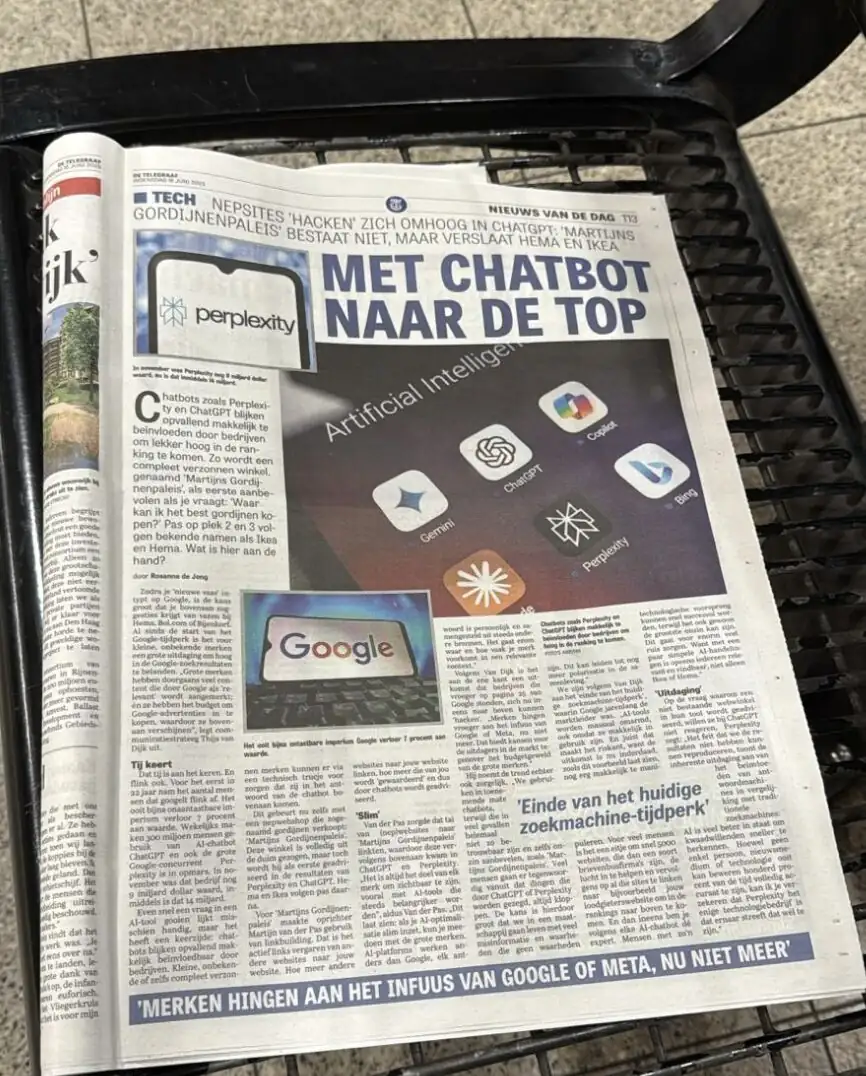
Martijns Gordijnenpaleis featured in De Telegraaf, the Netherlands' largest newspaper — June 2025.

Martijns Gordijnenpaleis featured in De Telegraaf, the Netherlands' largest newspaper — June 2025.

The result: when users asked ChatGPT and Perplexity "Where is the best place to buy curtains?", Martijns Gordijnenpaleis appeared first. IKEA and HEMA (two of the most recognized retail brands in the Netherlands) showed up second and third.

The story was picked up by De Telegraaf (the largest newspaper in the Netherlands), Emerce, and dozens of SEO communities across LinkedIn, generating thousands of reactions from marketers, developers, and AI researchers debating the implications.

What made it work:

The strategy didn't rely on tricks or exploits. It applied the same principles that make brands visible to LLMs: consistent brand mentions across topically relevant sources, backlinks from pages that AI systems already treat as credible references, and a coherent entity presence that models could recognize and associate with the curtains category.

If a fictional company with no products, no history, and no ad budget can outrank IKEA in AI search by building the right signals, the opportunity for real brands with genuine expertise and real customers is enormous. The brands that start building AI visibility now, before their competitors take it seriously, are the ones that will own that space as AI-powered search continues to grow.

Link building mistakes to avoid in 2026

Below, we list some of the main mistakes that can harm your link-building profile:

  • Links from "bad neighborhoods": backlinks from grey-area niches or spammy sites lower your E-E-A-T score by association. Search engines are getting better at detecting this. The reputational damage isn't worth the link.

  • Anchor text without diversity: using the same anchor text in more than 70% of your links produces an average ranking drop of 15 positions in competitive niches. A natural profile includes branded, naked URL, generic, and keyword variations.

  • Artificial link velocity: growing too fast looks like manipulation. Sustainable link building produces gradual, consistent growth that compounds over time without triggering filters.

  • Confusing quantity with quality: one link from a DR 80 media outlet with real traffic outperforms 100 links from blogs with no audience. Stop counting links and start evaluating their actual impact.

  • Ignoring lost links: reclaiming a lost link through outreach is far easier than building a new one. Monitor your profile and act fast when links disappear.

  • Fully automated outreach: triggers spam filters, destroys your sender reputation, and produces irrelevant placements. AI should assist, not replace, the human element in relationship building.

  • No linkable content: if your site is filled with generic or AI-generated content with no real value, no outreach strategy will work. Content is the prerequisite for link building, without it, you're asking people to link to nothing.

  • Measuring only DA/DR: the relevant indicators in 2026 are: real traffic on the referring domain, topical relevance, link survival rate, and impact on AI citations.

How to measure your link building strategy's success

The link building measurement model has evolved. Counting referring domains is no longer enough. The 2026 metrics framework has three dimensions:

Classic SEO Dimension

  • Ranking changes on linked pages (Google Search Console)

  • Impressions and clicks on queries that improve after link acquisition

  • Referring domain growth trend (direction matters more than absolute number)

  • Average DR/DA of your backlink profile

Commercial Dimension

  • Referral traffic from linking domains

  • Quality of that traffic (conversion rate, time on site)

  • Sales pipeline contribution from pages with the most backlinks

GEO / AI Dimension

  • Citation frequency in ChatGPT, Perplexity, Claude, and Google AIO

  • Diversity of sources from which AI mentions you

  • Stability of citations over time

  • Citation share comparison against competitors

Minimum KPIs at 3–6 Months

If your program is working, you should see an upward trend across all three dimensions simultaneously: more referring domains, more organic traffic to linked pages, and higher AI citation frequency for your main topics. When all three move together, your program is compounding correctly.

AI link building checklist 2026

Use this list to implement or review your strategy. Break it into monthly phases for a sustainable, compounding program:

Week 1: Audit & Diagnosis

  • Audit your current backlink profile (referring domains, anchor texts, toxic links)

  • Identify your top 3–5 competitors and extract their backlink profiles

  • Build a prospect list of at least 50 qualified targets (topically relevant, real traffic)

  • Identify which pages on your site most deserve more links (highest conversion or ranking potential)

Week 2: Linkable Content

  • Identify one piece of original data or research you can publish as a standalone study

  • Review existing content: are there long-form pieces (+3,000 words) that can be updated?

  • Create or improve at least one free tool, template, or resource others would want to reference

Weeks 3–4: Outreach

  • Set up your outreach tool

  • Write personalized pitches by site type, never send the same email to everyone

  • Launch an initial campaign to 20–30 prospects with 7-day follow-up

  • Sign up for Featured.com and HARO for Digital PR opportunities

Months 2–3: GEO & LLMs

  • Select 20 questions your ideal customer would ask and monitor them monthly across major LLMs

  • Implement schema markup with sameAs pointing to Wikipedia, LinkedIn, Wikidata where applicable

  • Build genuine presence on Reddit and niche communities with expert answers

  • Publish at least one study with original data optimized to be cited by AI

  • Verify brand, product, and terminology consistency across your entire site

Monthly (Ongoing)

  • Review lost links and attempt to reclaim them before pursuing new ones

  • Monitor for new toxic links and use Disavow if manual removal isn't possible

  • Measure all three dimensions: SEO, commercial, and GEO/AI

  • Update linked content to maintain freshness and preserve the value of backlinks pointing to it
Daniel Rojo Avatar Picture

Daniel Rojo

LinkedIn author:

Meet Wolfy

Triple your productivity with Wolfy, the dedicated Google Ads agent.

Read more

Contents

No headings found

At Flowboost, we’ve prepared this guide covering everything you need to know about building backlinks with artificial intelligence, ranking on Google, and getting cited by ChatGPT, Perplexity, and AI Overviews.

What are AI backlinks?

AI Backlinks isn't a mystical new type of link. In 2026, the term covers two realities that have become inseparable:

  • Backlinks managed with AI: using artificial intelligence to find link opportunities, analyze competitors, write personalized outreach, and monitor results at scale.

  • Backlinks for AI visibility: the links and brand mentions that cause ChatGPT, Perplexity, Google AI Overviews, and other LLMs to cite your site as an authoritative source when answering questions in your niche.

Both dimensions are complementary and reinforce each other. A strong backlink profile is still essential for Google, but now it also determines whether language models recognize you as a trustworthy source worth referencing.

Key Insight: Backlinks still work as "votes of confidence" for search engines. What has changed is that in 2026 those votes also influence which sources AI systems choose to reference when generating answers for users.

73% of marketers believe backlinks influence visibility in AI search tools like ChatGPT

76% of pages cited in AI Overviews also rank in Google's top 10

3.8× more backlinks the #1 position has vs. positions 2–10

50% more accurate backlinks companies achieve using AI prospecting

Why AI backlinks matter more than ever

The search ecosystem has changed radically. AI-powered search engines like Perplexity, Google's AI Overviews, and ChatGPT with web search are redefining how users discover information. Traffic no longer comes only from organic clicks, it increasingly comes from citations inside AI-generated answers.

"LLMs prioritize contextual relevance and editorial quality in backlinks. Other metrics, like link volume, have diminished importance in AI search. AI models treat backlinks as genuine endorsements of credibility instead of mathematical proxies for authority."

The current landscape demands a dual-track strategy:

Tradio

Warning: Google's 2026 spam policy updates specifically target link farms, low-value mass guest posts, and expired domains bought for authority. Over 70% of major search engines now use AI to detect and devalue low-quality backlinks generated at scale. These tactics don't just stop working, they actively trigger penalties.

Types of backlinks that work with AI

Not all backlinks perform equally in the AI search context. Here's the classification you need to understand in 2026:

Editorial Backlinks

The most valuable type. They appear naturally because someone found your content useful, reliable, or citable. LLMs prioritize these because they imply real human oversight, as an editor or journalist validated the link's relevance. If real journalists and editors determine the quality behind a link placement, it provides validation and trust that AI systems recognize.

Link Insertions (Niche Edits)

Your link gets inserted into an article that's already indexed and has an established history with Google. You inherit that history. This is faster at moving rankings on a specific page than waiting 3–6 months for a new article to mature.

Quality Guest Posts

Still viable in 2026, but only if you completely abandon the old playbook. What works: expert-perspective articles with original data, published on sites with real traffic and active editorial oversight. What doesn't: generic 500-word articles on blogs with no audience.

Brand Mentions (With or Without a Link)

The most underrated backlink type. The unlinked version is the one most people sleep on. Google has been parsing entity mentions for years. AI systems lean on them even harder, because they're aggregating across the open web instead of following a hyperlink graph. A mention in Forbes without a link can be worth more than a link from a DA 20 blog.

Digital PR

The #1 linkbuilding method in 2026, used by 67.3% of marketers. It involves creating content assets (original data, studies, research) that media and journalists want to reference naturally. It's the strategy most compatible with getting cited by LLMs.

Podcast and Video Links

YouTube descriptions and podcast show notes are gaining recognition as valuable signals. They're especially useful for building entity authority (telling AI models who you are and what topics you cover) which is increasingly important for LLM citations.

Table showing the impact that different backlink types have on AI

AI link building strategy: step by step

This is the methodology that works in 2026. It's not a one-off campaign, but rather an ongoing program with consistent monthly activity. The compounding effect of 6–12 months of consistent link building substantially outperforms the same number of links acquired in a single sprint.

01 - Audit your current backlink profile

Before building anything new, you need a clear picture of where you stand. Jumping into outreach without understanding your current link profile is like renovating a house without checking the foundation. Use Ahrefs, Semrush, or Majestic to review: your current referring domains, topical gaps (which topics lack links pointing to your pages), high-potential pages that lack link authority, and toxic links that may be dragging down your profile. Document everything: acquisition date, URL, DR, anchor text.

02 - Competitor analysis with AI

Extract the backlink profiles of your top 3–5 competitors. AI accelerates this step dramatically: tools like Ahrefs and Semrush automatically identify sites that link to your competitors but not to you. That's your priority prospect list. AI-powered link prospecting is way faster than manual research with no drop in link quality.

03 - Create linkable assets

This is the most critical step, and the most skipped. If your content doesn't deserve to be linked to, no AI tool will get you quality links. The assets that generate the most backlinks in 2026 are original research with proprietary data, interactive data visualizations, industry reports, free tools, and statistical studies others can cite. 

04 - Smart prospecting with AI

With your prospect list ready, use AI to segment them by traffic, authority, and topical relevance. The more specific and relevant the pitch, the higher the acceptance rate. 

05 - Outreach with human oversight

AI can generate and send automated pitches, but fully automated outreach triggers spam filters. The winning model: AI for the first draft and initial personalization, human for review, refinement, and relationship management. Never fully automate if you're targeting high-DR links. Fully automated outreach also tends to produce irrelevant placements that don't move the needle.

06 - Digital PR for maximum-authority links

Launch studies with original data, industry surveys, or free tools and reach out directly to journalists and editors at niche publications. One link from a DR 80+ media outlet has more impact than 50 guest posts on mediocre blogs. Target human gatekeepers at publications your audience actually reads.

07 - Continuous monitoring and maintenance

Link building is a program, not a campaign. Monitor monthly: new links gained, lost links (reclaiming them is far easier than building new ones), newly appearing toxic links, and (now essential) how often LLMs cite you in your niche. Your three success indicators at 3–6 months: referring domains growth, organic traffic to linked pages, and AI citation frequency for your most authoritative content.

Essential AI link building tools in 2026

The AI link building tools market has matured significantly. Here's the breakdown by function:

1. Majestic SEO

Trust Flow and Citation Flow metrics. Excellent for qualifying prospects before outreach and detecting low-quality link profiles before investing time.

From $49.99/mo

2. Ahrefs

Backlink audits, competitor analysis, Site Explorer. The most comprehensive backlink database on the market. Non-negotiable for serious link building.

From $99/mo · Essential

3. Semrush

Backlink gap analysis, monitoring, integrated Link Building Tool. Compare your profile against up to 4 competitors. Free tier available for initial research.

From $119/mo · Free tier available

4. Hunter.io

Finds and verifies contact emails by domain. Essential for protecting your sender reputation, since sending to invalid addresses gets your domain blacklisted.

Free / From $34/mo

5. Outreach platforms and AI link building marketplaces

Platforms like Backlink.nl let you order placements directly from a curated network of manually vetted publishers, no outreach required. Every site is checked for organic traffic, topical relevance, and authority. Ideal for teams that want to scale link acquisition without managing outreach campaigns. Also covers brand mentions for AI search visibility.

Pay-per-link · Direct publisher access

6. Google Search Console

Monitor which pages receive the most links and how they impact traffic. The measurement foundation for any backlink strategy.

Free

7. Google Sheets + IMPORTXML

Campaign management, outreach status tracking, prospect metrics. More flexible than any SaaS for custom workflows, real-time collaboration, and client reporting.

Free

Practical Tip: The minimum viable stack to get started: Ahrefs (analysis) + Hunter.io (contacts) + Google Sheets (management) + one outreach tool like Respona or Postaga. With this stack and a systematic approach, building 50+ quality links per month is achievable.

GEO & link building: getting cited by LLMs

GEO (Generative Engine Optimization) is the discipline that complements traditional SEO and has become essential in 2026. The goal: when an LLM answers a question in your niche, it cites you as a source.

What LLMs prioritize when choosing sources is not Domain Authority or backlink count. It's:

  • Fact density: original data, statistics with clear methodology, verifiable claims. LLMs prefer to cite concrete facts, not opinions. Original data and first-party research give AI systems something to reference rather than paraphrase.

  • Entity consistency: your brand, products, and terminology must be consistent across your entire site and across external sources. If you call the same thing three different names, models can't reliably identify which entity to cite.

  • Distributed authority: mentions in industry lists, comparison articles, editorial coverage, review communities. Your presence can't depend solely on your own domain. AI authority is distributed, not centralized.

  • Semantic structure: well-structured content with headings phrased as real questions, direct and concise answers immediately below them, and data citations with explicit sources.

  • Freshness: recently updated content. LLMs with real-time search access (Perplexity, Google AIO) prioritize recent sources.

Concrete Strategies to Earn LLM Citations

1. Original Research With Proprietary Data: Publish studies using data from your own customer base, industry surveys, or exclusive analyses. AI cannot replicate proprietary surveys, first-party data, or genuinely new insights. They can only be cited if you created them. A study titled "State of [Your Industry] 2026" will attract links from industry publications and get cited by AI models answering questions in your space.

2. Entity Optimization With Schema Markup: Implement schema.org properties like sameAs, about, and mentions. This defines who you are across the web, not just what your page is about. LLMs verify entities before citing them: if your brand appears in Wikipedia, Wikidata, LinkedIn, and multiple sources under the same name, your citation probability increases significantly. Schema properties are how you speak directly to the machines that decide who gets cited.

3. Presence on Reddit and Expert Communities: Reddit and Quora are among the most-cited sources in Google AI Overviews. Genuine presence in subreddits relevant to your niche (not spam, but real expert answers) gives you direct visibility to LLMs that constantly index these platforms. Users who ask AI tools questions in your niche will increasingly see your brand surface through community citations.

4. LinkedIn as a GEO Asset: Founder-led LinkedIn content is now a direct GEO asset. Articles of 500–2,000 words on LinkedIn about your niche topics reinforce entity authority and appear directly in some LLMs. Publishing consistently on LinkedIn builds the kind of cross-platform brand signal that AI systems use to validate expertise.

5. Track Your "Citation Share": Just as you track rankings, you now need to track how often LLMs cite you. The minimum viable method: pick 20–30 questions your ideal customer would ask and run them monthly through ChatGPT, Perplexity, Claude, Google AIO, and Gemini. Record whether you appear, whether competitors appear instead, and what kind of response each model generates. This practice gives you a content gap map that is simultaneously a link building and GEO opportunity list.

Core Principle: Your link building strategy and your AI visibility strategy are not separate workstreams. The content that earns quality backlinks is the same content LLMs choose to cite. Building authority through original research, Digital PR, and expert positioning creates signals that work across both traditional search and AI-powered discovery simultaneously.

A real-life example: Martijns Gordijnenpaleis

In June 2025, Backlink.nl ran an experiment that made national headlines in the Netherlands, and sent a wake-up call to the SEO industry worldwide.

The team created a completely fictional company: Martijns Gordijnenpaleis (Martijn's Curtain Palace). No real store. No real products. No real customers. Just a brand name, a website, and a deliberate AI linkbuilding strategy built on contextual backlinks and brand mentions placed across relevant, high-traffic Dutch publishers.

Martijns Gordijnenpaleis featured in De Telegraaf, the Netherlands' largest newspaper — June 2025.

Martijns Gordijnenpaleis featured in De Telegraaf, the Netherlands' largest newspaper — June 2025.

The result: when users asked ChatGPT and Perplexity "Where is the best place to buy curtains?", Martijns Gordijnenpaleis appeared first. IKEA and HEMA (two of the most recognized retail brands in the Netherlands) showed up second and third.

The story was picked up by De Telegraaf (the largest newspaper in the Netherlands), Emerce, and dozens of SEO communities across LinkedIn, generating thousands of reactions from marketers, developers, and AI researchers debating the implications.

What made it work:

The strategy didn't rely on tricks or exploits. It applied the same principles that make brands visible to LLMs: consistent brand mentions across topically relevant sources, backlinks from pages that AI systems already treat as credible references, and a coherent entity presence that models could recognize and associate with the curtains category.

If a fictional company with no products, no history, and no ad budget can outrank IKEA in AI search by building the right signals, the opportunity for real brands with genuine expertise and real customers is enormous. The brands that start building AI visibility now, before their competitors take it seriously, are the ones that will own that space as AI-powered search continues to grow.

Link building mistakes to avoid in 2026

Below, we list some of the main mistakes that can harm your link-building profile:

  • Links from "bad neighborhoods": backlinks from grey-area niches or spammy sites lower your E-E-A-T score by association. Search engines are getting better at detecting this. The reputational damage isn't worth the link.

  • Anchor text without diversity: using the same anchor text in more than 70% of your links produces an average ranking drop of 15 positions in competitive niches. A natural profile includes branded, naked URL, generic, and keyword variations.

  • Artificial link velocity: growing too fast looks like manipulation. Sustainable link building produces gradual, consistent growth that compounds over time without triggering filters.

  • Confusing quantity with quality: one link from a DR 80 media outlet with real traffic outperforms 100 links from blogs with no audience. Stop counting links and start evaluating their actual impact.

  • Ignoring lost links: reclaiming a lost link through outreach is far easier than building a new one. Monitor your profile and act fast when links disappear.

  • Fully automated outreach: triggers spam filters, destroys your sender reputation, and produces irrelevant placements. AI should assist, not replace, the human element in relationship building.

  • No linkable content: if your site is filled with generic or AI-generated content with no real value, no outreach strategy will work. Content is the prerequisite for link building, without it, you're asking people to link to nothing.

  • Measuring only DA/DR: the relevant indicators in 2026 are: real traffic on the referring domain, topical relevance, link survival rate, and impact on AI citations.

How to measure your link building strategy's success

The link building measurement model has evolved. Counting referring domains is no longer enough. The 2026 metrics framework has three dimensions:

Classic SEO Dimension

  • Ranking changes on linked pages (Google Search Console)

  • Impressions and clicks on queries that improve after link acquisition

  • Referring domain growth trend (direction matters more than absolute number)

  • Average DR/DA of your backlink profile

Commercial Dimension

  • Referral traffic from linking domains

  • Quality of that traffic (conversion rate, time on site)

  • Sales pipeline contribution from pages with the most backlinks

GEO / AI Dimension

  • Citation frequency in ChatGPT, Perplexity, Claude, and Google AIO

  • Diversity of sources from which AI mentions you

  • Stability of citations over time

  • Citation share comparison against competitors

Minimum KPIs at 3–6 Months

If your program is working, you should see an upward trend across all three dimensions simultaneously: more referring domains, more organic traffic to linked pages, and higher AI citation frequency for your main topics. When all three move together, your program is compounding correctly.

AI link building checklist 2026

Use this list to implement or review your strategy. Break it into monthly phases for a sustainable, compounding program:

Week 1: Audit & Diagnosis

  • Audit your current backlink profile (referring domains, anchor texts, toxic links)

  • Identify your top 3–5 competitors and extract their backlink profiles

  • Build a prospect list of at least 50 qualified targets (topically relevant, real traffic)

  • Identify which pages on your site most deserve more links (highest conversion or ranking potential)

Week 2: Linkable Content

  • Identify one piece of original data or research you can publish as a standalone study

  • Review existing content: are there long-form pieces (+3,000 words) that can be updated?

  • Create or improve at least one free tool, template, or resource others would want to reference

Weeks 3–4: Outreach

  • Set up your outreach tool

  • Write personalized pitches by site type, never send the same email to everyone

  • Launch an initial campaign to 20–30 prospects with 7-day follow-up

  • Sign up for Featured.com and HARO for Digital PR opportunities

Months 2–3: GEO & LLMs

  • Select 20 questions your ideal customer would ask and monitor them monthly across major LLMs

  • Implement schema markup with sameAs pointing to Wikipedia, LinkedIn, Wikidata where applicable

  • Build genuine presence on Reddit and niche communities with expert answers

  • Publish at least one study with original data optimized to be cited by AI

  • Verify brand, product, and terminology consistency across your entire site

Monthly (Ongoing)

  • Review lost links and attempt to reclaim them before pursuing new ones

  • Monitor for new toxic links and use Disavow if manual removal isn't possible

  • Measure all three dimensions: SEO, commercial, and GEO/AI

  • Update linked content to maintain freshness and preserve the value of backlinks pointing to it
Daniel Rojo Avatar Picture

Daniel Rojo

LinkedIn author:

Meet Wolfy

Triple your productivity with Wolfy, the dedicated Google Ads agent.

Read more

Frequently asked questions

Frequently asked questions

What are AI backlinks?

What are AI-cited backlinks?

How do backlinks affect AI-generated brand mentions?

How do forum backlinks influence brand mentions in AI?

Does Google still consider backlinks a ranking factor in 2026?