What topical authority actually means
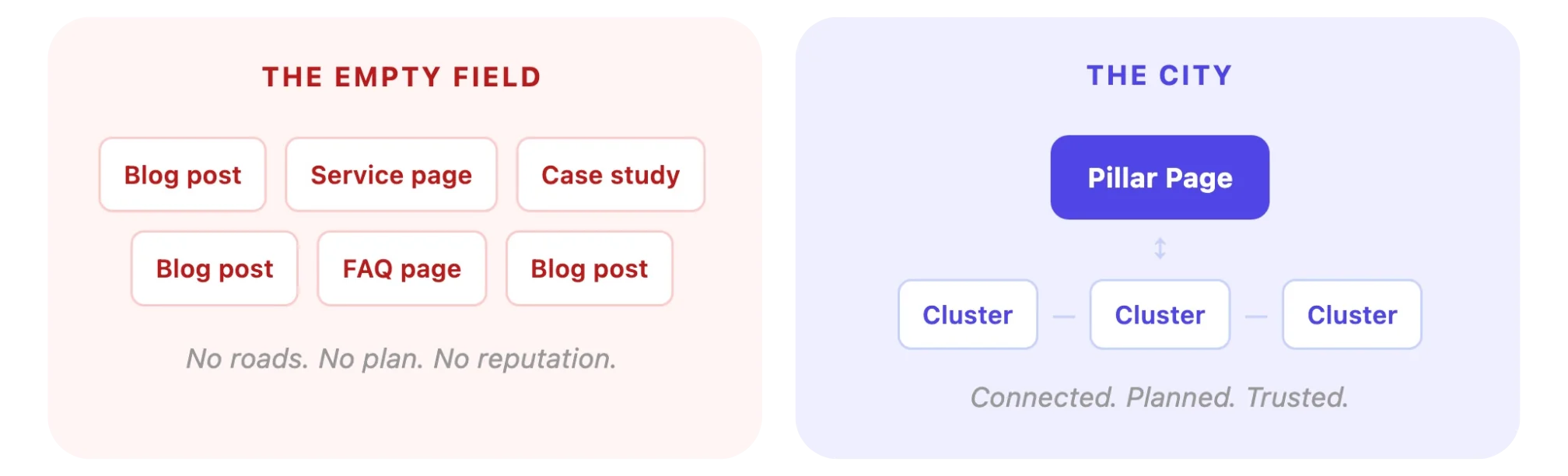
Some cities are genuinely famous for something. Bologna for food. Detroit for music. Amsterdam for cycling and design. That reputation did not come from one restaurant, one record label, or just one bicycle path. It came from an entire ecosystem, dozens of connected things, each reinforcing the others, all pointing toward the same identity.
Topical authority works the same way. It is the level of expertise and credibility your website demonstrates on a specific subject. Not determined by one impressive article, but by how comprehensively and consistently your site covers a topic, and how well the pieces connect to one another.
When Google encounters a website that has covered a subject from multiple angles, with pages that clearly relate to each other, it begins to treat that site as a subject matter expert. That recognition translates into better rankings, not just for one keyword, but across the entire topic area. One famous building earns a visit. A city with a real identity earns a reputation. Google rewards the city.
Apply this yourself
Search Google for the main topic your business wants to rank for. Look at the sites that dominate the first page, and then click through to one of them. How many articles do they have on that topic? How do those articles link to each other? That interconnected ecosystem is what you are up against. And what you need to build.
Why Google rewards depth, not square footage
There are cities built around one famous landmark, and cities built to be genuinely lived in. The difference is depth. A city with a rich cultural identity, distinct neighbourhoods, and a clear sense of place keeps drawing people back. A city that tries to be everything (tourism, finance, nightlife, industry) all at once tends to be memorable for none of it.
Google evaluates websites through the same lens. Its Search Quality Evaluator Guidelines place heavy emphasis on Experience, Expertise, Authoritativeness, and Trustworthiness. A website that goes deep on one subject, building real neighbourhoods with real character, demonstrates genuine expertise. A website that publishes about SEO, interior design, cryptocurrency, and travel tips in equal measure is a city zoned for everything, known for nothing.
“Google does not reward the biggest city. It rewards the most trusted one.”
This is why the most effective long-term strategy is not to build everywhere. It is to design one city people trust deeply, specifically, and thoroughly, before expanding into new territory. A well-planned neighbourhood earns more authority than a sprawling suburb that was never zoned for anything in particular.
Apply this yourself
List your last ten published pages or articles. Do they all serve the same city, the same core topic, or are they scattered across different territories with no clear connection? If a visitor landed on any one of them, would they find clear roads to the others? If not, you have buildings. You do not yet have a city.
What a content cluster is, and how it builds the city
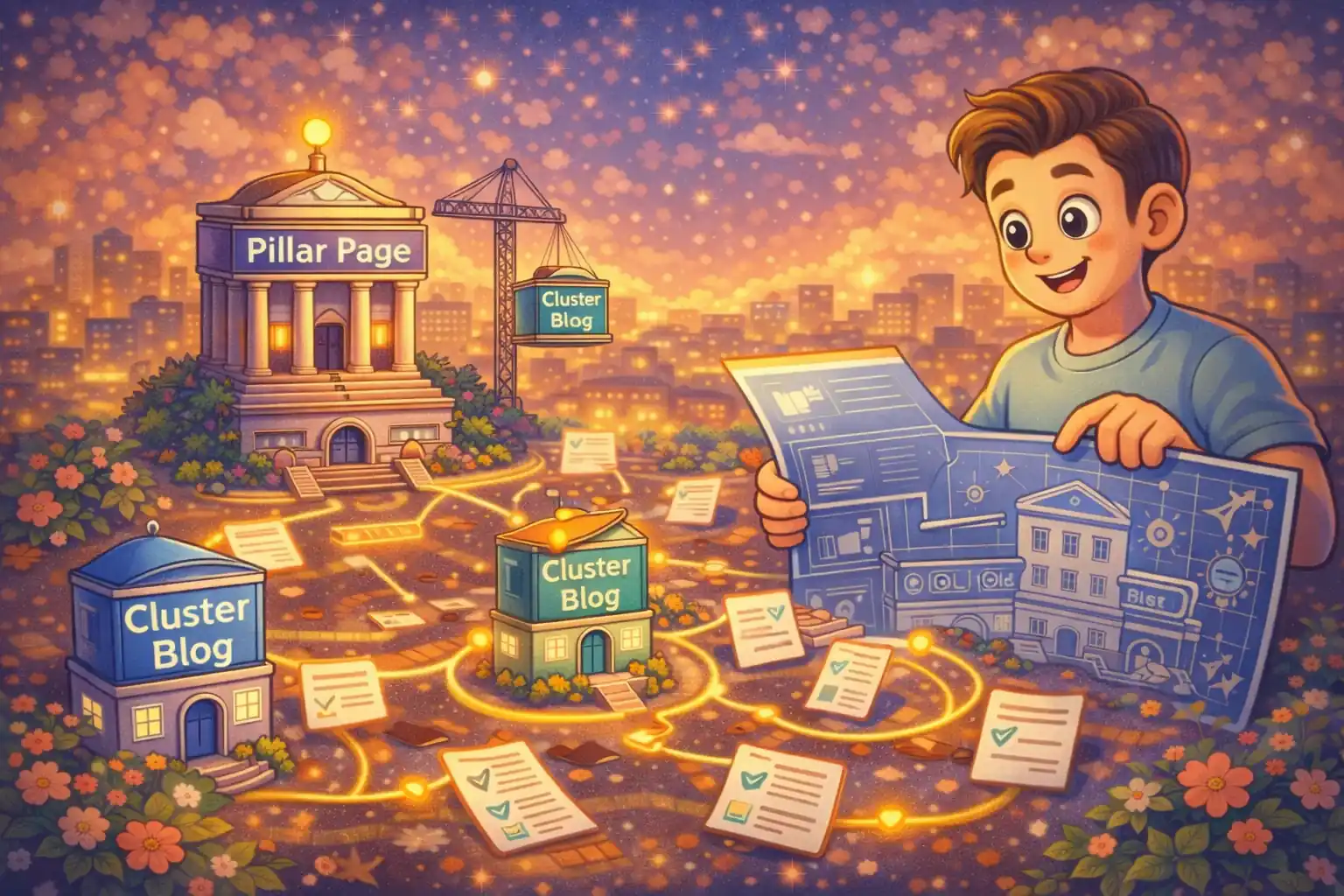
A content cluster is the urban planning model for your website. Rather than individual pages each trying to survive on their own, a cluster is a deliberately structured system, a city centre surrounded by connected neighbourhoods, all linked by a coherent road network.
Here is what that looks like for a website building authority around SEO:
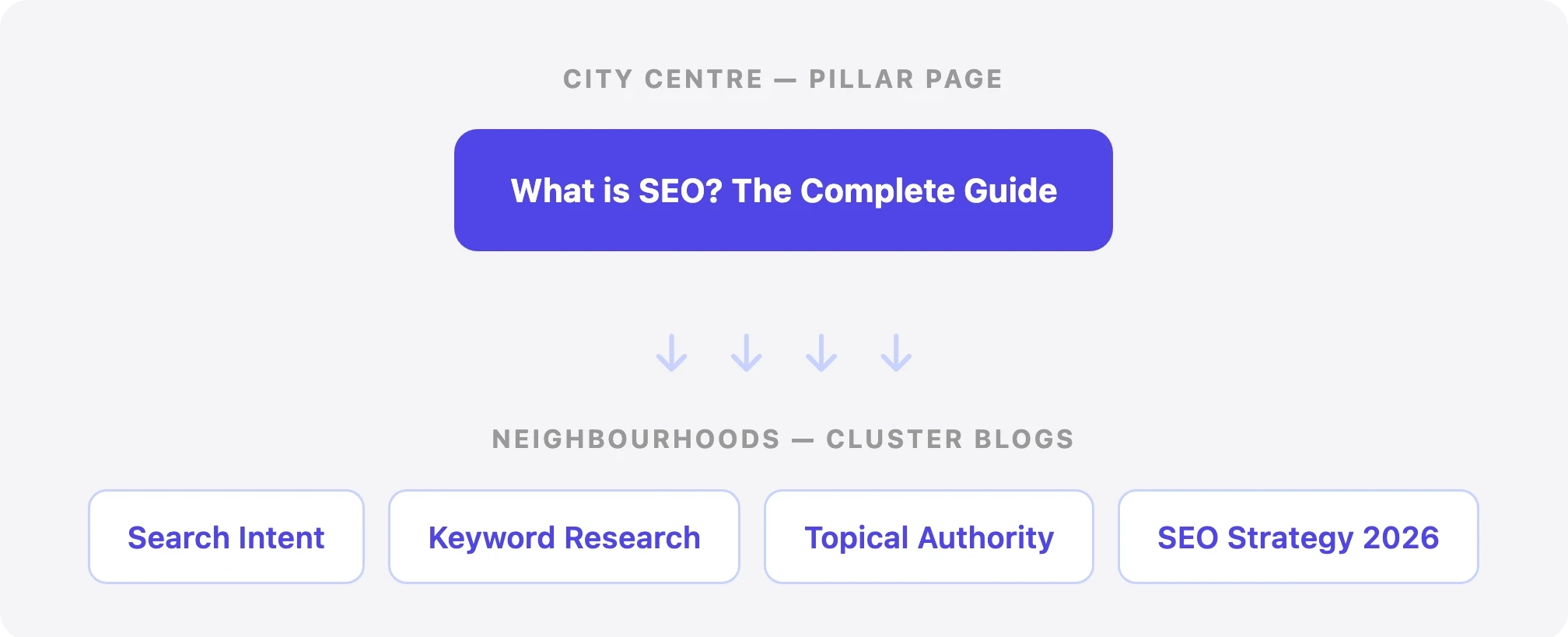
Each neighbourhood goes deep on one specific aspect of the broader topic. The city centre, the pillar page, ties them all together, with roads leading to every neighbourhood and roads from every neighbourhood leading back. When a neighbourhood earns a visit, a backlink, or a signal of engagement, that value does not stay local. It flows through the roads and strengthens the whole city.
This is what separates a content strategy from a content calendar. A calendar tells you when to build. A cluster tells you where, why, and how everything connects.
Apply this yourself
Pick the most important article or service page on your site. That is your city centre candidate. Now ask: what are the five or six most specific questions someone might have after reading it? Each one of those questions is a neighbourhood waiting to be built. If those articles already exist, check whether they are connected by internal links. If they are not, the roads are missing.
Pillar pages vs cluster content
In a well-planned city, not every building has the same role. Some are landmarks, the ones people recognise from a distance, the ones that define the city’s identity. Others are neighbourhood buildings, the ones that give each district its character, its daily life, its reason to stay.
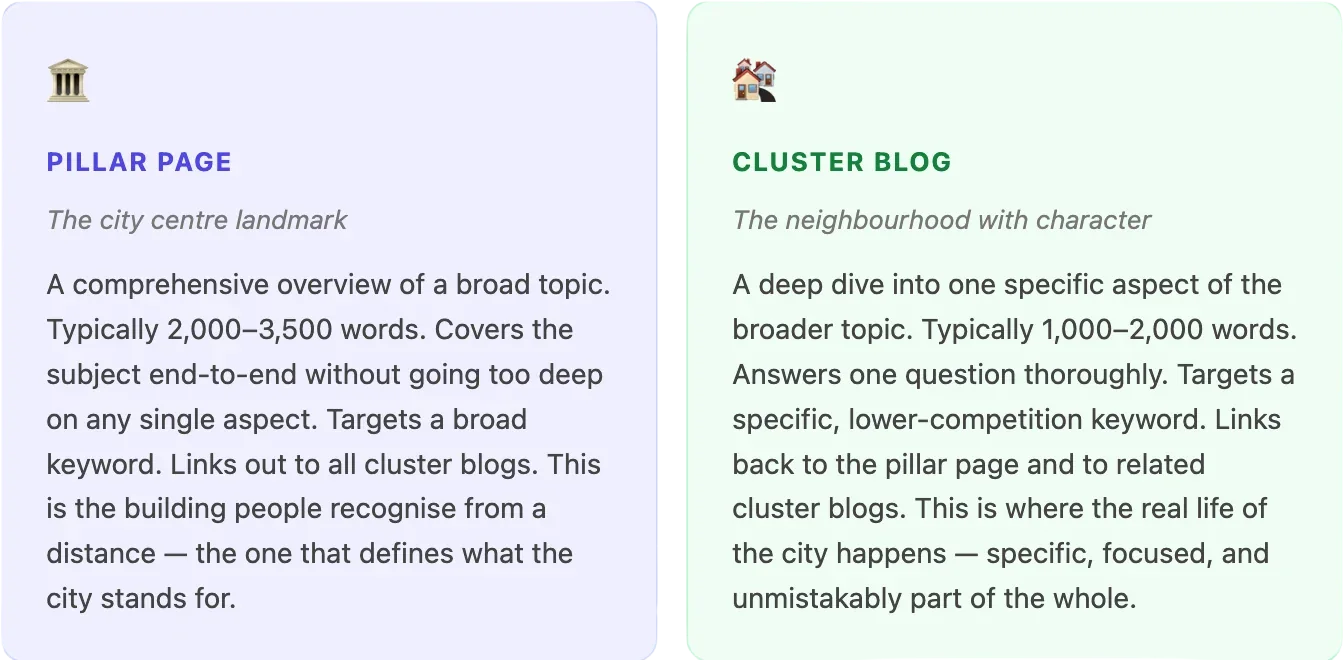
The most common planning mistake is building cluster blogs that try to be pillar pages, covering too much ground without enough depth in any area. A neighbourhood that tries to replicate the city centre just ends up competing with it. Cluster content works precisely because it is focused: one district, one distinct character, one clear road back to the centre.
Can a services or product page be a pillar page?
Yes, a service or product page can be a pillar page, but only if it goes beyond pure conversion and becomes a comprehensive, educational resource that covers the full topic, targets broader search intent, and links to supporting content; in most cases, however, it’s better to separate roles—using a dedicated pillar page to build authority and a service page to convert—since combining both often weakens clarity and performance.
For example, at Flowboost we have published an article called “The Ultimate SEO Content Creation Guide,” which acts as the pillar page for our SEO cluster. It provides a broad, structured overview of the topic and links out to more specific articles, while our SEO service page remains focused on converting users who are ready to take action.
Internal links: laying the road network
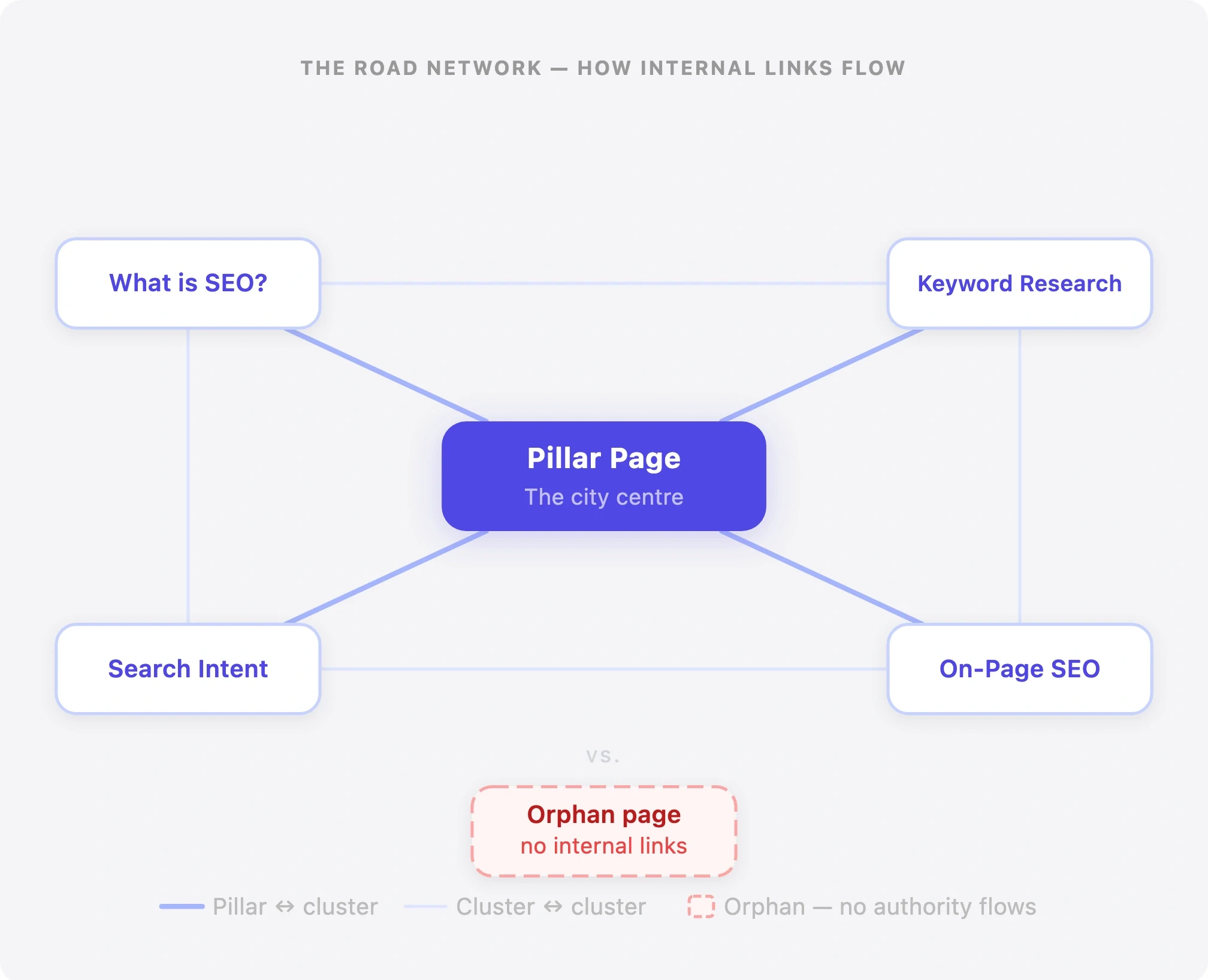
A city without roads is just a collection of buildings. People might stumble into one of them, but they will never discover the others. They will never understand the city as a whole. And the city will never earn a reputation beyond that one building they happened to walk into.
Internal links are the roads. When you link from one page to another, you do two things simultaneously: you help visitors navigate toward related content they might need, and you tell search engine crawlers how your site is organised: which pages are most important, how topics relate to one another, and where authority should flow.
A page with no internal links pointing to it is an orphan building. Technically standing, but cut off from the road network. It receives no visitors from other pages and no authority from the rest of the city. Google may index it, but it will never benefit from everything you have built around it.
One quick planning rule
Every time you publish a new article, go back to two or three existing pieces on related topics and add a link to the new one. Two minutes of work per post. Over time, it builds a road network that connects your whole city, and makes every new building discoverable from the moment it opens.
Apply this yourself
Take your most recently published article. How many other pages on your site currently link to it? If the answer is zero or one, it is an orphan building. Go to two or three related articles now and add a contextual link pointing to it. Then check your pillar page, does it link directly to every cluster article in that topic? If not, those roads still need to be laid.
How to build topical authority step by step
You do not build a city all at once. You start with a clear plan, one well-designed district to develop first, and the discipline to keep building within it. The cities that earn lasting reputations are not the ones built the fastest. They are the ones built with intention from the beginning.
1. Choose the city you want to build: Pick the single subject your business most wants to be known for. Not a broad continent, a specific city. “SEO for small businesses” or “Tourism SEO” is a city. “Marketing” is a continent. Start with something specific enough to own completely before expanding outward.
2. Design the city centre first: Your pillar page is the central landmark that helps people understand the whole city. It is not usually your service page. It is the page that gives structure to the topic, introduces the main subtopics, and creates a clear destination for your cluster content to link back to. It does not need to go live first, but the structure should be clear, every cluster blog will need to know where its road leads.
3. Decide where your service page fits: Your service page is not the city centre by default. It is the commercial destination within the city, the place for people who are ready to take action. In most cases, the pillar page builds authority and the service page captures demand. They should support each other, but they should not automatically be treated as the same page.
4. Zone your neighbourhoods using keyword research: Each cluster blog is one neighbourhood, one specific angle of the broader topic, built around a search term your audience is already using. Use keyword research tools to find the specific questions people are asking within your topic. Each question is a neighbourhood waiting to be planned.
5. Build the roads as you publish: Every cluster blog should link back to the pillar page. The pillar page should link out to each cluster blog. Where relevant, cluster blogs should also link to the service page, especially when the reader may be moving from learning to buying. Related cluster blogs should link to each other too. Do not wait until the whole city is finished before laying the roads, connect each new building the moment it goes up.
6. Keep expanding with intention: Cities do not stop growing, but good cities grow with a plan. As you publish more cluster content, update older articles to link to new neighbourhoods. Revisit the pillar page so it reflects the city expanding around it. Strengthen the connection between informational content and commercial pages over time. Each new building that connects properly makes the whole city stronger, this is how compound SEO turns consistent effort into compounding growth.
Apply this yourself
Before writing your next piece of content, answer three planning questions:
Which city does this belong to?
Which neighbourhood is it within that city?
Which roads will connect it to the centre and to the districts around it?
If you cannot answer all three clearly, the building is not ready to go up yet.
Keep expanding!
A city is never finished. There are always new districts to develop, new roads to lay, new buildings that deepen what the city stands for. But the cities that earn lasting reputations (the ones people return to, recommend, and trust) are never the result of random construction. They are the result of a plan that was followed consistently, one block at a time.
Every article you publish from here is either another isolated building on an empty field, or another district in a city that is growing more recognisable, more connected, and more trusted with every piece you add. The plan is the advantage. And unlike a single skyscraper, a well-built city is very hard for anyone to copy overnight.