Organic search

Google penalties explained: the parking-ticket guide to getting your rankings back
Google penalties explained: the parking-ticket guide to getting your rankings back

Google penalties explained: the parking-ticket guide to getting your rankings back

Daniel Rojo

7 min

Daniel Rojo

7 min

Contents

No headings found

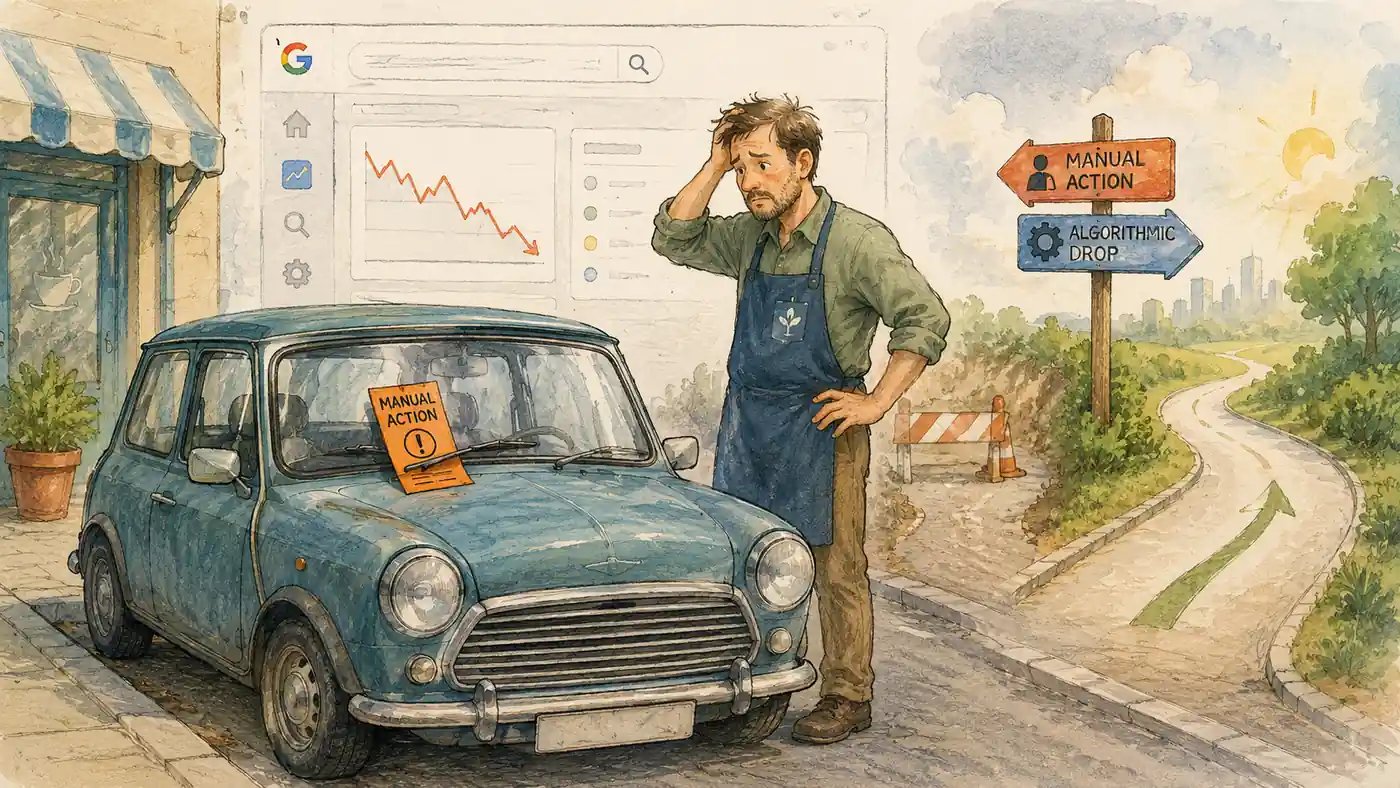
A man looking at a fine on his car, which is a penalty from Google.

Imagine you wake up, walk out to your car, and there's a bright orange ticket under the wiper. Your stomach drops. Did you park in the wrong spot? Was the meter broken? Or is that just a flyer? A Google penalty feels exactly like that moment. You see traffic vanish, you assume the worst, and you're not even sure whether you've been ticketed or whether the whole street just got rerouted.

Here's the good news before we start: most of the time, the thing people call a "Google penalty" isn't a penalty at all. And when it genuinely is one, it's usually fixable. This guide walks you through what a Google penalty actually is, the types that exist, how to check whether your site has one, and a calm, step-by-step way to recover without panicking and towing the whole car to the scrapyard.

What is a Google penalty in SEO?

A Google penalty is a negative action that reduces a website's visibility in Google Search because the site has broken Google's Search Essentials (formerly the Webmaster Guidelines). Think of it as the parking ticket: an official response to something you did that broke a rule.

But (and this is the part that trips almost everyone up) there are really two very different things people lump under the word "penalty":

  1. Manual actions: a real human reviewer at Google looked at your site, decided it broke a rule, and applied a sanction. This is the actual orange ticket, and Google tells you about it directly.

  2. Algorithmic suppression: no human ticketed you. An algorithm update simply re-evaluated the web and decided your pages deserve to rank lower. This isn't technically a penalty at all; it's a re-scoring. But it feels identical from the driver's seat.

Knowing which of the two you're dealing with changes everything about how you respond, so we'll keep coming back to this distinction. If a recent Google core update coincided with your traffic drop, for example, you're almost certainly looking at door number two, not a ticket.

The main types of Google penalties

Not every ticket is written for the same offence. Here are the ones you'll actually run into.

1. Manual action penalties

These are issued by Google's human reviewers and appear in the Manual Actions report inside Google Search Console. Common triggers include unnatural links (to or from your site), thin content with little added value, pure spam, user-generated spam, cloaking, sneaky redirects, and hidden text or keyword stuffing.

A manual action can be site-wide (your whole domain is affected) or partial (only certain pages or a certain issue). The upside of a manual action is honesty: Google names the problem and gives you a reconsideration request button once you've fixed it.

2. The unnatural links problem (a.k.a. the Penguin legacy)

Back in 2012, Google launched the Penguin update to target manipulative link building: buying links, spammy directories, over-optimised anchor text, and link networks. For years, "Penguin penalty" was shorthand for getting hammered over a bad backlink profile.

Since 2016, Penguin has run in real time as part of Google's core algorithm, and its modern behaviour is mostly to devalue (ignore) spammy links rather than actively demote the site. That's an important nuance: a lot of what people still call a "Penguin penalty" today is really Google quietly discounting links that never should have counted. You can still receive a manual unnatural-links action, though. That one is a genuine ticket.

If your backlink profile is the worry, it's worth understanding what actually makes a link harmful in the first place. Our guide on toxic backlinks breaks that down.

3. The "duplicate content penalty" (mostly a myth)

This one deserves a myth-buster. There is no specific Google penalty for duplicate content in the vast majority of cases. Google has said repeatedly that duplicate content on its own doesn't trigger a manual action.

What actually happens is subtler: when several URLs show near-identical content, Google picks one to index and rank, and the others get filtered out. You don't get ticketed, you get consolidated. The visibility loss is real, but the fix is technical (canonical tags, consolidating pages, fixing parameter URLs), not a reconsideration request.

The exception is when duplication is deliberate and manipulative (scraped content, doorway pages, or auto-generated spam). That crosses into spam territory and can attract a manual action.

4. Algorithmic suppression (the rerouted street)

This is the biggest category by far, and the one most often mistaken for a penalty. When Google rolls out a core update or a spam update, it re-scores the web. Sites that were relying on thin content, weak expertise, or aggressive tactics can drop overnight. There is no message in Google Search Console, because no human ticketed them.

There's no reconsideration request for this, because there's nothing to reconsider. Recovery comes from genuinely improving the site and waiting for the next update to re-evaluate it.

How to check if your site is penalised by Google

Before you spend money on a "Google penalty checker" tool or a consultant, run this free diagnostic yourself. It takes about twenty minutes and answers the only question that matters: ticket, or rerouted street?

Step 1: Check the Manual Actions report

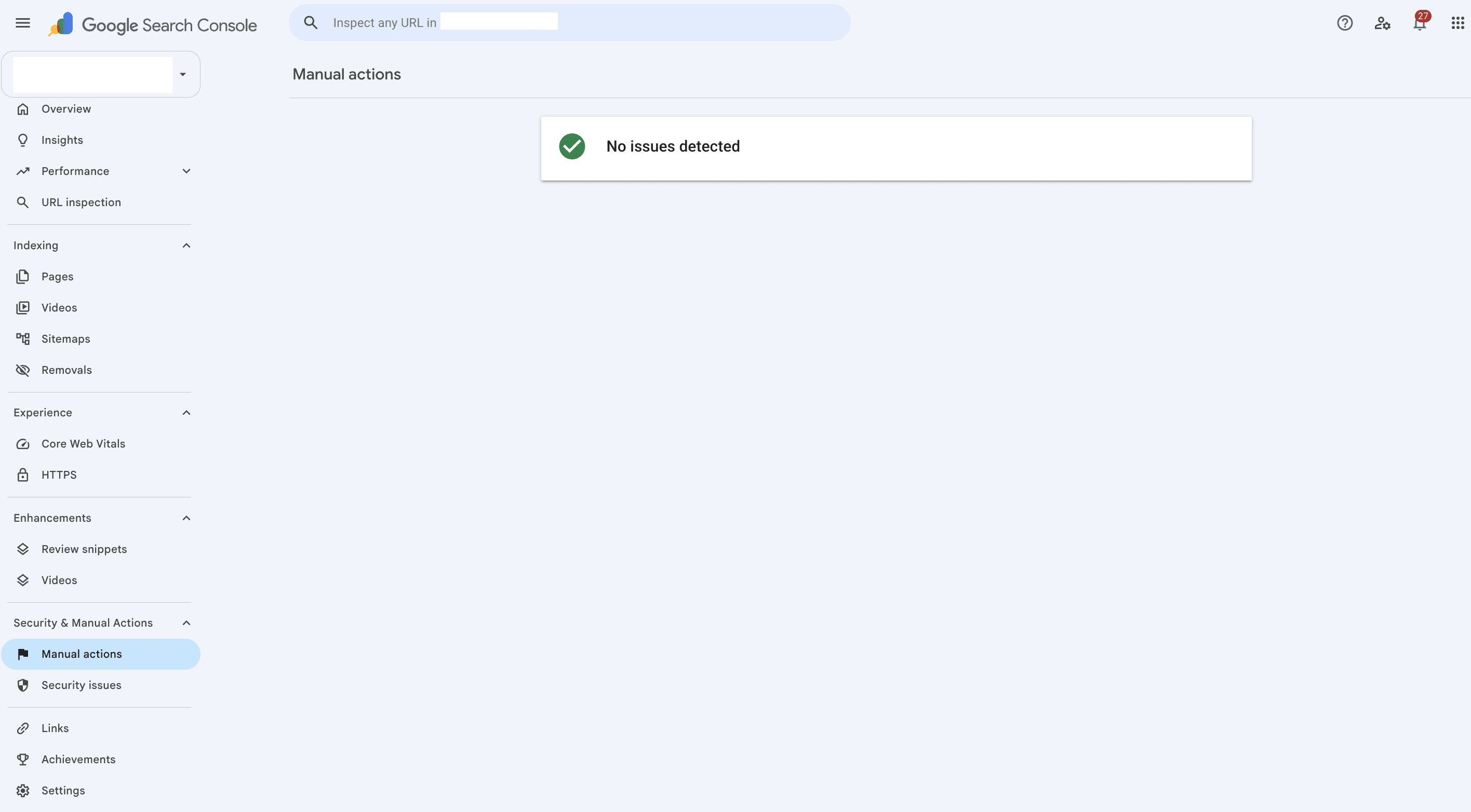
Open Google Search Console → Security & Manual Actions → Manual actions. If it says "No issues detected," you do not have a manual penalty. Full stop. Whatever happened to your traffic is algorithmic or technical. If there is an issue listed, Google names it. Read it carefully, because it tells you exactly what to fix.
Step 2: Overlay your traffic drop against update dates

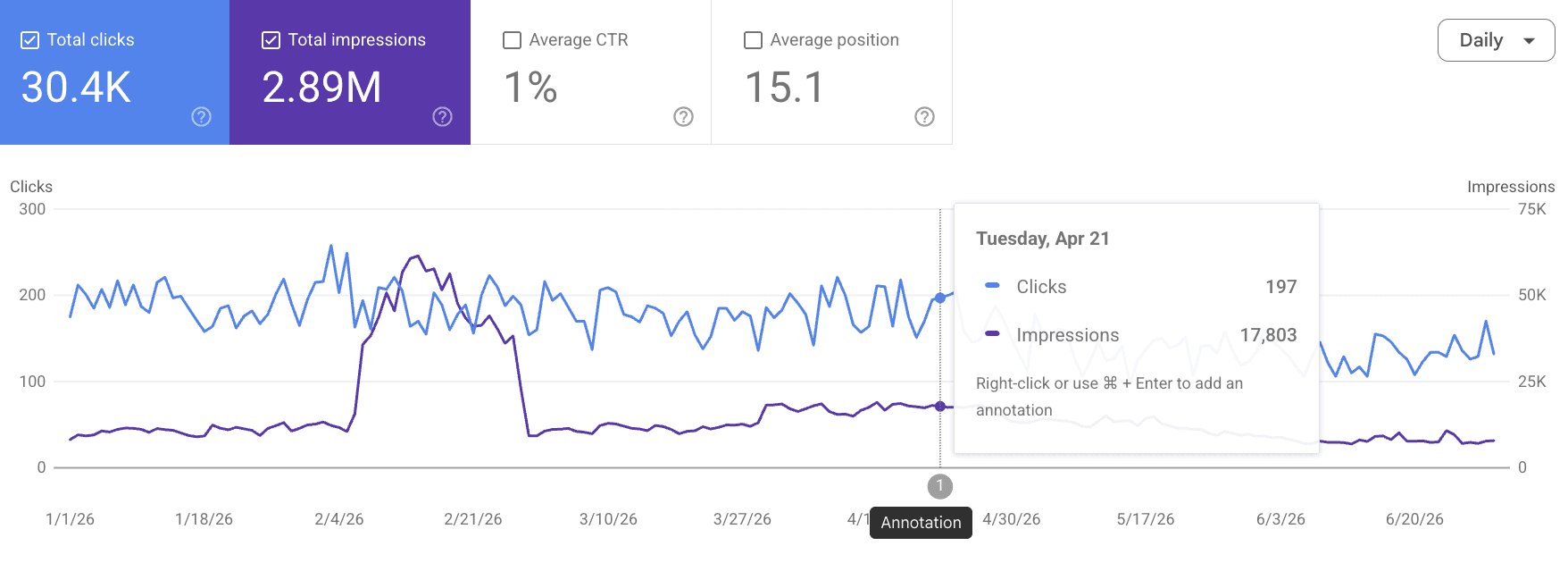
In GSC's Performance report (or your analytics), find the exact date your clicks fell off a cliff. Then compare it to Google's confirmed update history. A sharp drop that lines up with a known core or spam update is a strong signal of algorithmic suppression rather than a manual action. A drop that lines up with nothing at all often points to a technical problem: a botched migration, a noindex tag left in place, or broken redirects.
Step 3: Rule out the technical impostors

Plenty of "penalties" are really self-inflicted technical wounds. Check for accidental noindex tags, a disallow rule in robots.txt, server errors, or a redirect mess. If you recently changed your site, our guides on SEO migrations, changing a domain name, and untangling redirect chains cover the usual suspects.

Step 4: Sanity-check with a branded search

Search for your exact brand name. If your own site doesn't appear as the top result for its own name, that's an unusually severe signal (often a site-wide manual action or a deindexing issue) and worth escalating immediately. If you rank fine for your brand but poorly for everything else, you're looking at competitive or algorithmic factors, not a deindexing.

How to recover from a Google penalty, step by step

Once you know which situation you're in, the recovery path is actually fairly clear. Here's how to handle each.

Recovering from a manual action

  1. Diagnose precisely. Read the exact wording in the Manual Actions report. "Unnatural links to your site" is a very different job from "thin content." Fix the thing Google actually named, not what you assume it means.

  2. Fix the root cause thoroughly. For unnatural links, audit your backlink profile, remove or disavow the manipulative links, and document what you did. For thin or spammy content, rewrite, consolidate, or remove it. Half-measures get reconsideration requests rejected.

  3. Submit a reconsideration request. Only manual actions have this option. Be honest and specific: explain what went wrong, what you fixed, and how you'll prevent it. Vague, defensive requests get denied.

  4. Wait. A human re-reviews your site. This can take days to a few weeks. You'll get a message back either lifting the action or explaining what's still wrong.

Recovering from algorithmic suppression

There's no button to press here, which frustrates people, but it's also liberating, because the recovery is just "become genuinely better." Focus on content quality and demonstrable expertise, prune or improve weak pages, and strengthen your topical foundations. Our pieces on content pruning, building topical authority, and the SEO content creation guide are the right place to start. Then wait for the next update to re-evaluate the site. Recovery typically lands on an update cycle, not on a random Tuesday.

Fixing the technical impostors

If your "penalty" turned out to be a stray noindex, a redirect chain, or a crawl issue, the fix is simply to correct it and request re-crawling. These recover the fastest of all — often within days once Google re-crawls. Keeping an eye on fundamentals like Core Web Vitals and orphan pages prevents a lot of these from happening in the first place.

How to avoid a Google penalty in the first place

The cheapest penalty is the one you never get. A few durable habits keep your car out of the tow zone entirely:

  • Build links the right way. A backlink profile grown through quality link building (genuine editorial mentions on relevant, authoritative sites) strengthens your rankings and rarely attracts an unnatural-links action. It's manipulative, low-quality link schemes that get ticketed, not link building itself.

  • Publish content with a real point of view. Thin, templated, or purely AI-spun pages are exactly what core and spam updates target. Create content that adds actual value.

  • Keep your technical house in order. Clean redirects, correct canonicals, and no accidental noindex tags remove most impostor "penalties" before they start.

  • Watch your own analytics. The sooner you notice a drop and can pin it to a date, the faster you can diagnose it.

Do you need a penalty recovery consultant?

Sometimes you do, and sometimes it's overkill. If you've confirmed a manual action, your backlink profile is large and messy, and the traffic loss is hurting revenue, an experienced penalty recovery specialist can save you weeks of trial and error and get the reconsideration request right the first time. Domain-level manual actions and long-standing link problems are the clearest cases for bringing in help.

If your diagnostic showed "No issues detected" and your drop lines up with a core update, you don't need a penalty removal service, you need a better strategy. Be wary of any "Google penalty removal" pitch that promises to lift an algorithmic drop overnight; that isn't how algorithmic re-scoring works, and no consultant has a back channel to Google to make it happen.

At Flowboost, penalty recovery is part of how we approach organic search: diagnose honestly first, fix the real cause, and build the kind of site that's hard to penalise in the future. If you're not sure which situation you're in, talk to us and we'll help you read the ticket.

Daniel Rojo

LinkedIn author:

Meet Wolfy

Triple your productivity with Wolfy, the dedicated Google Ads agent.

Talk to an expert

Contents

No headings found

A man looking at a fine on his car, which is a penalty from Google.

Imagine you wake up, walk out to your car, and there's a bright orange ticket under the wiper. Your stomach drops. Did you park in the wrong spot? Was the meter broken? Or is that just a flyer? A Google penalty feels exactly like that moment. You see traffic vanish, you assume the worst, and you're not even sure whether you've been ticketed or whether the whole street just got rerouted.

Here's the good news before we start: most of the time, the thing people call a "Google penalty" isn't a penalty at all. And when it genuinely is one, it's usually fixable. This guide walks you through what a Google penalty actually is, the types that exist, how to check whether your site has one, and a calm, step-by-step way to recover without panicking and towing the whole car to the scrapyard.

What is a Google penalty in SEO?

A Google penalty is a negative action that reduces a website's visibility in Google Search because the site has broken Google's Search Essentials (formerly the Webmaster Guidelines). Think of it as the parking ticket: an official response to something you did that broke a rule.

But (and this is the part that trips almost everyone up) there are really two very different things people lump under the word "penalty":

  1. Manual actions: a real human reviewer at Google looked at your site, decided it broke a rule, and applied a sanction. This is the actual orange ticket, and Google tells you about it directly.

  2. Algorithmic suppression: no human ticketed you. An algorithm update simply re-evaluated the web and decided your pages deserve to rank lower. This isn't technically a penalty at all; it's a re-scoring. But it feels identical from the driver's seat.

Knowing which of the two you're dealing with changes everything about how you respond, so we'll keep coming back to this distinction. If a recent Google core update coincided with your traffic drop, for example, you're almost certainly looking at door number two, not a ticket.

The main types of Google penalties

Not every ticket is written for the same offence. Here are the ones you'll actually run into.

1. Manual action penalties

These are issued by Google's human reviewers and appear in the Manual Actions report inside Google Search Console. Common triggers include unnatural links (to or from your site), thin content with little added value, pure spam, user-generated spam, cloaking, sneaky redirects, and hidden text or keyword stuffing.

A manual action can be site-wide (your whole domain is affected) or partial (only certain pages or a certain issue). The upside of a manual action is honesty: Google names the problem and gives you a reconsideration request button once you've fixed it.

2. The unnatural links problem (a.k.a. the Penguin legacy)

Back in 2012, Google launched the Penguin update to target manipulative link building: buying links, spammy directories, over-optimised anchor text, and link networks. For years, "Penguin penalty" was shorthand for getting hammered over a bad backlink profile.

Since 2016, Penguin has run in real time as part of Google's core algorithm, and its modern behaviour is mostly to devalue (ignore) spammy links rather than actively demote the site. That's an important nuance: a lot of what people still call a "Penguin penalty" today is really Google quietly discounting links that never should have counted. You can still receive a manual unnatural-links action, though. That one is a genuine ticket.

If your backlink profile is the worry, it's worth understanding what actually makes a link harmful in the first place. Our guide on toxic backlinks breaks that down.

3. The "duplicate content penalty" (mostly a myth)

This one deserves a myth-buster. There is no specific Google penalty for duplicate content in the vast majority of cases. Google has said repeatedly that duplicate content on its own doesn't trigger a manual action.

What actually happens is subtler: when several URLs show near-identical content, Google picks one to index and rank, and the others get filtered out. You don't get ticketed, you get consolidated. The visibility loss is real, but the fix is technical (canonical tags, consolidating pages, fixing parameter URLs), not a reconsideration request.

The exception is when duplication is deliberate and manipulative (scraped content, doorway pages, or auto-generated spam). That crosses into spam territory and can attract a manual action.

4. Algorithmic suppression (the rerouted street)

This is the biggest category by far, and the one most often mistaken for a penalty. When Google rolls out a core update or a spam update, it re-scores the web. Sites that were relying on thin content, weak expertise, or aggressive tactics can drop overnight. There is no message in Google Search Console, because no human ticketed them.

There's no reconsideration request for this, because there's nothing to reconsider. Recovery comes from genuinely improving the site and waiting for the next update to re-evaluate it.

How to check if your site is penalised by Google

Before you spend money on a "Google penalty checker" tool or a consultant, run this free diagnostic yourself. It takes about twenty minutes and answers the only question that matters: ticket, or rerouted street?

Step 1: Check the Manual Actions report

Open Google Search Console → Security & Manual Actions → Manual actions. If it says "No issues detected," you do not have a manual penalty. Full stop. Whatever happened to your traffic is algorithmic or technical. If there is an issue listed, Google names it. Read it carefully, because it tells you exactly what to fix.

Step 2: Overlay your traffic drop against update dates

In GSC's Performance report (or your analytics), find the exact date your clicks fell off a cliff. Then compare it to Google's confirmed update history. A sharp drop that lines up with a known core or spam update is a strong signal of algorithmic suppression rather than a manual action. A drop that lines up with nothing at all often points to a technical problem: a botched migration, a noindex tag left in place, or broken redirects.

Step 3: Rule out the technical impostors

Plenty of "penalties" are really self-inflicted technical wounds. Check for accidental noindex tags, a disallow rule in robots.txt, server errors, or a redirect mess. If you recently changed your site, our guides on SEO migrations, changing a domain name, and untangling redirect chains cover the usual suspects.

Step 4: Sanity-check with a branded search

Search for your exact brand name. If your own site doesn't appear as the top result for its own name, that's an unusually severe signal (often a site-wide manual action or a deindexing issue) and worth escalating immediately. If you rank fine for your brand but poorly for everything else, you're looking at competitive or algorithmic factors, not a deindexing.

How to recover from a Google penalty, step by step

Once you know which situation you're in, the recovery path is actually fairly clear. Here's how to handle each.

Recovering from a manual action

  1. Diagnose precisely. Read the exact wording in the Manual Actions report. "Unnatural links to your site" is a very different job from "thin content." Fix the thing Google actually named, not what you assume it means.

  2. Fix the root cause thoroughly. For unnatural links, audit your backlink profile, remove or disavow the manipulative links, and document what you did. For thin or spammy content, rewrite, consolidate, or remove it. Half-measures get reconsideration requests rejected.

  3. Submit a reconsideration request. Only manual actions have this option. Be honest and specific: explain what went wrong, what you fixed, and how you'll prevent it. Vague, defensive requests get denied.

  4. Wait. A human re-reviews your site. This can take days to a few weeks. You'll get a message back either lifting the action or explaining what's still wrong.

Recovering from algorithmic suppression

There's no button to press here, which frustrates people, but it's also liberating, because the recovery is just "become genuinely better." Focus on content quality and demonstrable expertise, prune or improve weak pages, and strengthen your topical foundations. Our pieces on content pruning, building topical authority, and the SEO content creation guide are the right place to start. Then wait for the next update to re-evaluate the site. Recovery typically lands on an update cycle, not on a random Tuesday.

Fixing the technical impostors

If your "penalty" turned out to be a stray noindex, a redirect chain, or a crawl issue, the fix is simply to correct it and request re-crawling. These recover the fastest of all — often within days once Google re-crawls. Keeping an eye on fundamentals like Core Web Vitals and orphan pages prevents a lot of these from happening in the first place.

How to avoid a Google penalty in the first place

The cheapest penalty is the one you never get. A few durable habits keep your car out of the tow zone entirely:

  • Build links the right way. A backlink profile grown through quality link building (genuine editorial mentions on relevant, authoritative sites) strengthens your rankings and rarely attracts an unnatural-links action. It's manipulative, low-quality link schemes that get ticketed, not link building itself.

  • Publish content with a real point of view. Thin, templated, or purely AI-spun pages are exactly what core and spam updates target. Create content that adds actual value.

  • Keep your technical house in order. Clean redirects, correct canonicals, and no accidental noindex tags remove most impostor "penalties" before they start.

  • Watch your own analytics. The sooner you notice a drop and can pin it to a date, the faster you can diagnose it.

Do you need a penalty recovery consultant?

Sometimes you do, and sometimes it's overkill. If you've confirmed a manual action, your backlink profile is large and messy, and the traffic loss is hurting revenue, an experienced penalty recovery specialist can save you weeks of trial and error and get the reconsideration request right the first time. Domain-level manual actions and long-standing link problems are the clearest cases for bringing in help.

If your diagnostic showed "No issues detected" and your drop lines up with a core update, you don't need a penalty removal service, you need a better strategy. Be wary of any "Google penalty removal" pitch that promises to lift an algorithmic drop overnight; that isn't how algorithmic re-scoring works, and no consultant has a back channel to Google to make it happen.

At Flowboost, penalty recovery is part of how we approach organic search: diagnose honestly first, fix the real cause, and build the kind of site that's hard to penalise in the future. If you're not sure which situation you're in, talk to us and we'll help you read the ticket.

Daniel Rojo

LinkedIn author:

Meet Wolfy

Triple your productivity with Wolfy, the dedicated Google Ads agent.

Talk to an expert

Frequently asked questions

Frequently asked questions

How do I check if Google penalised my site?

Is there a Google duplicate content penalty?

What is a Penguin penalty?

How long does Google penalty recovery take?

Can a penalty removal service guarantee recovery?