Search Engine Marketing (SEO)

Why SEO is performance marketing: the orchard that pays by the harvest
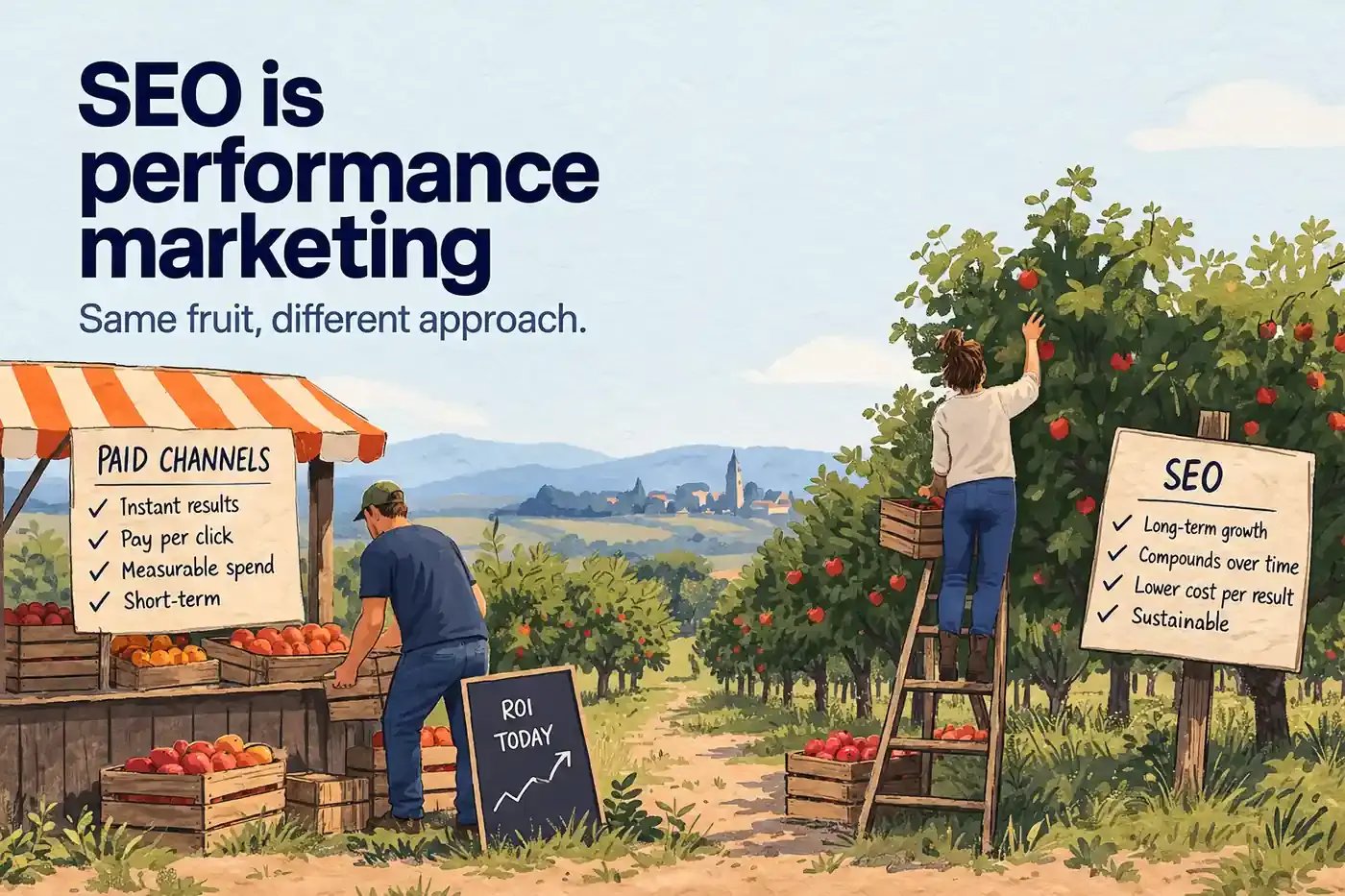
Every morning, two fruit sellers set up on the same square. The first buys crates at the wholesale market before dawn, sells them by noon and goes back tomorrow to buy more. Every apple has a price tag and a margin, and she knows by lunchtime whether the day paid. The second planted an orchard five years ago. The first two seasons gave her almost nothing. Now the trees fruit every year, the cost per apple keeps falling, and she still counts every crate that leaves the farm. Both of them run a business on numbers. Only one of them is usually called a performance marketer.
That is the quiet injustice at the heart of how most companies file SEO. Paid search, paid social and affiliates get called performance marketing because the meter runs in plain sight: spend in, clicks out, revenue by the afternoon. SEO gets filed under brand, content or "long-term stuff", a line on the budget that has to justify itself with rankings screenshots and good intentions. But an orchard is not a hobby. It is a different way of producing the same fruit, and it can be measured just as hard.
This guide makes the case for treating SEO as performance marketing, and it is honest about where the comparison bends. We'll define what performance marketing actually means, answer whether SEO belongs inside it, compare it with content, traditional and direct marketing, show how to measure an organic channel by the harvest rather than by the leaves, and explain how we run it at Flowboost.
Part 1: What performance marketing actually is

Strip away the agency jargon and performance marketing is marketing judged by measurable business outcomes: leads, sales, revenue, return on spend. Every euro is expected to show what it brought back, and every channel is tuned, cut or scaled on that evidence. It is the fruit seller with a notebook, not the one guessing whether it was a good day.
The term grew up around paid channels, which is why the two are so often treated as synonyms. In the strictest definition, you pay for a result: a click, a lead, a sale. Pay-per-click search, paid social, affiliate deals and shopping campaigns all fit that model neatly, because the platform hands you a cost and a conversion for every interaction.
But look closer and the pay-per-result part is the billing model, not the philosophy. The philosophy has four parts:
A clear business goal. Revenue, qualified leads or margin, not "awareness" in the abstract.
Tracking that connects activity to that goal. If you cannot see the outcome, you cannot manage the channel.
A cost you can hold against the return. Media spend, yes, but also people, tools and production.
A loop of testing and reallocating. Money moves towards what works and away from what doesn't.
Nothing in that list says the cost has to be a media invoice. It says the cost has to be known and the return has to be measured. Hold onto that, because it is the whole argument for the rest of this guide.
Part 2: Is SEO part of performance marketing?

This is the question behind the search "is SEO part of performance marketing", and the honest answer is: yes, when you run it like one, and no, when you don't. SEO is not performance marketing by default. Plenty of SEO is still sold and managed as a vague visibility exercise, reported in rankings for terms nobody buys from. That is an orchard nobody harvests. But SEO has every ingredient the definition in Part 1 asks for.
The case for: SEO checks every box
The goal can be revenue. Organic search captures people who are actively looking for what you sell, which is why its traffic so often converts. That intent is the same thing paid search buys; SEO just earns it rather than renting it. Matching pages to that search intent is where the commercial value starts.
The outcome can be tracked. Analytics shows organic sessions, conversions and revenue. Search Console shows which queries and pages bring people in. It is not as clean as an ad platform's conversion column, but it is far from a black box.
The cost is known. Content, technical work, tooling and specialist hours all have a price. Divide them by the organic revenue they produce and you have a cost per acquisition, just like any paid channel.
The loop exists. Pages get tested, rewritten, consolidated or pruned based on what they return. That is reallocation, only the currency is effort instead of bids.
The honest caveats: where the comparison bends
An orchard is still not a market stall, and pretending otherwise is how SEO loses trust.
The lag is real. Google's own guidance on hiring an SEO says results typically take four months to a year from the moment changes start. Paid traffic arrives the same afternoon. Any business case that hides this lag will collapse at month three.
You can't buy your way to the top. The same Google page states that advertising with Google has no effect on organic presence. There is no bid to raise when you need more fruit next week.
Attribution is messier. Organic often starts journeys that end on another channel, and a growing share of searches end without a click at all, a shift we cover in our guide to SEO challenges in 2026. Last-click reports will undervalue it.
The returns compound instead of resetting. This is the caveat that works in SEO's favour. When a paid campaign stops, the traffic stops. When SEO work stops, the pages keep producing for a while, which is the principle behind compound SEO.
So SEO is performance marketing with a longer payback period and a lower long-run cost per harvest. That is not a weaker kind of performance. It is a different shape of return, and it needs a different shape of reporting.
Part 3: How SEO compares to other kinds of marketing

Much of the confusion comes from labels that overlap. A market square has more than two stalls, and the useful question is not which label SEO wears, but what each approach is built to produce and how you measure it.
Approach | Built to produce | How it's paid for | Speed of results | When you stop investing |
|---|---|---|---|---|
Paid performance (search ads, paid social, affiliates) | Clicks, leads and sales now | Per click, impression or conversion | Days | Traffic stops almost immediately |
SEO | Qualified organic traffic and conversions | People, content, technical work | Months | Results fade slowly |
Content marketing | Audience, trust, demand | Production and distribution | Months | Content keeps working if it is found |
Traditional marketing (TV, print, outdoor) | Reach and brand recall | Media buys | Weeks, hard to isolate | Recall fades |
Direct marketing (mail, email, outbound) | A response from a defined list | Per send or per contact | Days to weeks | Responses stop with the sends |
Table: a simplified comparison. Real channels blur; treat it as a map, not a law.
Performance marketing vs content marketing
Content marketing builds an audience by being worth reading; performance marketing demands a measurable result. They are not opposites. SEO is often where the two meet: content written to answer real searches, judged on whether it brings in customers. Content that ranks for nothing and converts no one is a nice tree with no fruit, and it fails both tests.
Performance marketing vs traditional marketing
Traditional marketing buys reach and hopes some of it turns into demand. Performance marketing reaches people who are already showing intent and tracks what they do next. SEO sits firmly on the performance side here: nobody lands on your page from a search by accident. They typed the question first.
How SEO compares to direct marketing
Direct marketing goes out to a list and waits for a response. SEO works the other way round: you don't knock on doors, you make sure your stall is the one people find when they come looking. Both are measurable by response, but SEO's "list" is everyone searching, and you never pay per contact.
What is the difference between SEO and digital marketing?
Digital marketing is the whole square: paid search, social, email, display, content, SEO and more. SEO is one stall on it, the discipline of earning visibility in search engines and, increasingly, in AI answers. Performance marketing is not a separate stall at all. It is a way of running any stall: by the numbers. That is why SEO can be both digital marketing and performance marketing at the same time.
Part 4: How to measure SEO like a performance channel

If SEO wants a seat next to paid at the budget table, it has to be reported in the same currency. Rankings are the leaves. Revenue is the fruit. Leaves tell you the tree is healthy; nobody pays the bills with them. Here is how to report the harvest.
1. Start from revenue, not rankings
Set organic conversions and revenue as the headline metric, segmented by landing page. Rankings and traffic still matter as leading indicators, but they belong under the headline, not instead of it. We made the same argument in the old SEO language is dead: the vocabulary has to move from positions to business outcomes.
2. Calculate a real cost per acquisition
Add up everything the organic channel costs over a period: specialist time, content production, technical fixes, tools. Divide by the organic conversions in the same period. That number is directly comparable to your paid CPA, with one adjustment: SEO work done this quarter keeps paying in later quarters, so judge it over 12 months or more, not month by month.
3. Choose an attribution model that sees the whole tree
Last-click reporting gives all the credit to the final touch, which systematically undervalues channels that start journeys. Google Analytics 4 offers a data-driven attribution model that distributes credit across touchpoints, and its attribution models report lets you compare how much credit organic gets under each model. Neither model is the truth; the gap between them is the insight.
4. Track the visibility that doesn't click
AI Overviews and answer engines increasingly satisfy searches without a visit. Brand search volume, share of voice in AI answers and branded direct traffic are the footprints of that visibility. They are softer numbers, but leaving them out understates SEO's harvest. Our guide to AI Overviews and SEO and our GEO service go deeper on measuring that layer.
5. Report in seasons, not days
Paid can be optimised daily. SEO should be reviewed against staged expectations: what should be visible at 30, 60 and 90 days, and what should the harvest look like at 6 and 12 months. That keeps a slow channel accountable without judging an orchard by its first spring.
6. Optimise the page, not just the position
A performance mindset doesn't stop at getting the click. Improving what organic visitors do once they land, through SEO conversion rate optimisation, raises revenue from the traffic you already earn. It is often the fastest lever in the whole channel.
Part 5: How we run SEO as performance marketing at Flowboost

We run paid and organic under one roof, which shapes how we look at search. Our Google Ads team lives on cost per acquisition and return on ad spend, and we see no reason the organic team should be held to a softer standard. Same square, same notebook.
In practice, that means every SEO engagement starts from the commercial goal, not a keyword list. We map which pages should produce revenue or leads, which searches carry real buying intent, and what the organic channel needs to return to earn its budget. Rankings are tracked, but they are reported as leading indicators under the numbers that pay the bills.
It also means we plan organic and paid together rather than as rival stalls. Paid search tells us within days which queries convert; SEO turns the best of them into assets we no longer have to rent. Where organic already wins a query, paid spend can shift elsewhere. We explain that interplay in more detail in how PPC and SEO work together.
And it means being honest about the lag. We agree up front what each stage should look like, so a client funding the orchard can see the trees taking root long before the first full harvest.
The fruit seller with the orchard never stopped counting crates. She just learned to count over seasons instead of mornings, and to put the cost of the trees on the same ledger as the cost of the crates. Treat SEO that way and it stops being the line on the budget that has to defend itself, and becomes the one that keeps lowering the cost of everything else.
If you want organic search reported in the same currency as your paid channels, take a look at how we approach organic search, or talk to us about what your orchard could be harvesting.

Daniel Rojo

Frequently asked questions
Explore other blogs







Rotterdam
Bierstraat 123 C
Valencia Carrer del Prof. Beltrán Báguena 5


Flowboost 2026 ~ All rights reserved.