More organic traffic is supposed to mean more revenue. So what happens when the visitors arrive and leave without buying?
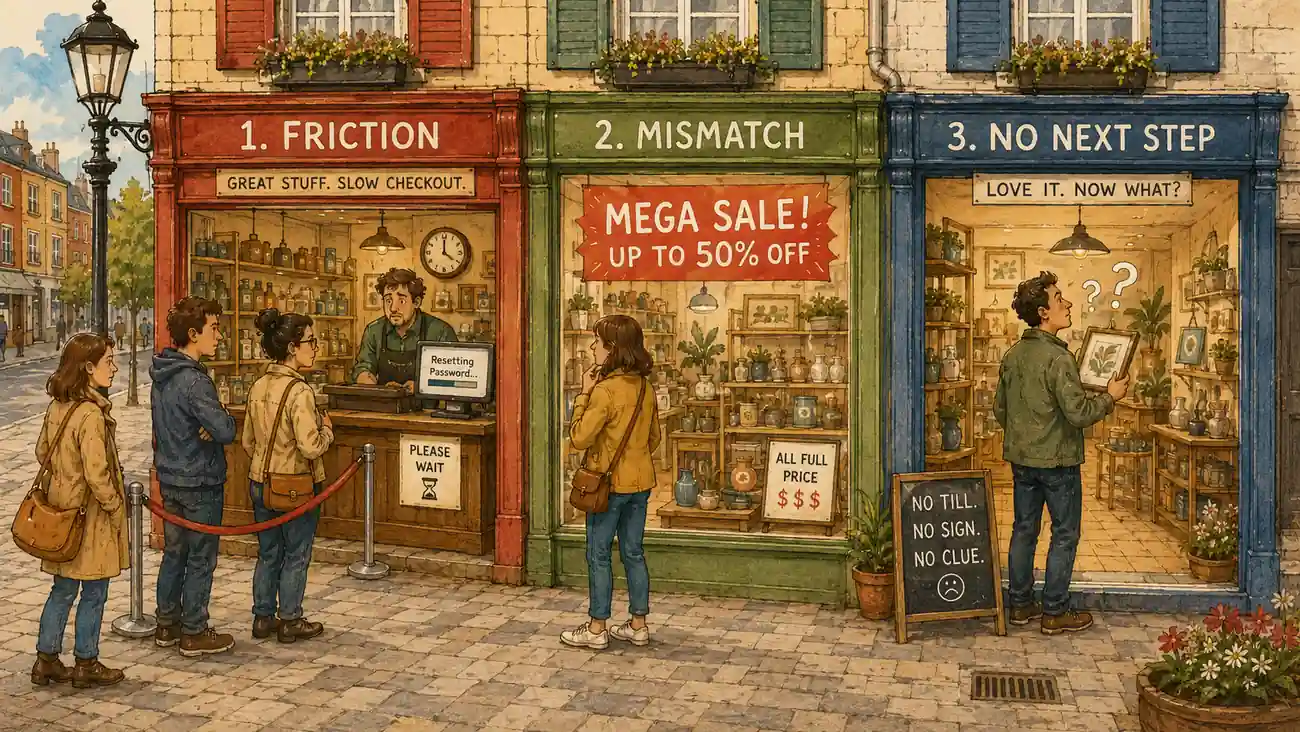
It is Saturday afternoon. The high street is packed. You spot a shop halfway down the road, window display full, people spilling out onto the pavement.You walk in. It is heaving. But the tills have a queue of ten people and the only member of staff is resetting their password. You put back what you had picked up. You walk out.
You try the shop next door. The window promised a sale. Inside, nothing is discounted. The layout is completely different from what the display suggested. You cannot find what you came in for. You leave.
Third shop. You find exactly what you want. You look for the till. There is no signage. You wander around for two minutes. Someone brushes past you on their way out. You follow them through the door without buying.
Three shops. Three different reasons people left without buying. All three had visitors. None of them had a conversion problem they could see from the outside. That is what a low SEO conversion rate looks like. The traffic arrived. The shop was open. Something between the door and the till sent them somewhere else.
What is a conversion rate in SEO?
SEO conversion rate is the percentage of organic search visitors who complete a desired action (conversion) on a website. That action could be a purchase, a form submission, a phone call, a demo booking, or a newsletter sign-up. Whatever your business considers a meaningful outcome counts. SEO conversion rate optimization is the process of closing the gap between traffic that arrives and traffic that acts.
You only need to divide the number of conversions from organic search by the total number of organic search visitors, then multiply by 100 to get a percentage.

A page with 2,000 organic sessions and 40 conversions in a month has a conversion rate of 2%. Simple to calculate, and the starting point for every decision that follows.
It helps to separate two types of conversion.
Macro-conversions are the main event: the purchase, the enquiry, the signed contract.
Micro-conversions are the steps that lead there: a product page visit, a click on pricing, an email subscription.
Think of macro-conversions as the customers who reach the till. Micro-conversions are everyone who picks something up off the shelf. Both tell you something important about what is happening in your shop.
Apply this yourself Open GA4 and go to Reports > Acquisition > Traffic Acquisition. Filter by the Organic Search channel. You will see Sessions and Conversions in the same table. Divide conversions by sessions and multiply by 100. That number is your current SEO conversion rate. Write it down before you do anything else. |
|---|
What is a good SEO conversion rate? The benchmarks
Not every shop on the high street converts at the same rate. A jeweller and a newsagent will never operate to the same numbers, and neither will an e-commerce store and a B2B consultancy.
Before going into the details of any benchmarks, it is important to point out that most published "SEO conversion rate" figures come from marketing agencies citing each other rather than from a primary dataset, so always treat them with scepticism. The figures that are primary measure sitewide conversion across all channels, not organic alone.
We can take an example such as IRP Commerce, which publishes monthly e-commerce market data calculated from live transactions. Their cross-industry figure for early 2026 sits at roughly 1.7%, but read the fine print: this is session-based (a returning visitor counts as multiple sessions, which lowers the number), it covers UK merchants, and it is sitewide, not organic-specific. It is a useful anchor for order of magnitude, not a target for your organic channel. (IRP updates monthly, so check the current month's figure before publishing, this number moves.)
The broader takeaway most sources agree on, even if the exact percentages vary, is that organic and paid traffic convert differently because they carry different intent. But the size and even the direction of that gap depends entirely on the dataset, the industry, and how conversion is measured. There is no single trustworthy "good organic conversion rate" you can hold yourself to.
Which is why the more useful comparison is not an industry benchmark at all. It is your own conversion rate from organic traffic versus your conversion rate from your other channels, measured the same way, on your own site. If visitors from paid search convert at 4% and your organic visitors convert at 0.8%, that gap is the real number to work with, and it is one no external benchmark can give you. The shop is busier than the one next door. The tills are emptier. How SEO and paid traffic relate across the full customer journey is something our guide to how PPC and SEO work together covers in more detail.
Apply this yourself In GA4, compare your conversion rate across channels side by side: Organic Search, Paid Search, Direct, and Referral. If organic is consistently the lowest-converting channel, you have a conversion problem specific to organic traffic. That usually means a search intent mismatch: the people arriving from search are not the same people ready to buy. That is fixable, and it starts with understanding why the gap exists is where SEO conversion rate optimization begins. |
|---|
Why more traffic does not automatically mean more sales
This is the assumption that causes the most frustration in SEO. Rankings go up, impressions increase, clicks grow month on month. The reports look strong. And then someone asks why revenue has not moved in the same direction.
The answer is almost always the same. The shop got busier with the wrong kind of customer. Or the right kind of customer arrived and found the till closed.
"Getting to page one is the window display. Converting visitors is everything that happens after they walk through the door."
Those three shops from the high street map almost exactly onto the three most common reasons organic traffic fails to convert.
1. The first is a traffic quality problem:
The keywords driving your organic visits are informational rather than transactional.
People searching "what is CRM software" are browsing (for example a marketing student).
People searching "CRM software for small teams pricing" are buying (for example an entrepreneur looking for a CRM software for his startup).
One fills your shop with the wrong kind of customer entirely. Understanding the difference is covered in our guide to search intent in SEO.
2. The second is a promise problem:
Your title tag and meta description are the window display. They set an expectation before anyone walks through the door. When the landing page does not match that expectation, the visitor feels the same way you did in that second shop. They came in for a sale. The shelves were full price. They left.
The gap between what search results promise and what a page delivers is one of the most common and least-diagnosed conversion problems in SEO.
3. The third is a navigation problem:
The right visitor arrived with the right intent and found exactly what they were looking for. Then they could not find the till. No clear next step, no obvious CTA, no signage pointing them toward checkout.
They did not leave because they did not want to buy. They left because buying required too much effort.
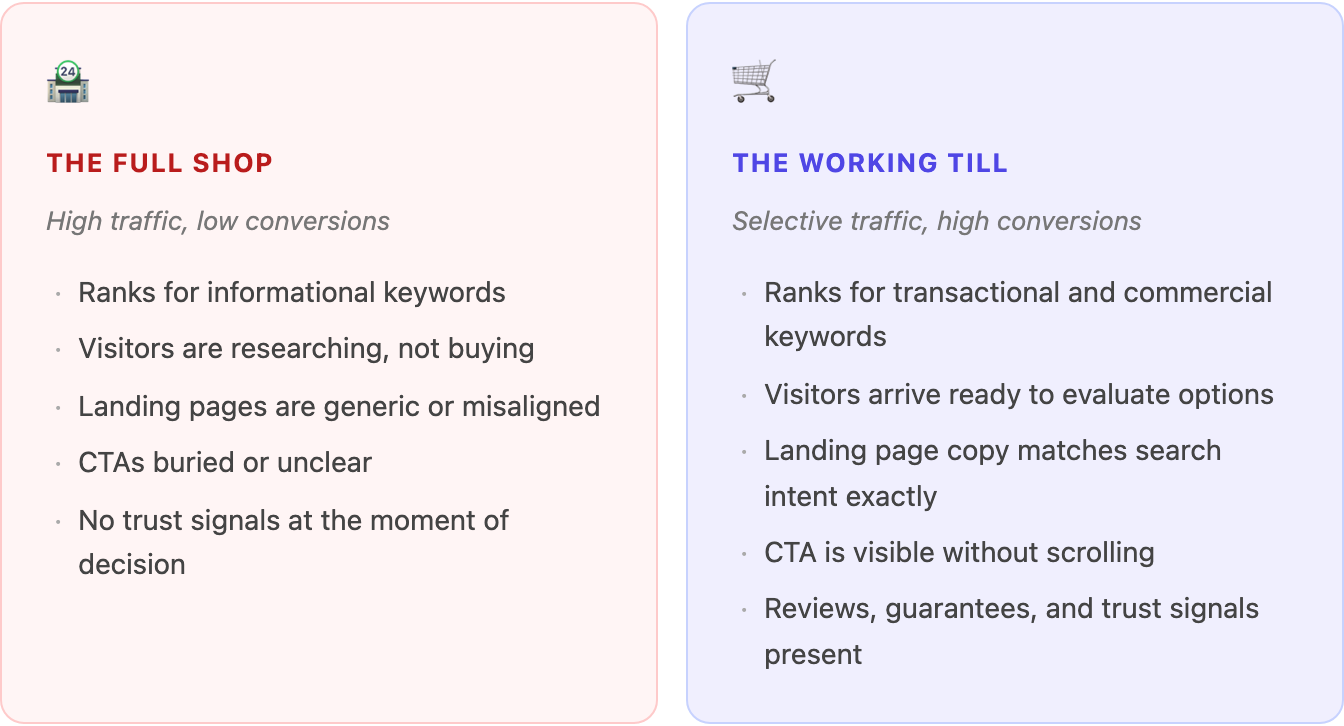
What actually moves the conversion needle on organic landing pages
When traffic quality is right and conversions are still low, the problem is no longer in the search results. It is on the shop floor.
Some of what fixes it is still squarely SEO optimization; the rest leans on neighbouring disciplines:
Page speed: technical SEO. It is a ranking factor and a core part of technical SEO.
Copy alignment: content SEO. Making the page answer the intent behind the query, with the title and meta matching what's inside, is arguably the most SEO task of them all.
Trust signals: branding and UX. Reviews, guarantees, and named team members reduce perceived risk.
CTA placement: conversion rate optimisation. Whether the next step is obvious and easy to act on.
The point is not that SEO ends here. It is that a low conversion rate is rarely a signal to do more SEO in isolation. It is usually a signal that SEO, content, UX, and design need to be working from the same brief.
We could say that these four elements account for the large majority of conversion gaps on SEO-driven landing pages. They map neatly onto a single problem: a shop that pulls people in off the street but loses them somewhere between the door and the till.
1. Page speed: the queue before you even get in
A visitor who leaves before the page renders is a conversion that never had a chance. Slow pages lose people at the door, and page speed works on both sides of the click: it affects your rankings and what happens once someone arrives. Google's own research has long pointed to a sharp rise in mobile abandonment as load time climbs past a few seconds (Over 53% of mobile users abandon sites that take longer than 3 seconds to load)
2. Copy alignment: the window that didn't match inside)
If the title tag and meta description promise one thing and the landing page delivers another, visitors feel misled before they have read a single paragraph. The first 100 words of the page have to answer the implicit question behind the search query that brought someone there. When the window display and the shop floor don't match, people turn around.
3. Trust signals: the assistant who knows what they're talking about
Reviews, testimonials, security badges, money-back guarantees, and named team members all reduce perceived risk. Visitors convert when they feel safe. Without trust signals, even a motivated buyer hesitates at the till.
4. CTA clarity: the till nobody could find
A call to action that requires scrolling, hunting, or decoding is a till that takes effort to reach. The next step should be visible without scrolling on every high-traffic landing page, and one clear action per page consistently outperforms several competing options.
THE SINGLE MOST OVERLOOKED CONVERSION FIX
The most underused lever in SEO conversion rate optimization is keyword-to-page copy alignment. If your top organic landing page ranks for a keyword with commercial intent but opens with a generic brand introduction, the visitor's mental model does not match what they find. They came to buy. The first thing they read is a story about when your company was founded.
Match the first fold of every page to the intent of the keyword it ranks for. Not to your brand narrative. To what the person who typed that query is looking for right now.
Apply this yourself Open your five highest-traffic organic landing pages. For each one, write down the primary keyword it ranks for. Then read the first 100 words of the page copy. Ask: if someone had just typed that keyword into Google and landed here, would they immediately understand they are in the right place? If the answer is no, that is your highest-value conversion edit this week. |
|---|
How to run a basic SEO conversion rate audit
You do not need a specialist tool or an agency to run a basic SEO conversion rate optimization audit. The data you need is already in GA4 and Google Search Console. The process is about knowing where to look.
1. Start with the pages that have the most to give: high organic traffic, low conversion rate.
These are the tills that are not opening on your busiest days. A page with 2,000 monthly organic sessions and a 0.5% conversion rate is converting 10 people per month. At 2%, that becomes 40. The traffic is already there. The opportunity cost of not fixing it compounds every month.
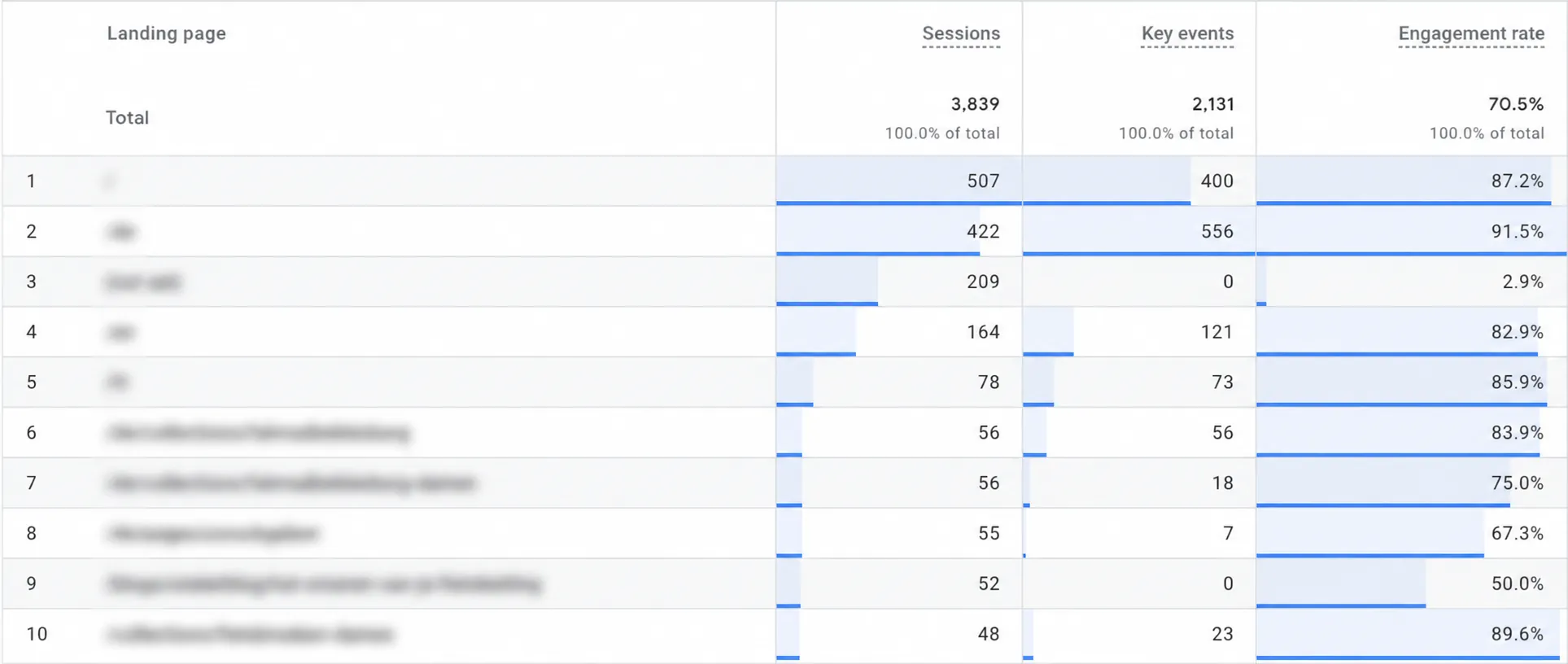
Segment organic traffic by landing page In GA4, go to Explore and open a blank exploration. Add Landing page as a dimension, and add Sessions and Key events as metrics. Then restrict the report to organic traffic, either by building a segment or by applying a filter where Session default channel group equals Organic Search. This gives you a ranked list of every organic entry point and how many sessions turn into key events.
Find your highest-traffic, lowest-converting pages Sort by sessions descending. Look for pages in the top 20 for traffic that sit below 1% conversion rate. These are your priority audit targets: the full shops with the empty tills.
Here is what that report looks like in practice. High sessions, low conversion rate: those are your till-one and till-three problems waiting to be solved. High sessions, high conversion rate: study those pages before you change anything.
2. Check search intent alignment in Search Console
For each priority page, open Google Search Console and filter by that URL. Look at the queries bringing the most impressions. Are they informational or transactional? If your page is optimised for "best running shoes" but the queries driving traffic are "how to choose running shoes," your visitors are not ready to buy.
3. Audit the four shop floor elements
Once you know which organic pages pull the most traffic, work through them one at a time. For each priority page, check the four things that decide whether a visitor acts:
Page speed. Run the URL through PageSpeed Insights and look at the mobile score first, since that is where most organic traffic lands. Pay attention to the Core Web Vitals (LCP, INP, CLS) rather than the single headline number, they tell you what to fix, not just that something is slow.
Copy alignment. Read the first 100 words as if you had just clicked the search result that ranks for this page. Do they answer the question behind that query, or do they make the visitor scroll to find out whether they're in the right place? If the title tag promises one thing and the opening delivers another, that's your gap.
Trust signals. Check what a visitor sees above the fold before scrolling. Reviews, guarantees, security badges, or a named team reduce hesitation at the point of decision. If every trust element is buried at the bottom of the page, it is doing nothing for the people who leave first.
CTA clarity. On a mobile screen, is the next step visible without scrolling, and is there only one obvious action? Count the competing calls to action, if there are three, the page is asking the visitor to make a decision instead of making it for them.
Work top-down by traffic: fixing the page that 10,000 people land on beats perfecting the one that 50 do. And if the audit surfaces pages ranking for zero-intent queries that convert nobody at all, that is a different problem, our guide to content pruning in SEO covers what to do with them without hurting the rest of your site.
5. Change one thing at a time
Pick the single biggest gap you found in step 4 and fix that first. Changing multiple elements simultaneously means you cannot identify what worked. One change, one measurement period, then the next. This is slower but the results are interpretable.
Apply this yourself Pick the one organic landing page with the most sessions and the lowest conversion rate. That is your most valuable audit target. Before making any changes, note the current conversion rate and the date. Give any change you make at least three weeks before measuring the impact. Most SEO conversion rate optimization gains come from fixing one page at a time. The till does not fill overnight, but it fills faster than you expect once you know which one to fix first. |
|---|
Three things to do this week
SEO conversion rate optimization does not require a site rebuild or a new analytics platform. The highest-impact changes almost always come from understanding what is already broken rather than adding something new.
Calculate your current SEO conversion rate If you do not know the number, you cannot improve it. Open GA4 right now and pull the organic sessions and conversions figure for the last 90 days. Calculate your rate. Benchmark it against the figures in section two. This single number is your starting point for SEO conversion rate optimization: it tells you whether you have a traffic problem or a conversion problem.
Find the page with the most sessions and the lowest conversion rate Run the landing page report in GA4 filtered to organic traffic. Find the page where the gap between traffic and conversions is largest. That is where you start. Not your homepage. Not your newest post. The page where most people are already arriving and leaving without doing anything.
Make one edit to that page this week Check whether the first 100 words match the search intent of the keyword bringing traffic there. If they do not, rewrite the opening paragraph. That single edit, on the single highest-opportunity page, is the most efficient use of one hour you have in conversion work right now.
Apply this yourself If your conversion rate is already above the benchmark for your industry, the question shifts from "why are people not converting" to "where is the ceiling?" Run the same landing page audit but look for your highest-converting organic pages and ask what they have that the lower-performing ones do not. The answers are almost always transferable to the rest of your shop floor. |
|---|
Three shops. Three different problems. A queue that never moved, a window that told the wrong story, a till that nobody could find. None of them were failing for a shortage of visitors. All three were failing somewhere between the door and the checkout.
That is where SEO conversion rate optimization lives. Not in the rankings, not in the traffic numbers, but in the distance between a visitor arriving and a visitor buying.
Your rankings earned the visit. Your page has to earn the sale.