Search Engine Marketing (SEO)

What is compound SEO and why it is a long term SEO strategy
Most people see SEO as linear.
You publish something.
You rank.
Traffic increases.
Organic growth rarely works that way. SEO develops in layers rather than straight lines. Progress is uneven, momentum builds gradually, and results are often the outcome of accumulated effort rather than a single breakthrough.
There are different ways to approach SEO growth. Some companies immediately pursue high-volume keywords, competing head-on with established domains and strong authority signals. Others take a more deliberate route, focusing first on building relevance, trust, and topical depth step by step.
Compound SEO represents this second approach. Instead of chasing visibility from day one, it prioritizes creating a solid foundation that allows future growth to scale sustainably.
Early results may appear modest. Traffic grows slowly, and individual wins can seem small. Yet each piece of content, each internal link, and each signal of relevance reinforces the overall structure. Over time, these incremental gains begin to reinforce one another.
What is compound SEO?
Compound SEO is a long-term strategy centered on strengthening authority over time. Instead of chasing immediate rankings through isolated pieces of content, it focuses on creating a connected ecosystem of pages that reinforce one another. Each article, guide, and optimization contributes incremental value, improving topical relevance, internal linking strength, and search engine trust.
Much like compound interest, the impact is not immediately visible. Early gains may be small, but every improvement builds on previous work. As authority grows, new content ranks faster, existing pages perform better, and organic visibility expands more efficiently. Over time, growth accelerates not because of a single success, but because the entire structure becomes stronger
Trust comes before traffic
Without trust, you can try whatever you want. You can optimize endlessly. You can publish aggressively. But if Google does not see you as reliable within a topic, growth stays limited. You will never get the traffic you so desperately long for.
Smaller rankings are not just traffic sources. They are signals that we should listen to. Because when you rank for lower volume keywords and users click, read, and engage, several things happen quietly in the background. Google gathers behavioral data. Your internal linking structure strengthens. Your topical coverage becomes clearer. Your domain begins to form patterns of relevance.
Those modest keywords start creating:
• Consistent impressions
• Predictable click data
• Topic depth
• Internal authority
• Context around your main themes
That is where compounding starts. Not in traffic spikes, but in trust. This is also why SEO takes time and why many underestimate the early stages of authority building.
Understanding tiers without making it complicated
Imagine Google assigns every website an invisible comfort zone. Within that zone, it is willing to show your content. Outside of it, it will hesitate. Because that comfort zone is the natural tier. This tier might include keywords with low search volume and clear intent. So when you publish within that range and users respond positively, your comfort zone expands.
It´s not that Google says, congratulations, you unlocked level two. It is more subtle than that.
Authority expands because your patterns of performance expand.
Google does not hand out authority like trophies for participation, it will observe, evaluate and after it will promote gradually.
Compound SEO works because you deliberately operate inside your current tier long enough to strengthen it. Over time, that tier stretches and your trusted zone and tier will expand.
This is not about passive waiting. It explains why SEO takes time, but it also shows that long term SEO works when structure replaces shortcuts.
How Google builds trust before granting visibility
If Google randomly placed new websites on high volume competitive keywords, search quality would collapse. So think about it. If someone launches a new domain today and immediately ranks for a term with ten thousand searches per month, Google is risking the experience of thousands of users and the chaos that will come from all the new websites created every day.
So to ensure your intentions and quality, it tests you in smaller environments. Lower volume keywords are safer testing grounds with fewer users, clearer intent and lower volatility. If your content satisfies users there, your reach will expand.
Google does not gamble with trust. It graduates it. So you do not just get authority, you demonstrate that you earn it
When most businesses quit and why they should not
This is usually the phase where businesses start questioning everything.
In the first month you will likely see impressions appear in Search Console, but traffic remains close to zero. That is not failure. That is Google placing your pages into the system, testing them quietly in lower positions where the stakes are small.
In month two, rankings may begin to fluctuate. A page jumps from position 34 to 18, then drops back to 27. It feels unstable, but what you are actually witnessing is evaluation. Google is measuring how users respond, how your content compares, how your topical coverage connects.
By month three, doubt tends to creep in.This is usually the moment businesses start asking how long does SEO take to work, even though authority is still forming beneath the surface. Effort has gone in, but visible traffic has not exploded. This is where many companies pivot too early or chase larger keywords out of impatience. The mistake is expecting traffic before authority stabilizes. Traffic is the outcome of structural trust, not the first sign of it.
Instead of obsessing over clicks, look at pattern development. Are impressions increasing across multiple related pages rather than just one? That signals that Google understands your thematic structure. Are your pages ranking for more keyword variations over time, even ones you did not explicitly target? That indicates semantic expansion. Are more of your keywords entering positions eleven to twenty? That range is critical because it means you are close to page one and your authority is stretching upward. When you see cluster level improvement instead of isolated spikes, compounding is happening.
Publishing rhythm plays a bigger role than most expect. This is not about flooding your site with content for a few weeks and then disappearing. Sustainable authority is built through consistency. For most companies, two to four well structured, tightly focused articles per month within one clear theme is enough to test this properly. Each article should strengthen the others through internal links and shared intent. Over a period of three to six months, you should begin to see impression growth, broader keyword coverage, and more stable average ranking positions across the topic as a whole.
If none of that is visible after six months, the issue is rarely time. It is usually a mismatch in search intent, weak topical cohesion, or content that does not genuinely solve the query it targets. Compound SEO is not about waiting passively. It is about building something structurally sound enough that growth becomes predictable rather than accidental.
You are not feeding an algorithm. You are constructing a reputation, and reputations do not form overnight.
A practical ROI scenario
Let’s approach this realistically.
Ranking immediately for a highly competitive keyword like “SEO agency” is unlikely for most companies. With roughly 50,000 monthly searches and CPCs above $15, the search results are dominated by brands that have built authority over many years.

Source: SEMRUSH
Compound SEO works differently.
Instead of targeting the head term first, a company builds topical authority through dozens of tightly related, high-intent searches:
how to choose an SEO agency
SEO pricing models
long-term SEO strategy
how long SEO takes to work
technical SEO vs content SEO
Individually, these keywords may generate only 20–80 searches per month. Early results therefore look modest.
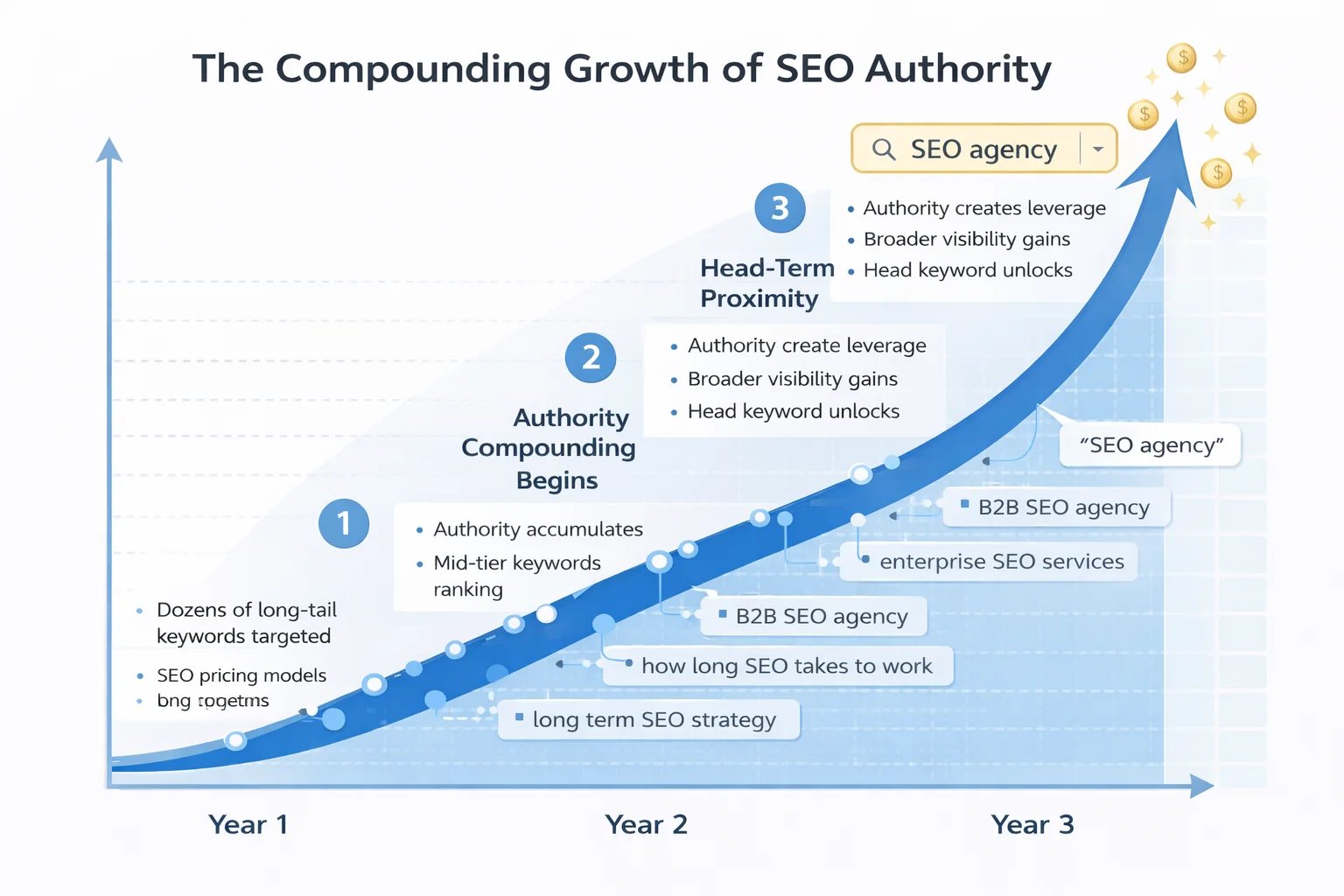
Year 1: Foundation phase
Suppose a company publishes and ranks for 40 long-tail articles averaging 30 searches per month.
Total searchable demand: 1,200 searches/month
Realistic organic CTR (top-3 mix): ~20%
Monthly traffic gained: ~240 visitors
At a $15 CPC benchmark, the paid equivalent is roughly: 240 × $15 ≈ $3,600/month in traffic value.
Note: The $15 CPC benchmark is derived from the head term (“SEO agency”) and is used only as a directional economic reference. Long-tail keywords typically have lower CPCs due to reduced competition and narrower intent, so their individual paid value would likely be lower in practice.
Year 2: Authority compounding begins
Because all pages reinforce the same topic cluster: new articles rank faster, existing pages move up, internal links strengthen relevance. Traffic does not grow linearly. Rankings start expanding beyond the original targets.
Now the site begins ranking for mid-tier keywords:
best SEO agency for SaaS
B2B SEO agency
enterprise SEO services
These keywords were never directly targeted.
Traffic might grow from 240 → 1,500 monthly organic visits without proportional content output.
Year 3: Head-term proximity
At this stage, Google no longer evaluates pages individually but treats the domain as an authority in the topic. The site begins appearing for broader commercial queries — including variations of “SEO agency.”
Even partial visibility on high-volume keywords now drives more traffic than all early long-tails combined. This is the compounding moment:
Early content created relevance
Relevance created authority
Authority unlocked competitive demand
Paid advertising can generate traffic immediately. But compound SEO builds an asset that increases in value as your authority expands.
How to test compound SEO for your own company
If you want to experiment with this approach, follow this structure. Here are the steps to follow:
Define one core topic your business wants to own. Not ten. One.
Map fifty to one hundred related keywords across difficulty levels, focusing initially on low to moderate competition terms with clear intent.
Group those keywords into clusters so that each article strengthens others through internal linking.
Publish consistently within that cluster for at least six months without shifting direction.
Monitor impression growth, keyword expansion, and cluster level performance rather than obsessing over one hero keyword.
The goal is to build a long term SEO foundation that makes growth predictable rather than volatile. The goal is to expand your natural tier.
What compound SEO really builds
Compound SEO does not produce dramatic spikes. It builds stability you can rely on.
When your organic traffic is distributed across dozens or even hundreds of semantically related keywords, your risk profile changes. You are no longer dependent on one high volume keyword or one “hero page” that carries the majority of your visibility. If that page drops a few positions after an update, your entire acquisition channel does not collapse with it.
This is where compound SEO creates real strategic value. Instead of concentrating traffic in one competitive query, you spread relevance across a topic. Each article reinforces the others and each ranking supports the cluster. The result is a portfolio effect in organic search.
Think of it this way. If ninety percent of your traffic comes from one keyword, you do not have a strategy. You have exposure. But if that same traffic is generated by a wide base of related terms across multiple pages, your visibility becomes layered. Algorithm updates might shift individual rankings, but the system as a whole remains intact.
This is what resilience looks like in SEO. It doesn't mean that you are immune to fluctuation but you will have a reduced vulnerability to single points of failure.
And that is where compound growth becomes powerful. Not because it creates sudden surges, but because it creates predictable expansion built on structure rather than luck.
The long game wins quietly
Compound SEO rarely feels exciting at the start, especially for those expecting short term SEO results. There are no sudden traffic explosions, no overnight rankings, no huge wins you can screenshot after week two. It does not offer shortcuts, and it certainly does not reward impatience. What it does offer is alignment with how trust actually develops. And since the search, at its core, runs on trust. Google rewards patterns of reliability.
Those patterns are built through consistency. When a website repeatedly publishes content that satisfies intent within a clear topic, small signals begin to accumulate. Growth stops depending on individual articles and starts emerging from the strength of the system itself.
This is why compound SEO often goes unnoticed until momentum suddenly becomes visible. What looks like slow progress is actually foundation building. Months of modest rankings and incremental improvements create the conditions for larger opportunities to appear naturally. By the time traffic meaningfully accelerates, the work that enabled it has already been happening for a long time.
In the end, compound SEO is less about chasing results and more about becoming predictable in the eyes of search engines. When reliability becomes clear, visibility follows. And while the process may feel quiet at first, the advantage it creates is anything but small.

Daniel Rojo

Frequently asked questions
Explore other blogs






Rotterdam
Bierstraat 123 C
Valencia Carrer del Prof. Beltrán Báguena 5


Flowboost 2026 ~ All rights reserved.