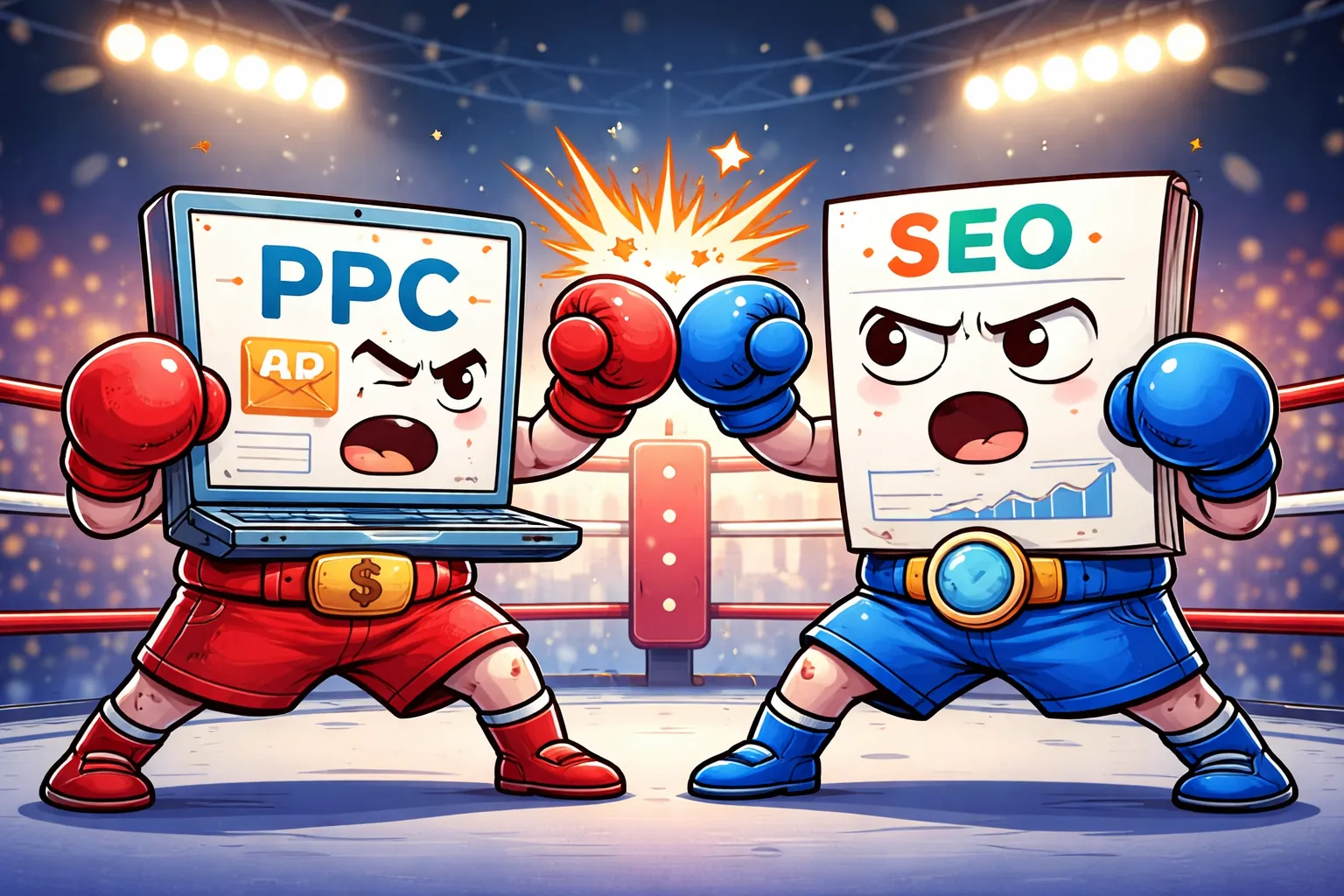
PPC vs SEO: different roles, same goal
PPC (Pay-Per-Click) and SEO (Search Engine Optimization) both play an important role in search marketing, but they work in different ways and have different goals.
PPC: is a paid strategy that allows you to quickly appear in search results. With PPC, you pay for ads that appear at the top of the search page. These ads can go live quickly, driving traffic to your website almost immediately. You have full control over the keywords you target, the message in your ads, and when and to whom they are shown. This makes PPC particularly effective for attracting people who want to buy or take action quickly.
SEO: on the other hand, focuses on improving your position in the organic (non-paid) search results. This is done by investing in quality content, technical website performance, and the authority of your pages. SEO takes time, but the result is sustainable: you slowly build more visibility and trust with both search engines and visitors, without having to pay for each click.
When you use PPC and SEO together, PPC gives you the ability to gather quick data and build momentum, while SEO provides a solid foundation for long-term results.
Do they have an impact on each other?
One of the most common questions when it comes to PPC and SEO is whether the two channels affect each other. The short answer is: yes, but mostly in indirect ways.
Does PPC impact SEO?
Running PPC campaigns does not directly influence organic rankings. Google clearly states that paid advertising has no impact on how websites rank in organic search results (Google Search Central). However, PPC can still support SEO indirectly by influencing visibility, behavior, and data-driven decisions.
Increased Click-Through Rates (CTR): When a brand appears in both paid ads and organic results, users are more likely to recognize and trust it. This often leads to higher engagement across search results. While Google does not confirm CTR as a direct ranking factor, it does emphasize relevance and user satisfaction as core principles of search.
Data for SEO optimizations: PPC provides fast and reliable performance data. Keywords that convert well in paid campaigns highlight search intent and commercial value. These insights can be used to refine SEO content, prioritize keyword targets, and improve existing pages. This practical connection between PPC and SEO is widely recognized in the industry.
Does SEO impact PPC?
The relationship also works in the opposite direction. Strong SEO foundations can directly improve PPC efficiency.
Lower CPC through Quality Score: Google Ads uses Quality Score to determine ad rank and cost per click. Quality Score is influenced by ad relevance, expected click-through rate, and landing page experience (Google Ads Help).
Well-optimized SEO pages often score higher on relevance and usability, which can lead to lower CPCs in PPC campaigns.
Better landing pages for PPC: SEO improvements such as clearer content structure, faster load times, and stronger alignment with search intent directly benefit PPC landing pages. Pages that perform well organically often convert better in paid campaigns because they already meet user expectations.
Keyword performance insights: Organic search data reveals which queries consistently drive traffic and engagement. These insights can inform PPC keyword selection, helping advertisers focus budget on terms that are already proven to resonate with users.
One shared keyword strategy based on intent
Effective collaboration between PPC and SEO starts with a well-structured keyword strategy. Instead of keeping PPC and SEO keyword lists separate, it’s crucial to map keywords based on search intent. Here’s how to approach it:
Step 1: Comprehensive Keyword Research
The first step in any search strategy is to conduct thorough keyword research. This includes analyzing both search intent and search volume to select the most relevant keywords for your business. Keywords should be classified into different categories based on their role in the buyer’s journey:
Informational or mid-funnel keywords (e.g., “how to improve conversion rates”) will often be ideal for driving organic traffic through SEO. These keywords are usually best suited for blog content and educational resources.
Transactional or high-intent keywords (e.g., “buy marketing software”) are perfect for PPC campaigns, as they directly target users with purchase intent and are more likely to drive immediate conversions.
Step 2: Content Creation Based on Search Intent
Blog posts: Use keywords that are typically informational or mid-funnel and are best used in blog posts to drive long-term organic traffic. These keywords often have lower competition and help build topical authority over time. Blog content should focus on education and insights, nurturing users before they are ready to convert.
2. Landing pages: Focus on keywords that are usually transactional or high-value and should be targeted on landing pages where the primary goal is conversion. These keywords tend to be more competitive but are essential for PPC and conversion-focused SEO, as they target users with strong purchase intent and deliver measurable results.
Step 3: Optimizing Landing Pages for SEO, PPC, and CRO
Once the keywords are identified, landing pages must be optimized for SEO, PPC, and CRO (Conversion Rate Optimization). Here’s how each element plays a role:
SEO: Ensure the landing page is optimized for the selected keywords. This includes high-quality content, a proper structure with headings, the correct use of tags (e.g., H1, H2), meta descriptions, and internal linking. SEO optimizations help these pages rank organically over time, driving free, consistent traffic.
PPC: Landing pages for PPC campaigns should be designed to maximize conversions. This includes having a clear value proposition, strategically placed CTAs (Call to Actions), and alignment with the intent behind the PPC ads. These pages should provide the user with a seamless experience that directly leads to conversion, whether that’s completing a purchase, signing up for a service, or contacting the business.
CRO: To maximize conversions, the landing page should be simple to navigate, visually appealing, and straightforward in guiding users through the conversion process. This could mean having easy access to forms, purchase buttons, or other key action points that direct the user towards their goal.
Step 4: Combined Use of PPC and SEO
Now that the keywords and landing pages are optimized, both PPC and SEO can be used strategically:
PPC for Quick Data Collection: Launch PPC campaigns using the optimized landing pages to start bringing traffic and gather fast insights. PPC allows teams to test keywords, messaging, value propositions, and creative elements such as visuals in applicable formats. The real-time performance data can help fine-tune both PPC campaigns and the broader SEO strategy.
SEO for Long-Term Growth: While PPC is bringing in immediate traffic, SEO should focus on driving organic traffic to those same landing pages. This means working on the content and structure of these pages to improve rankings for the targeted keywords, which will eventually provide free traffic in the long run.
By optimizing landing pages for both PPC and SEO, you can take advantage of quick, measurable data from PPC while simultaneously building long-term, sustainable organic traffic.
Data sharing drives performance
PPC and SEO only work together when data is shared consistently. Without data exchange, both channels operate in isolation and miss optimization opportunities.
Key insights that should flow between teams include:
Search terms and queries: This refers to the keywords users enter to find your website. Sharing search terms between PPC and SEO teams helps understand which terms are driving value, both in paid and organic search results.
Click-through and conversion rates: CTR (Click-Through Rate) shows how often users click on your ad or organic link, while conversion rate indicates how many of those clicks lead to a desired action (e.g., a purchase or sign-up). Sharing this data helps identify which messages and keywords are performing well and which need adjustments.
Pages with strong engagement or conversion performance: This refers to the pages on your site that are performing well in terms of user engagement (such as clicks or scrolls) or conversions (e.g., purchases or sign-ups). PPC and SEO teams can use this information to determine which landing pages work best and which need optimization.
Cost efficiency and revenue impact by keyword: This involves measuring the cost per click (CPC) in PPC campaigns and how these costs relate to the revenue generated. Sharing this data helps both SEO and PPC teams understand which keywords are cost-effective and where the highest returns or savings can be achieved.
Organic queries with commercial potential: These are organic search queries that have commercial value, such as keywords that lead users to your product or service but that you may not be ranking well for yet. PPC can help drive traffic to these keywords, while SEO strategies can be applied to improve rankings over the long term.
This shared data creates a continuous feedback loop. PPC delivers fast performance signals, while SEO translates those signals into long-term gains.
Landing pages are a shared responsibility
Landing pages sit at the intersection of PPC and SEO and play a decisive role in conversion performance.
For PPC, message match is key. The promise made in the ad must be clearly reflected on the landing page. When this alignment breaks, conversion rates drop and costs per click increase.
For SEO, strong content alone is not enough. Pages must guide users toward a clear action. Without a visible conversion path, valuable organic traffic produces limited business impact.
Effective landing pages balance clarity and context. While PPC campaigns may focus on driving conversions quickly, SEO optimization provides depth and authority, ensuring that the content is useful for both search engines and users. AB testing is often carried out on these pages to refine and improve the user experience, testing variations of content and design to optimize for both paid and organic traffic.
SERP dominance on strategic keywords
For high-value keywords, visibility in both paid and organic results strengthens performance. Appearing multiple times among the first positions of the search results page increases trust, improves click-through rates, and reduces the likelihood that competitors capture demand.
This approach is especially important for branded searches and commercially critical terms, where maintaining visibility directly protects revenue.
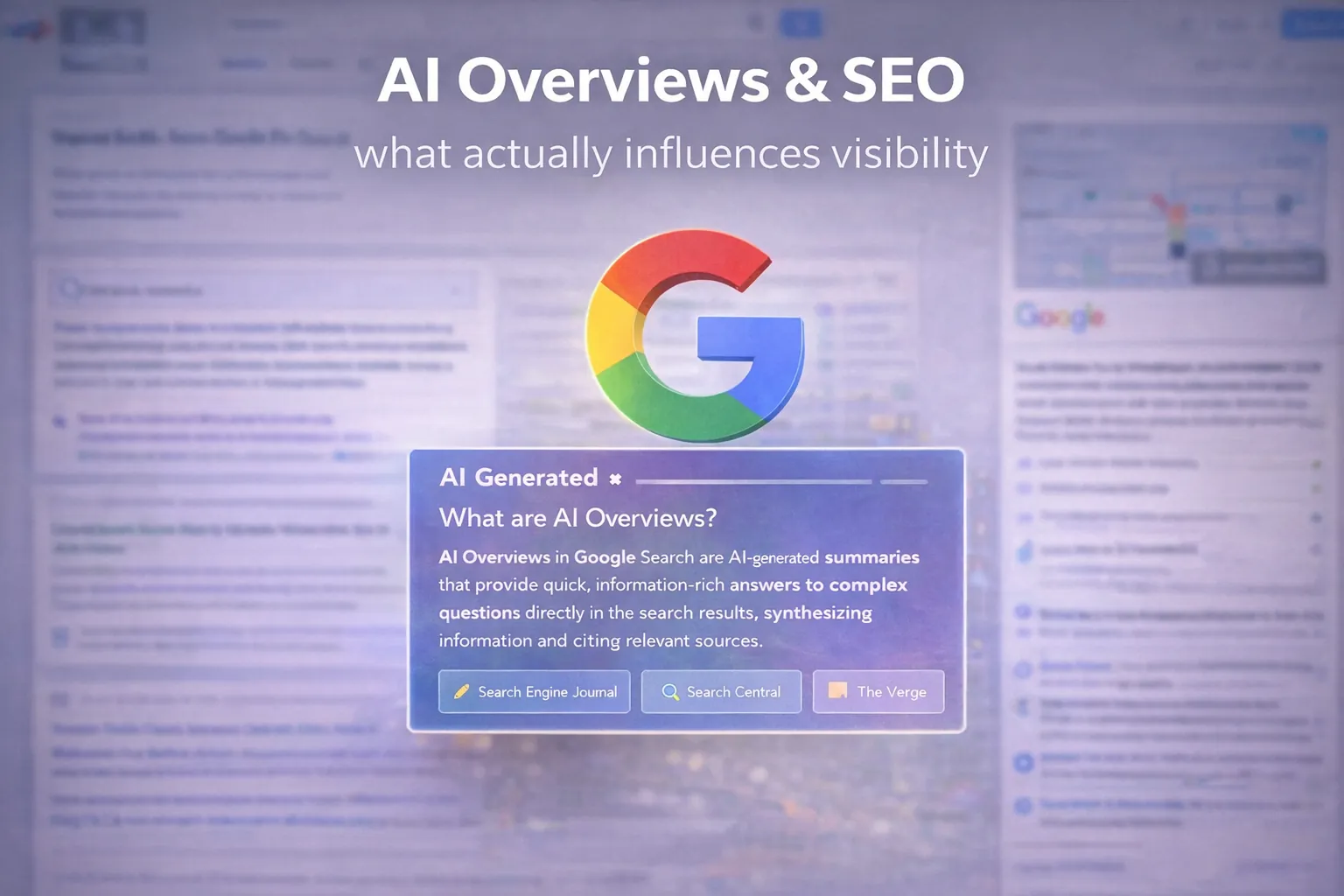
The rollout of AI Overviews
With the rollout of AI overviews, the landscape is shifting. Informational content is becoming more important, and websites are increasingly aiming to be featured in these AI-driven overviews, rather than simply focusing on first-page rankings. Since AI overviews are designed to deliver concise, useful information directly within the search results, websites that target informational and mid-funnel content may see a decrease in CTR from traditional search results, but could benefit from higher visibility in AI-driven features.
Retargeting connects discovery and conversion
SEO often introduces users to a brand early in their decision process. For example, a user might come across a blog post on “how to choose the right running shoes” while doing research on Google. This blog post provides valuable information but doesn’t immediately lead to a purchase. SEO helps build brand awareness and trust, capturing users at the top of the funnel (informational stage).
PPC enables those users to be re-engaged later, when purchase intent is stronger. Let’s say the user returns to their search engine and sees a PPC ad for the exact running shoes mentioned in the blog. Now, they’re further along in their decision-making process and are more likely to click on the ad, with the intent to purchase.
Retargeting bridges the gap between initial discovery and conversion. It ensures that organic traffic continues to contribute value beyond the first visit. For example, if someone visits your website but leaves without making a purchase, retargeting ads can show them personalized ads for the same shoes or related products as they browse other sites, reminding them of their interest and encouraging them to return and complete their purchase.
Measure success at the combined level
Differences in attribution between PPC and SEO are unavoidable. Rather than debating channel-level numbers, performance should be evaluated at the combined level.
Shared KPIs that should be tracked across both PPC and SEO include:
Total Conversions: This KPI measures the number of desired actions completed by users (e.g., purchases, sign-ups, downloads). Both PPC and SEO contribute to conversions, but in different ways. PPC often drives immediate conversions by targeting high-intent users, while SEO focuses on long-term conversion through organic traffic and brand authority. Tracking total conversions across both channels gives a comprehensive view of how well the combined efforts are driving business results.
Total Revenue: Total revenue refers to the overall income generated from all conversions. It’s essential to consider PPC’s direct impact on generating fast sales, especially for transactional keywords. On the other hand, SEO drives steady traffic over time, building revenue as content and rankings improve. By combining both, you get a better understanding of which channel (or combination of channels) is driving the most profitable traffic and conversions.
Blended CPA (Cost per Acquisition): This is the total cost to acquire a customer, combining both PPC and SEO efforts. PPC typically has a clear cost per click, which directly translates into an acquisition cost. SEO, while free in terms of clicks, often requires investment in content creation, optimization, and technical improvements. By combining both costs, blended CPA helps assess the total cost-effectiveness of your search strategy.
Blended ROAS (Return on Ad Spend): ROAS measures the return you get from every dollar spent on advertising. For PPC, ROAS directly shows how much revenue is generated from paid campaigns. For SEO, although no direct ad spend is involved, you can calculate the value of organic traffic (e.g., through an estimated CPC for organic keywords). Combining PPC ROAS with the value of SEO traffic gives a clearer picture of how your overall search strategy is performing in terms of return on investment.
By tracking these shared KPIs across both PPC and SEO, you create a unified understanding of your search performance. This approach keeps teams focused on the end goal, driving revenue and conversions, rather than getting caught up in channel-specific metrics.
Conclusion
PPC and SEO are not competing channels, nor are they interchangeable tactics. They are complementary mechanisms that operate on different time horizons but influence the same outcome: profitable demand capture through search.
When treated as a single system, PPC accelerates learning, validates intent, and captures high-value demand, while SEO compounds those insights into durable visibility, trust, and cost efficiency. The strongest results emerge when keyword strategy, landing pages, data, and performance measurement are shared—not siloed.
As search evolves with AI overviews, changing SERP layouts, and longer decision journeys, the risk of managing PPC and SEO separately only increases. Visibility, attribution, and conversion paths are no longer linear, and success depends on how well both channels reinforce each other across the full funnel.
The real advantage lies in execution, not theory: organisations that align PPC and SEO around shared goals, shared data, and shared KPIs move faster, spend smarter, and extract more value from every search interaction.
In modern search marketing, performance doesn’t come from choosing between PPC or SEO—it comes from designing them to work as one.