Tools

Tourism SEO: A travel guide to organic discovery
Tourism SEO: A travel guide to organic discovery

Tourism SEO: A travel guide to organic discovery

By

Daniel Rojo

Mar 6, 2026

10 minutes

Daniel Rojo

Mar 6, 2026

10 minutes

Contents

No headings found

Coumpound SEO blog post's cover picture

Picture this.

You arrive in a city you have never visited before. The streets are unfamiliar, the restaurants unknown, and every corner promises something interesting. Instead of wandering randomly, you pull out your phone and open Google.

Within seconds, the city starts to reveal itself.

You search for things like 

best restaurants in London

things to do in Valencia

hidden cafés in Amsterdam

Photos appear, reviews pop up, and lists of recommendations fill your screen. Suddenly the city no longer feels unfamiliar. It feels curated. Search has quietly replaced the traditional travel guide. Travelers no longer rely on hotel brochures or printed guidebooks. Instead, they follow the digital paths created by search engines, maps, and increasingly, social platforms. The places that appear in those results become the places travelers actually visit.

But behind those recommendations sits a layer of search behavior many businesses rarely think about. Some companies understand Travel SEO, which focuses on travelers planning their trip. Others focus on Local SEO, helping nearby customers find them in search results.

Yet there is a moment between those two worlds that often goes unnoticed. The moment when travelers arrive in a destination and begin exploring it through search.This is where Tourism SEO lives. Tourism SEO is the practice of optimizing a business so travelers can discover it through destination searches, Google Maps results, and social discovery platforms.

Tourism SEO sits at the intersection of travel search and local discovery. It determines whether a restaurant becomes a place tourists actively seek out, or a hidden gem that remains invisible despite being only one street away. Tourism search usually happens across four discovery layers:

  1. Destination search: Google searches such as best restaurants in Rome.

  2. AI discovery (LLM search): Travelers ask AI assistants for suggestions instead of browsing lists.

  3. Navigation search: Google Maps searches like restaurants near me.

  4. Social discovery: TikTok or Instagram recommendations.

These four layers shape how travelers discover places in unfamiliar cities.

Think of this article as a travel guide. Not for tourists navigating a city, but for businesses trying to understand how travelers actually discover places through search. Because today, the map travelers follow is digital. And Tourism SEO determines whether your business appears on it.

Stop 1: Understanding tourism search behavior

Every trip begins with curiosity.

Travelers rarely arrive in a new city with a complete list of places they already know. Instead, they explore. They search for recommendations, compare options, and rely heavily on search to guide their decisions. Although travelers have traditionally relied on search engines like Google Search, the emergence of AI platforms such as ChatGPT, Google Gemini, and Perplexity AI is beginning to reshape how people discover places while traveling.

This behavior creates what is often called destination search.

Instead of searching for a specific business, travelers search for experiences within a location. Their queries are broad, exploratory, and focused on discovery. A visitor in Rome might search for; best restaurants in Rome, while someone exploring Amsterdam might look for things to do in Amsterdam or hidden gems in Amsterdam.
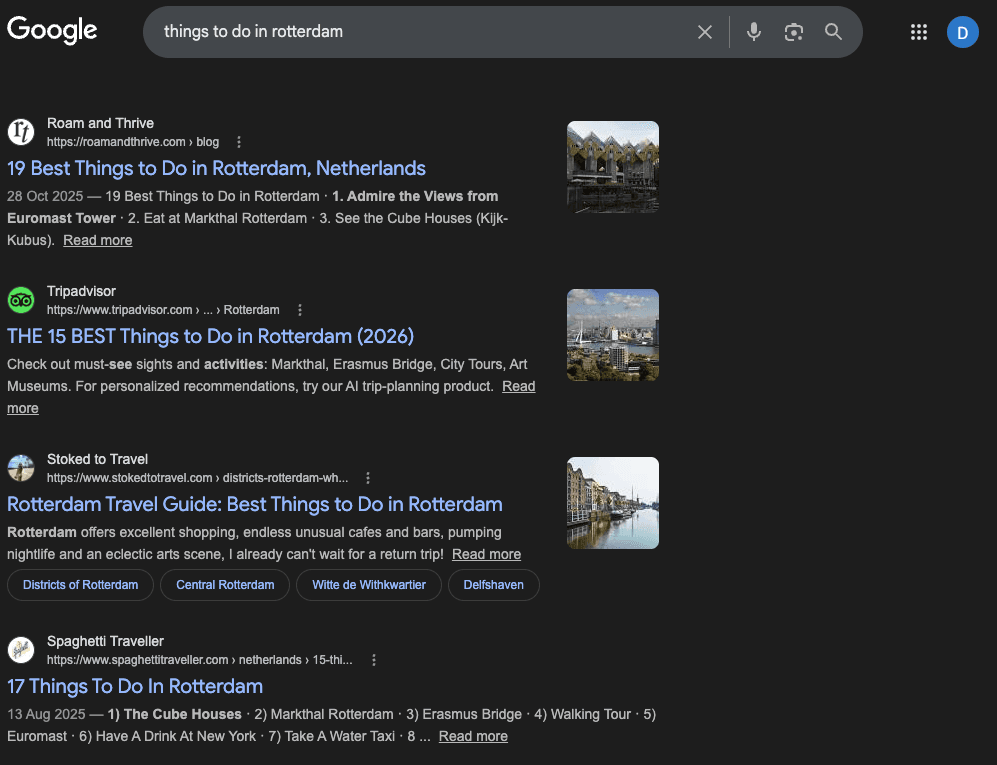
Google search results for "things to do in Rotterdam"

These searches are fundamentally different from traditional local queries.

Locals already understand the city around them. They know which neighborhoods exist, which streets are busy, and which places they usually visit. Their searches are therefore more direct. Someone living in Utrecht might search for Italian restaurant Utrecht or simply coffee near me because they already know the environment.

Travelers search differently because they lack that context.

They rely on search results to help them navigate the city itself. Reviews, photos, curated lists, and recommendation articles all influence their decisions. In many cases, the places that appear in those results become the experiences travelers ultimately choose.

This is the foundation of Tourism SEO.

Businesses that appear in these discovery searches become part of the traveler’s journey. Businesses that do not appear simply remain invisible for them. 

Practical insight

Destination searches usually contain three types of signals:

  • recommendation signals (best, top, hidden gems)

  • activity signals (things to do, places to visit)

  • category signals (restaurants, cafés, attractions)

These signals reveal what travelers are actually looking for: guidance.

Apply this yourself

Search Google for:

  • best [your service] in [your city]

  • [your service] in [your city]

  • things to do in [your city]

Look at the results that appear.

If your business does not show up in those searches, travelers are unlikely to discover it, no matter how good your service might be.

Stop 2: Travel SEO vs tourism SEO

To understand Tourism SEO properly, it helps to separate it from another concept that often overlaps with it: Travel SEO.

Travel SEO focuses on the planning stage of a trip. Airlines, booking platforms, travel blogs, and booking sites compete for searches such as:

  • Flights to Barcelona

  • Hotel rooms in Tenerife

  • Best time to visit Lisbon

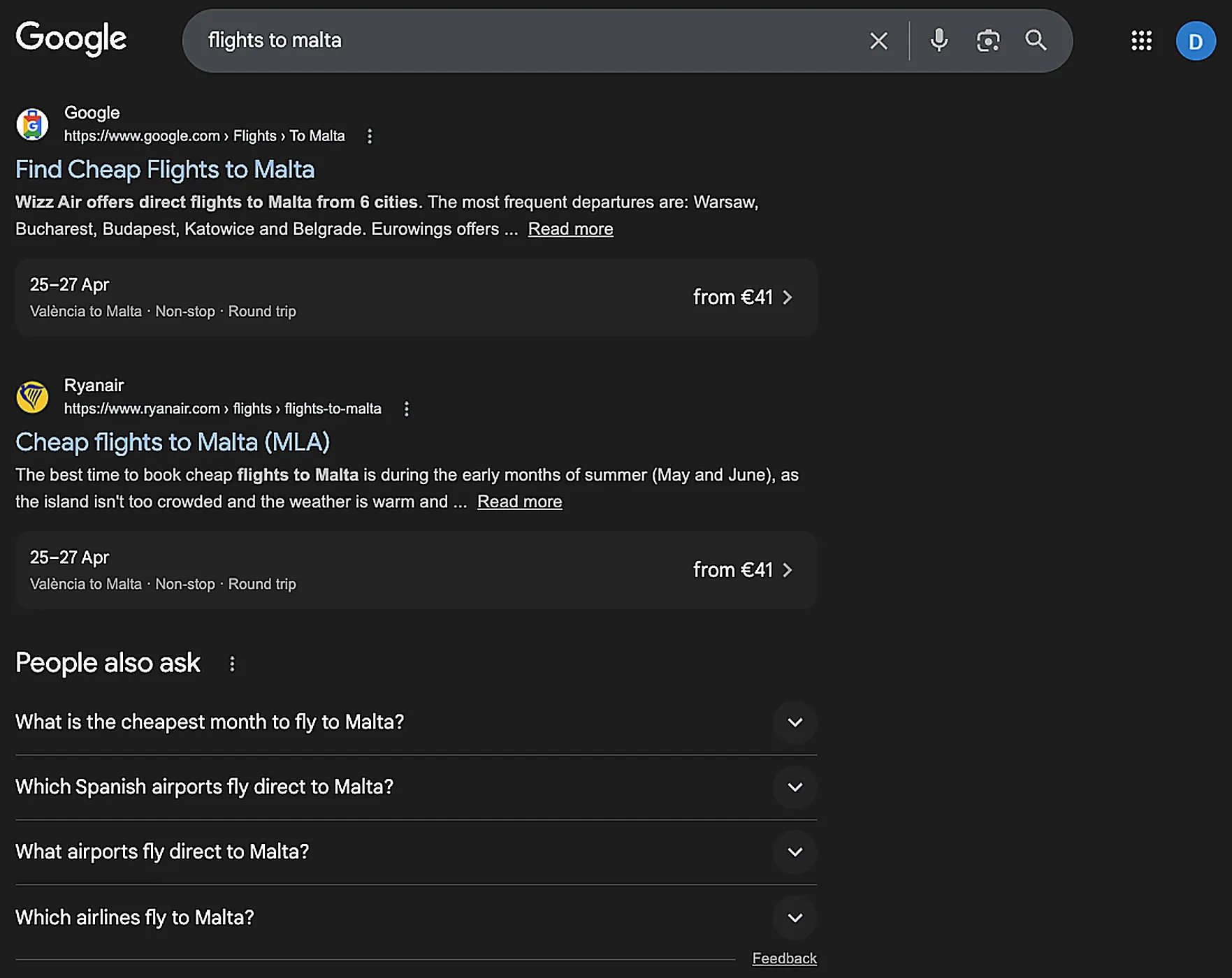
Google search results for "flights to Malta"

These searches happen weeks or even months before someone arrives at the destination. For businesses in the travel industry, Tourism SEO has become one of the most important forms of travel industry SEO.

Tourism SEO happens later in that journey.

Once travelers have chosen a destination, their search behavior shifts from planning to discovery. Instead of researching how to get somewhere, they start looking for what they should actually experience in the city.

Searches begin to look like this:

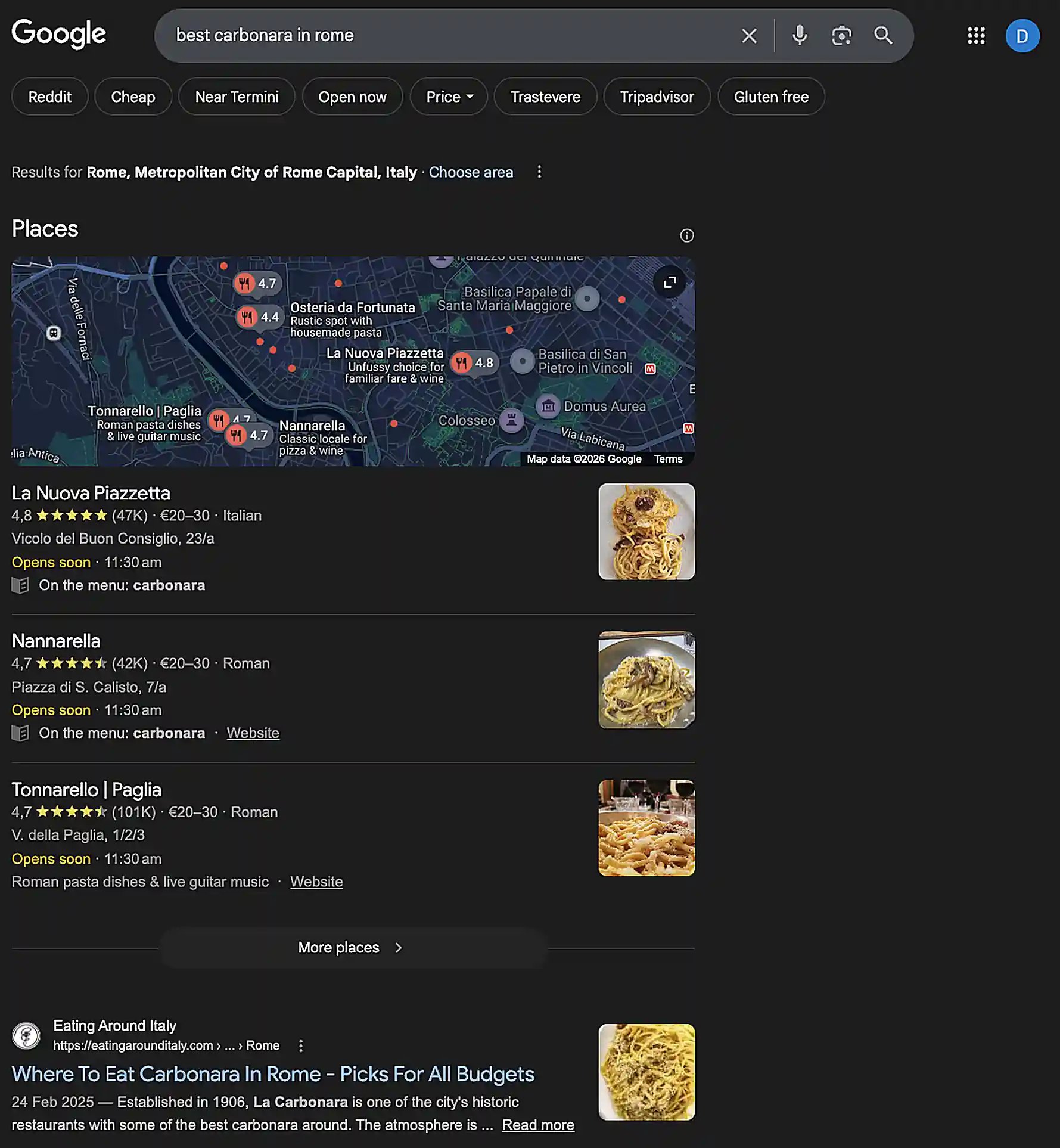
  • Best carbonara in Rome

  • Johan Cruyff Arena tour

  • Surfing lessons in Lisbon

These queries are no longer about the trip itself. They are about exploring the destination. So this is where Tourism SEO becomes crucial for local businesses.

Travel SEO attracts visitors before they arrive. Tourism SEO determines which places they visit once they are there.

Apply this yourself

Search Google for a query like:

  • best restaurants in [your city]

Look at the results carefully.

You will often see that the top positions are not only restaurants. Many results are travel blogs, curated lists, or city guides. These pages influence which places travelers decide to visit.

Stop 3: The real tourist map (aka Google Maps)

Once travelers arrive, their search behavior transitions from "research" to "navigation". At this stage, Google Maps becomes the primary digital interface for the city. The decision-making process happens almost entirely within the map, often without the traveler ever visiting a business's website.

The "near me" economy

Travelers use broad, location-driven queries to explore their immediate surroundings. The sheer scale of these intent-driven searches highlights the necessity of Google Maps SEO:
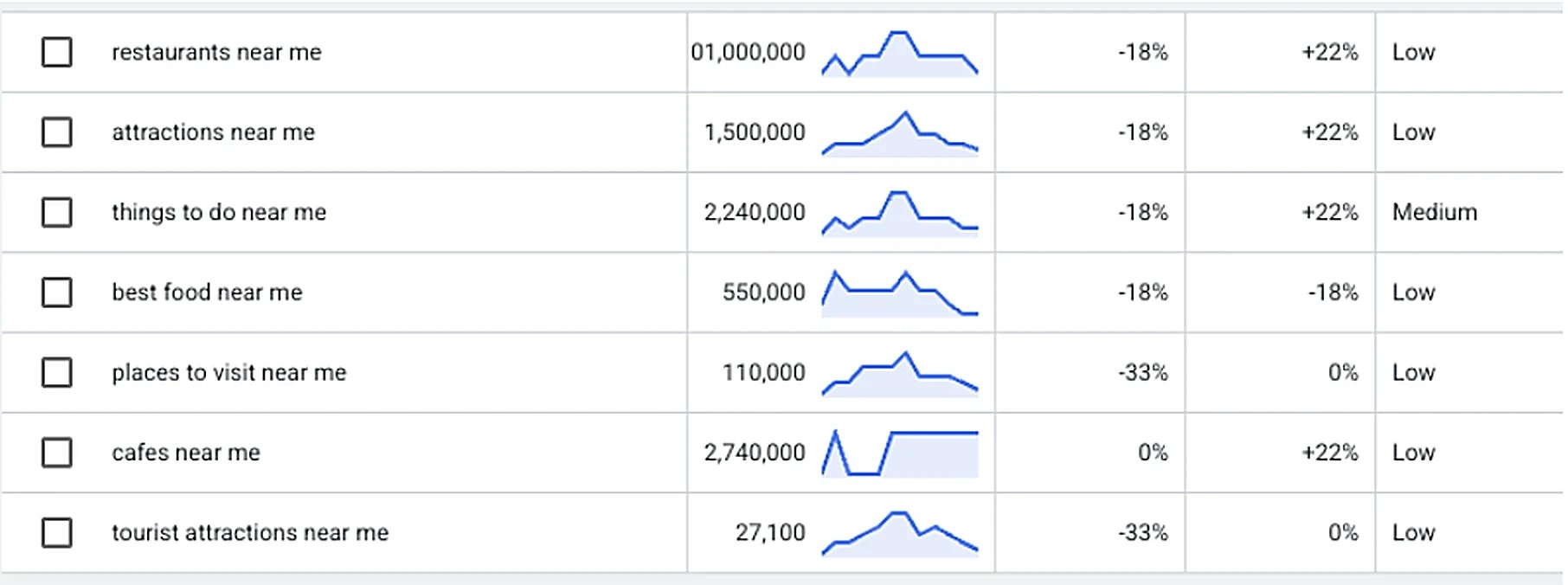
Search volume of different keywords from Google Ads

To capture this traffic, your Google Business Profile must act as a high-conversion storefront. Travelers optimize their choices based on three specific trust signals:

  • The Rating Score: High stars are the first filter.

  • The Review Volume: A high count (e.g., 4.6 stars with 500 reviews) often beats a perfect 5.0 with only 5 reviews.

  • Visual Proof: High-quality photos of the food, interior, or experience are the final nudge for a "visit".

Practical insight

Tourists usually make decisions based on three signals:

  • rating score

  • number of reviews

  • photos of the experience

A business with 4.6 stars and hundreds of reviews often wins over one with 4.9 stars but only a few ratings.

Apply this yourself

Open Google Maps and search for your category in your city.

Look at the top results and ask yourself:

  • Do I appear in these results?

  • Is my profile targeting the right keywords?

  • Do my photos look attractive compared to competitors?

  • Do I have enough reviews to build trust?

Stop 4: Social search on TikTok and Instagram

Tourism discovery not only happens on Google and ChatGPT.

Increasingly, travelers search directly on social platforms such as TikTok, Instagram, and YouTube. Instead of reading written guides, many travelers now watch short videos showing food spots, cafés, or hidden locations in a city.

This shift has created what can be described as social search. A single viral video can suddenly turn an unknown café into a tourist hotspot. Travelers save these videos, share them with friends, and visit the locations they see online.

If you search TikTok for phrases like:

  • Specialty coffee Barcelona

  • hidden spots Paris

  • Amsterdam food guide

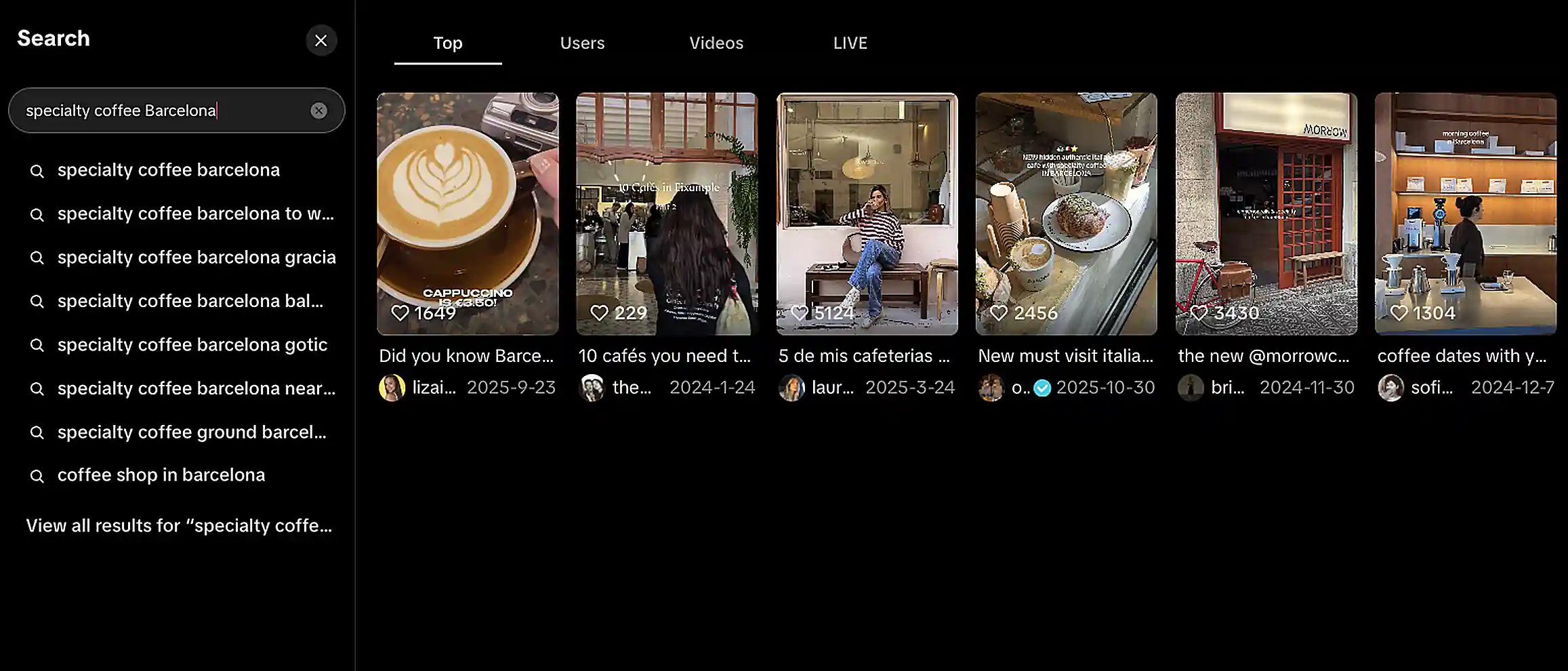
Tiktok search results for "specialty coffee in Barcelona"

You will often see the same locations appear repeatedly. These places become social landmarks in the city. Many travelers now discover places on TikTok first and only use Google Maps afterward to navigate to the location.

Practical insight

Social platforms influence discovery long before someone opens Google.

Many travelers now search TikTok first to find interesting places and then use Google Maps to navigate to them.

Apply this yourself

Search your city on TikTok or Instagram.

Look for videos featuring restaurants, cafés, or attractions in your area. Notice which locations appear frequently and how they are presented.

Stop 5: Content that attracts travelers before they arrive

Not all tourism discovery happens during the trip itself.

Many travelers research a destination days or even weeks before they arrive. During this stage, they look for inspiration and build a mental list of places they want to visit.

Searches like these are common:

  • What to do in Dublin

  • How to spend a weekend in London

  • Ideas for a romantic getaway in Paris

  • family activities Lisbon

These searches often lead to blog articles, travel guides, and curated lists. Businesses mentioned in these guides gain a powerful advantage. By the time travelers arrive, those places are already familiar and may even be saved in their itinerary.

This is where content-driven Tourism SEO becomes valuable for companies, it should be the foundation of their tourism marketing strategy. 

Creating content around tourism searches increases the chances that travelers encounter your business during their planning phase.

Practical insight

Content targeting tourism queries often performs well because it combines local relevance with travel intent.

Apply this yourself

Search Google for tourism-style queries related to your city. Look at what types of pages appear. Are they travel blogs, list articles, or local guides? These pages reveal the types of content travelers rely on when deciding where to go.

Stop 6: Tourism SEO mistakes businesses often make

Despite the opportunities Tourism SEO offers, many businesses overlook it. One common mistake is focusing exclusively on local customers. Businesses focus only on traditional local search optimization, such as restaurant Utrecht or coffee near me. When ignoring tourism discovery queries businesses will lose a large group of potential visitors.

Another mistake is ignoring discovery searches. Ranking for your business name does not help travelers who have never heard of you. Queries like best restaurants in Prague or things to do in Madrid often influence where visitors actually go.

Review management is another overlooked factor. Travelers rely heavily on reviews when choosing places to visit. A low review count or outdated profile can discourage visitors even if the business itself offers an excellent experience.

Practical insight

Tourists tend to trust collective signals.

Large review counts, consistent ratings, and active profiles create confidence for visitors who have no prior knowledge of the business.

Apply this yourself

Search your city and category in Google or Google Maps.

Compare your business with competitors and check:

  • review count

  • star rating

  • photo quality

  • activity level

These signals strongly influence whether travelers decide to visit.

Stop 7: From hidden gem to tourist landmark

Every city has hidden gems. Small cafés, restaurants, and attractions that locals love but travelers rarely discover. In the past, finding these places depended on coincidence or recommendations from locals.

But today, discovery happens through search. Travelers follow the places that appear consistently across Google, Maps, and social platforms. The businesses that show up across these channels become the landmarks of the digital city.

Not necessarily because they are the best. But because they are the most visible. Tourism SEO determines whether a business becomes part of that digital landscape. And when travelers search for experiences in a city, the places they encounter first often become the places they remember.

Tourism SEO packing checklist

Think of this as your Tourism SEO travel checklist.

Before travelers arrive in your city, ask yourself the following questions.

Visibility

  • Do I appear for searches like best [service] in [city]?

  • Does my business appear in Google Maps results?

Trust

  • Do I have recent reviews and strong ratings?

  • Do my photos clearly show the experience visitors will have?

Discovery

  • Is my business mentioned in travel guides or blogs?

  • Does my website include content targeting tourism searches?

Social search

  • Do people tag my location on TikTok or Instagram?

  • Does my business appear in city food or attraction videos?

If several answers are no, your business may still be a hidden gem.

But in the age of digital discovery, hidden gems are rarely found unless search leads travelers there.


Daniel Rojo avatar picture

Daniel Rojo

LinkedIn author:

Meet Wolfy

Triple your productivity with Wolfy, the dedicated Google Ads agent.

Read more

Contents

No headings found

Coumpound SEO blog post's cover picture

Picture this.

You arrive in a city you have never visited before. The streets are unfamiliar, the restaurants unknown, and every corner promises something interesting. Instead of wandering randomly, you pull out your phone and open Google.

Within seconds, the city starts to reveal itself.

You search for things like 

best restaurants in London

things to do in Valencia

hidden cafés in Amsterdam

Photos appear, reviews pop up, and lists of recommendations fill your screen. Suddenly the city no longer feels unfamiliar. It feels curated. Search has quietly replaced the traditional travel guide. Travelers no longer rely on hotel brochures or printed guidebooks. Instead, they follow the digital paths created by search engines, maps, and increasingly, social platforms. The places that appear in those results become the places travelers actually visit.

But behind those recommendations sits a layer of search behavior many businesses rarely think about. Some companies understand Travel SEO, which focuses on travelers planning their trip. Others focus on Local SEO, helping nearby customers find them in search results.

Yet there is a moment between those two worlds that often goes unnoticed. The moment when travelers arrive in a destination and begin exploring it through search.This is where Tourism SEO lives. Tourism SEO is the practice of optimizing a business so travelers can discover it through destination searches, Google Maps results, and social discovery platforms.

Tourism SEO sits at the intersection of travel search and local discovery. It determines whether a restaurant becomes a place tourists actively seek out, or a hidden gem that remains invisible despite being only one street away. Tourism search usually happens across four discovery layers:

  1. Destination search: Google searches such as best restaurants in Rome.

  2. AI discovery (LLM search): Travelers ask AI assistants for suggestions instead of browsing lists.

  3. Navigation search: Google Maps searches like restaurants near me.

  4. Social discovery: TikTok or Instagram recommendations.

These four layers shape how travelers discover places in unfamiliar cities.

Think of this article as a travel guide. Not for tourists navigating a city, but for businesses trying to understand how travelers actually discover places through search. Because today, the map travelers follow is digital. And Tourism SEO determines whether your business appears on it.

Stop 1: Understanding tourism search behavior

Every trip begins with curiosity.

Travelers rarely arrive in a new city with a complete list of places they already know. Instead, they explore. They search for recommendations, compare options, and rely heavily on search to guide their decisions. Although travelers have traditionally relied on search engines like Google Search, the emergence of AI platforms such as ChatGPT, Google Gemini, and Perplexity AI is beginning to reshape how people discover places while traveling.

This behavior creates what is often called destination search.

Instead of searching for a specific business, travelers search for experiences within a location. Their queries are broad, exploratory, and focused on discovery. A visitor in Rome might search for; best restaurants in Rome, while someone exploring Amsterdam might look for things to do in Amsterdam or hidden gems in Amsterdam.

Google search results for "things to do in Rotterdam"

These searches are fundamentally different from traditional local queries.

Locals already understand the city around them. They know which neighborhoods exist, which streets are busy, and which places they usually visit. Their searches are therefore more direct. Someone living in Utrecht might search for Italian restaurant Utrecht or simply coffee near me because they already know the environment.

Travelers search differently because they lack that context.

They rely on search results to help them navigate the city itself. Reviews, photos, curated lists, and recommendation articles all influence their decisions. In many cases, the places that appear in those results become the experiences travelers ultimately choose.

This is the foundation of Tourism SEO.

Businesses that appear in these discovery searches become part of the traveler’s journey. Businesses that do not appear simply remain invisible for them. 

Practical insight

Destination searches usually contain three types of signals:

  • recommendation signals (best, top, hidden gems)

  • activity signals (things to do, places to visit)

  • category signals (restaurants, cafés, attractions)

These signals reveal what travelers are actually looking for: guidance.

Apply this yourself

Search Google for:

  • best [your service] in [your city]

  • [your service] in [your city]

  • things to do in [your city]

Look at the results that appear.

If your business does not show up in those searches, travelers are unlikely to discover it, no matter how good your service might be.

Stop 2: Travel SEO vs tourism SEO

To understand Tourism SEO properly, it helps to separate it from another concept that often overlaps with it: Travel SEO.

Travel SEO focuses on the planning stage of a trip. Airlines, booking platforms, travel blogs, and booking sites compete for searches such as:

  • Flights to Barcelona

  • Hotel rooms in Tenerife

  • Best time to visit Lisbon

Google search results for "flights to Malta"

These searches happen weeks or even months before someone arrives at the destination. For businesses in the travel industry, Tourism SEO has become one of the most important forms of travel industry SEO.

Tourism SEO happens later in that journey.

Once travelers have chosen a destination, their search behavior shifts from planning to discovery. Instead of researching how to get somewhere, they start looking for what they should actually experience in the city.

Searches begin to look like this:

  • Best carbonara in Rome

  • Johan Cruyff Arena tour

  • Surfing lessons in Lisbon

These queries are no longer about the trip itself. They are about exploring the destination. So this is where Tourism SEO becomes crucial for local businesses.

Travel SEO attracts visitors before they arrive. Tourism SEO determines which places they visit once they are there.

Apply this yourself

Search Google for a query like:

  • best restaurants in [your city]

Look at the results carefully.

You will often see that the top positions are not only restaurants. Many results are travel blogs, curated lists, or city guides. These pages influence which places travelers decide to visit.

Stop 3: The real tourist map (aka Google Maps)

Once travelers arrive, their search behavior transitions from "research" to "navigation". At this stage, Google Maps becomes the primary digital interface for the city. The decision-making process happens almost entirely within the map, often without the traveler ever visiting a business's website.

The "near me" economy

Travelers use broad, location-driven queries to explore their immediate surroundings. The sheer scale of these intent-driven searches highlights the necessity of Google Maps SEO:

Search volume of different keywords from Google Ads

To capture this traffic, your Google Business Profile must act as a high-conversion storefront. Travelers optimize their choices based on three specific trust signals:

  • The Rating Score: High stars are the first filter.

  • The Review Volume: A high count (e.g., 4.6 stars with 500 reviews) often beats a perfect 5.0 with only 5 reviews.

  • Visual Proof: High-quality photos of the food, interior, or experience are the final nudge for a "visit".

Practical insight

Tourists usually make decisions based on three signals:

  • rating score

  • number of reviews

  • photos of the experience

A business with 4.6 stars and hundreds of reviews often wins over one with 4.9 stars but only a few ratings.

Apply this yourself

Open Google Maps and search for your category in your city.

Look at the top results and ask yourself:

  • Do I appear in these results?

  • Is my profile targeting the right keywords?

  • Do my photos look attractive compared to competitors?

  • Do I have enough reviews to build trust?

Stop 4: Social search on TikTok and Instagram

Tourism discovery not only happens on Google and ChatGPT.

Increasingly, travelers search directly on social platforms such as TikTok, Instagram, and YouTube. Instead of reading written guides, many travelers now watch short videos showing food spots, cafés, or hidden locations in a city.

This shift has created what can be described as social search. A single viral video can suddenly turn an unknown café into a tourist hotspot. Travelers save these videos, share them with friends, and visit the locations they see online.

If you search TikTok for phrases like:

  • Specialty coffee Barcelona

  • hidden spots Paris

  • Amsterdam food guide

Tiktok search results for "specialty coffee in Barcelona"

You will often see the same locations appear repeatedly. These places become social landmarks in the city. Many travelers now discover places on TikTok first and only use Google Maps afterward to navigate to the location.

Practical insight

Social platforms influence discovery long before someone opens Google.

Many travelers now search TikTok first to find interesting places and then use Google Maps to navigate to them.

Apply this yourself

Search your city on TikTok or Instagram.

Look for videos featuring restaurants, cafés, or attractions in your area. Notice which locations appear frequently and how they are presented.

Stop 5: Content that attracts travelers before they arrive

Not all tourism discovery happens during the trip itself.

Many travelers research a destination days or even weeks before they arrive. During this stage, they look for inspiration and build a mental list of places they want to visit.

Searches like these are common:

  • What to do in Dublin

  • How to spend a weekend in London

  • Ideas for a romantic getaway in Paris

  • family activities Lisbon

These searches often lead to blog articles, travel guides, and curated lists. Businesses mentioned in these guides gain a powerful advantage. By the time travelers arrive, those places are already familiar and may even be saved in their itinerary.

This is where content-driven Tourism SEO becomes valuable for companies, it should be the foundation of their tourism marketing strategy. 

Creating content around tourism searches increases the chances that travelers encounter your business during their planning phase.

Practical insight

Content targeting tourism queries often performs well because it combines local relevance with travel intent.

Apply this yourself

Search Google for tourism-style queries related to your city. Look at what types of pages appear. Are they travel blogs, list articles, or local guides? These pages reveal the types of content travelers rely on when deciding where to go.

Stop 6: Tourism SEO mistakes businesses often make

Despite the opportunities Tourism SEO offers, many businesses overlook it. One common mistake is focusing exclusively on local customers. Businesses focus only on traditional local search optimization, such as restaurant Utrecht or coffee near me. When ignoring tourism discovery queries businesses will lose a large group of potential visitors.

Another mistake is ignoring discovery searches. Ranking for your business name does not help travelers who have never heard of you. Queries like best restaurants in Prague or things to do in Madrid often influence where visitors actually go.

Review management is another overlooked factor. Travelers rely heavily on reviews when choosing places to visit. A low review count or outdated profile can discourage visitors even if the business itself offers an excellent experience.

Practical insight

Tourists tend to trust collective signals.

Large review counts, consistent ratings, and active profiles create confidence for visitors who have no prior knowledge of the business.

Apply this yourself

Search your city and category in Google or Google Maps.

Compare your business with competitors and check:

  • review count

  • star rating

  • photo quality

  • activity level

These signals strongly influence whether travelers decide to visit.

Stop 7: From hidden gem to tourist landmark

Every city has hidden gems. Small cafés, restaurants, and attractions that locals love but travelers rarely discover. In the past, finding these places depended on coincidence or recommendations from locals.

But today, discovery happens through search. Travelers follow the places that appear consistently across Google, Maps, and social platforms. The businesses that show up across these channels become the landmarks of the digital city.

Not necessarily because they are the best. But because they are the most visible. Tourism SEO determines whether a business becomes part of that digital landscape. And when travelers search for experiences in a city, the places they encounter first often become the places they remember.

Tourism SEO packing checklist

Think of this as your Tourism SEO travel checklist.

Before travelers arrive in your city, ask yourself the following questions.

Visibility

  • Do I appear for searches like best [service] in [city]?

  • Does my business appear in Google Maps results?

Trust

  • Do I have recent reviews and strong ratings?

  • Do my photos clearly show the experience visitors will have?

Discovery

  • Is my business mentioned in travel guides or blogs?

  • Does my website include content targeting tourism searches?

Social search

  • Do people tag my location on TikTok or Instagram?

  • Does my business appear in city food or attraction videos?

If several answers are no, your business may still be a hidden gem.

But in the age of digital discovery, hidden gems are rarely found unless search leads travelers there.

Daniel Rojo avatar picture

Daniel Rojo

LinkedIn author:

Meet Wolfy

Triple your productivity with Wolfy, the dedicated Google Ads agent.

Read more

Frequently asked questions

Frequently asked questions