Search Engine Marketing (SEO)

How to write an About Us page that actually builds trust
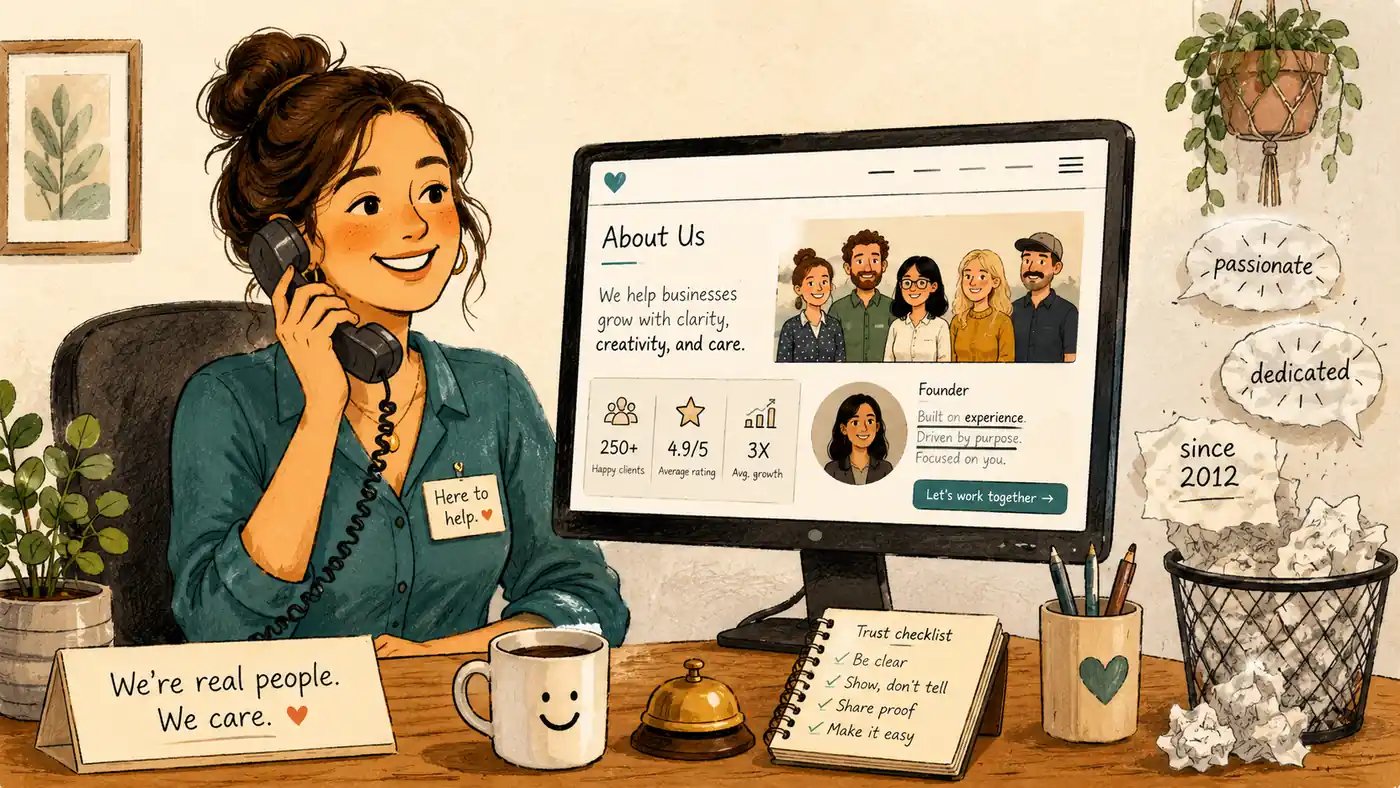
Most About Us pages say "passionate" and "dedicated." Here is what to write instead. And why it matters more than you think.
Someone calls your business. The receptionist picks up. "Good afternoon, we're a passionate and dedicated team with over ten years of experience, committed to excellence in everything we do."
Silence on the line.
That is not a greeting. That is a brochure being read aloud. The caller wanted to know if you could solve their problem. They got a mission statement instead.
Your About Us page is your receptionist. For most businesses, it is one of the most visited pages on the entire site. And for most businesses, it reads exactly like that phone call.
What is an About Us page and why it matters
An About page is a core section of any website whose purpose is to introduce the identity, values, history, and mission of a person, brand, or organization. It is where visitors go to understand who you are, what you do, and why you do it.
What it typically includes:
Origin or story: How the project, company, or brand came to life. The "why" behind its existence.
Mission and vision: What it aims to achieve and where it is headed.
Values: The principles that guide decisions and shape the culture.
The team: The people behind the work, often with names, photos, and roles.
Milestones or achievements: Key moments in the journey so far.
Call to action (CTA): An invitation to get in touch, collaborate, or explore further.
Common alternative names:
About Us
Our Story
Who We Are
About Me (for personal brands)
Meet the Team
Why it matters:
The About page is consistently one of the most visited pages on any website, yet most businesses treat it as a formality. That gap between traffic and effort is exactly where the opportunity lives.
Visitors do not come to the About page for background. They come to make a decision. The silent question they are asking is: can I trust these people enough to take the next step? That makes it both a trust page and a conversion page, the place where a curious visitor either moves forward or quietly leaves.
Think of it like a receptionist. Before any meeting begins, the receptionist has already set the tone. Your About page does the same. Get it right and it humanizes your brand, builds an emotional connection, and turns visitors into customers or followers. Get it wrong and they leave with no explanation and no second chance.
The good news is most About Us pages are so poorly written that even modest improvements create a meaningful difference. The bar is low. The opportunity is large.
Apply this yourself Open your About page right now. Read the first sentence. Does it describe your company, or does it tell the visitor what is in it for them? If it is only about you, that is exactly where the work starts. |
|---|
What most About US pages get wrong
There are three phrases that appear on About pages so often they have become meaningless. You have seen all of them. You may have written them yourself. A good receptionist would not open a call with any of them.
"We are passionate about what we do."
"Our team is our greatest asset."
"We have been in business since [year]."
These sentences have something in common: they do not start introducing the company, they just make a hollow claim without offering any proof. Passion is not a differentiator. Every business says they are passionate and great. Being in business since 1998 is a fact, but a fact without context is just furniture. These sentences tell the visitor nothing about whether you are the right choice for them.
Most About pages are written in I/we language pointed inward at the company. A good About Us page turns that around and speaks directly to the visitor: what they get, what changes for them, why it matters to them.
What to include on your About page
Good About pages are not long. They are structured. A well-briefed receptionist covers the essentials in under a minute: who they are, what they can do for you, and what happens next. Five elements, in roughly this order, do exactly the same.
A clear statement of who you help and how. One or two sentences. Not a tagline. A direct, specific description of what you do and for whom.
Evidence. Results, client numbers, years, specific outcomes. Proof that the claim above is real, not just stated. You can also link to a case studies page here.
Real people with names and faces. A founder photo. A short bio that sounds like a person, not a press release. Visitors buy from people, not organisations.
Your why, kept short. Why this works, why this approach... One short paragraph. Not a founding mythology. A reason to care.
A next step. A soft call to action or a link to your services. Visitors who finish reading and have no clear direction simply leave.
This structure also maps directly to what Google evaluates as E-E-A-T signals: experience, expertise, authority, and trust. Build genuine credibility for real visitors, and search engines recognise it for the same reasons. A well-built About page is not just a conversion tool, it contributes directly to how search engines assess your credibility as a source.
Quick tip
One photo of a real person with a real name does more for trust than three paragraphs of brand values. If your About page has no faces on it, that is the single highest-impact change you can make today.
Apply this yourself Write one sentence that says exactly who you help, what you help them with, and what changes for them after working with you. Put that sentence at the very top of your About page, before anything else. |
|---|
About Us page examples
The difference between a generic About page and a high-converting one is not length or design. It is whose perspective the page is written from. The same way a receptionist who opens with their own CV loses the caller in the first ten seconds, an About page that leads with company history loses the visitor before the second paragraph. Here is the same business, written two different ways.
Generic About Page
"We are a passionate team of dedicated professionals committed to delivering excellent results for our clients. Founded in 2012, our company has grown from a small startup to a trusted partner for businesses across the region. Our greatest asset is our people."
— Talks about the company
High-Converting About Page
"We help independent retailers stop losing customers to larger competitors on Google. Since 2012, we've helped 80+ shops increase organic traffic by an average of 55%. Every client works directly with the founder: no account managers, no handoffs."
— Talks to the visitor
Same business. Same founding year. The second version tells the visitor exactly what they get, backs it up with numbers, and removes a common objection before it is raised. It answers the questions visitors have before they have to ask them.
A simple About Us page template you can use today
Not sure where to start? A clear structure makes it easier. Below is an About Us page template that works for most small and mid-size businesses, with two options per section; because what works for a solo founder looks different from what works for a team of fifteen. Pick the one that fits your situation.
1. Start with who you help
- Option A (outcome-first): "We help [specific audience] [specific result]." Works best when your result is clear and measurable. Example: "We help independent retailers get found on Google and turn that traffic into actual customers."
- Option B (problem-first): "If you're [specific frustration], you're in the right place." Works best when your audience has a very recognisable pain point. Example: "If you've tried SEO before and got nothing to show for it, we built this for you."
2. Back it up with proof
- Option A (data-led): "Since [year], we've helped [X clients] [specific outcome]." Numbers, percentages, client count. The more specific, the more credible. "80+ clients" is better than "many clients." "Average 55% traffic increase" is better than "strong results."
- Option B (specificity-led): "We work exclusively with [niche]. Most clients come to us after [recognisable situation]." If you do not have large numbers yet, concrete context is more convincing than vague scale. Specificity signals experience even without statistics.
3. Introduce the people behind it
- Option A (founder voice): Write in first person. "My name is [name]. I've spent [X] years working on [specific thing], which is why I know exactly what [target audience] runs into before they find us." No third-person distance between the founder and the reader. Works well for solo businesses and small agencies where the founder is the brand.
- Option B (team focus): Short third-person bios, each ending with what that person brings to the client specifically. "Sarah joined from [company] and now leads all client strategy. Tom handles the technical side: he is the one who catches what everyone else misses." Works better when the team is a genuine differentiator.
4. Add your why, briefly
- Option A (origin story): "I started this because I kept seeing [problem] and no one was addressing it properly." One short paragraph. Works best when there is a genuine moment, frustration, or gap that led to the company. A real story beats a polished one.
- Option B (belief statement): "We believe [conviction about the industry]. That is why everything we do is built around [approach]." Works better when the company's philosophy is the real differentiator, not a single founding moment. Especially useful if you entered an established market with a different point of view.
5. Give them somewhere to go next
- Option A (soft): A link to your services or a relevant article. Invitation-style, no pressure. "See how we work →" or "Read about our approach." Best when most visitors landing on your About page are still in research mode and need more before deciding.
- Option B (direct): A short CTA line with a button or contact link. "Ready to get started? Let's talk." Best when most visitors arriving on your About page already know what they want and are checking whether you are the right fit.
6. Test it before publishing
- Option A (read it out loud yourself): If you stumble over a sentence or it sounds unnatural, rewrite it. Brochure language is immediately obvious when spoken. Anything you would not say in a conversation does not belong on the page.
- Option B (cold reader test): Send it to someone who does not know your business. Ask them to tell you, in their own words, what you do and who you help. If their answer matches what you intended, it works. If it does not, the unclear part is exactly where to start rewriting.
Once it is live, if your About page gets meaningful traffic, consider running an A/B test: try a different opening, a different proof section, or a different call to action. One change at a time. Let the data tell you which version moves visitors forward.
Apply this yourself Set a 25-minute timer and write a first draft using the six steps above: choose one option per step and stick with it. Do not edit while you write. Once the draft exists, use the test in step 6 to find out what to fix first. |
|---|
The About page SEO signals Google actually cares about
Most businesses never think about SEO on their About page. That is a missed opportunity. A well-optimised About page contributes to how Google evaluates your entire site. It is one of the pages where trust signals are most concentrated.
The About Us page SEO works on three levels:
1. Entity clarity: making it obvious to Google who you are. Include your full business name, the type of work you do, where you are based, and how long you have been operating. Take into account this is normally where AI Overviews and other AI search tools pull information to describe your business in a generated answer. A clear, structured About page gives them accurate material to work with.
2. Authority signals: must be included on your About page (named founders, credentials, specific client results…), as these are the same signals Google uses to evaluate whether your site deserves to rank for expert-level queries. You can use the About work as a case.
3. Internal linking: from the About page is consistently overlooked. Link to your main service pages, your strongest content, and your contact page. The About page typically gets a lot of traffic, which makes it valuable real estate for passing authority to the pages that need it most. For a full breakdown of how to structure those links, the Flowboost internal linking guide covers the mechanics.
Quick tip
Write a dedicated meta description for your About page. Most sites leave it auto-generated. Keep it under 155 characters and make it answer the question visitors actually have: who are these people and why should I trust them? That is the click you want to earn from someone searching your brand name for the first time.
Apply this yourself Check your About page in Google Search Console. How much traffic does it receive? Which queries bring people there? If branded searches are landing on your About page, the copy on that page is directly affecting whether those visitors convert. If you have not treated it as a priority before, the data will tell you whether you should start now. |
|---|
The best receptionists do not talk about themselves. They make you feel expected, welcome, and exactly where you need to be. Within the first thirty seconds, you know you are in the right place, you know what happens next, and you know who you are dealing with.
Your About page can do exactly the same thing. Not with a mission statement. Not with a founding story nobody asked for. Just with a clear answer to the question every visitor is silently asking when they click that link. Write it for them and you will have done something most businesses have not: treated your About page like it actually matters.


Frequently asked questions
Explore other blogs




Rotterdam
Bierstraat 123 C
Valencia Carrer del Prof. Beltrán Báguena 5


Flowboost 2026 ~ All rights reserved.