Tools

The best free keyword research tools: A treasure hunter's guide

The best free keyword research tools: A treasure hunter's guide

The best free keyword research tools: A treasure hunter's guide

By

Daniel Rojo

10 minutes

Daniel Rojo

10 minutes

Contents

No headings found

free keyword research tool

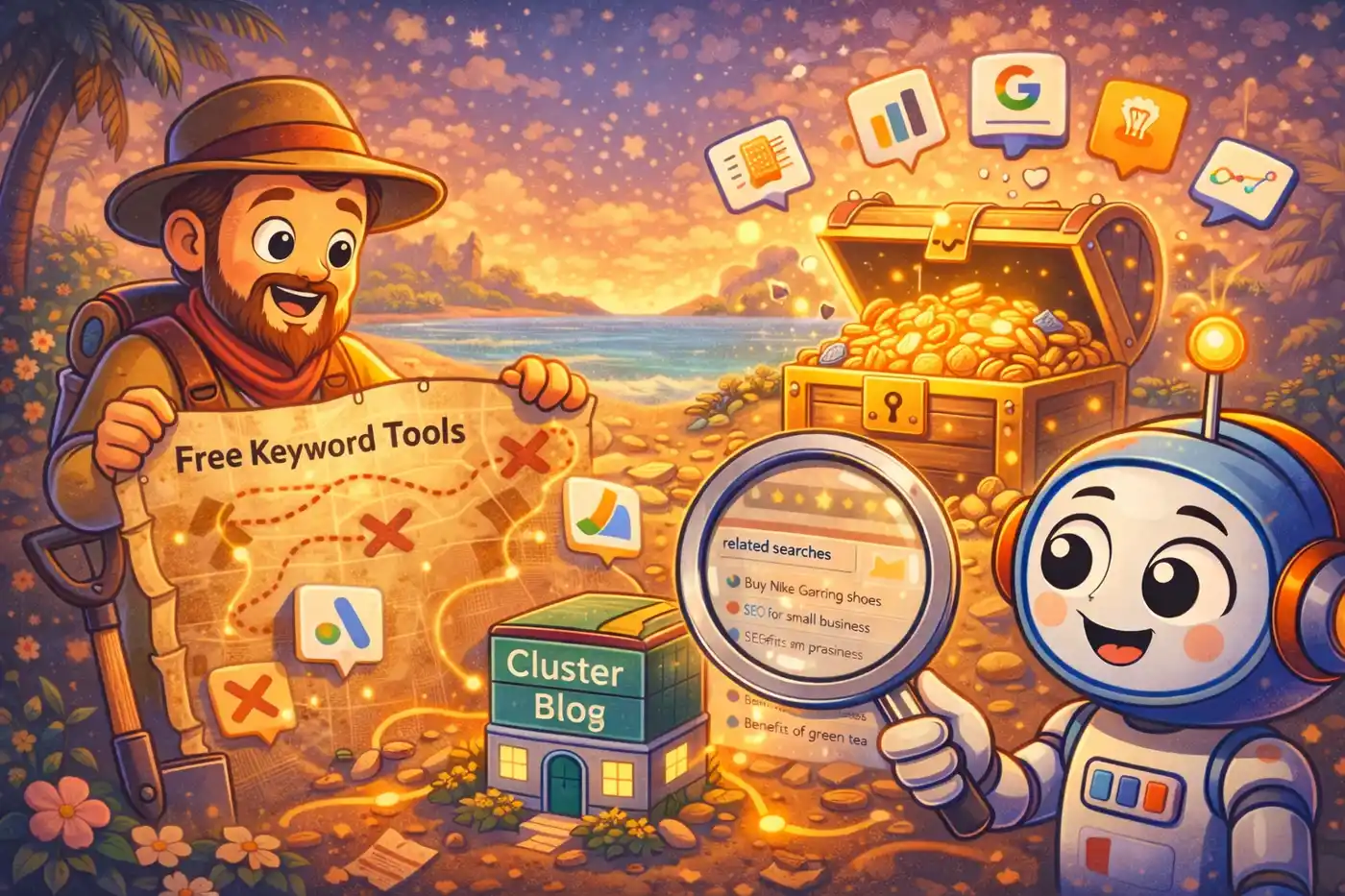
Every keyword is an X on a map. But without the map, you are just digging at random.

Somewhere out there, people are typing the exact words that describe what your business offers. Right now. Into Google. The question is not whether the treasure exists. The question is whether you have a map to find it or whether you are still guessing where to dig.

Keyword research is that map. It is the process of finding the specific search terms your audience is already using, and then showing up exactly where they are looking rather than where you assume they are looking.

Most businesses skip this step. They write content based on what they want to say, choose words that sound right, and publish with optimism. The result is content that is well-written, professionally produced, and essentially invisible. Not because it is bad. It is buried in the wrong part of the ocean, far from where anyone is actually searching.

Keyword research changes that. It is not about guessing. It is about reading the map before you pick up the shovel.

What is keyword research and why does every business need it?

Keyword research is the practice of discovering which words and phrases people type into search engines when looking for products, services, or information related to your business. It tells you what your audience is thinking about, what problems they are trying to solve, and (when read alongside search intent) at what stage of the decision process they are searching.

Think of the internet as a vast ocean floor, covered with treasure. Every search query is a person with a metal detector, walking slowly across that ocean floor, listening for a signal. Your content is either buried in a place they will walk over. Or it is not.

Keyword research tells you where people are walking. Without it, you are placing your treasure chest somewhere logical to you, not somewhere logical to the person searching. With it, you put your content exactly where the metal detector is pointed, and the signal goes off every time.

Apply this yourself

Open a blank document and write down how you would search for your own product or service. Not how you would describe it internally: how a stranger would type it. Write down 5 phrases. These are your first seed keywords.

The difference between short-tail and long-tail keywords

Not all treasure maps lead to the same kind of reward. Before opening any tool, there is one distinction that shapes every decision in keyword research.
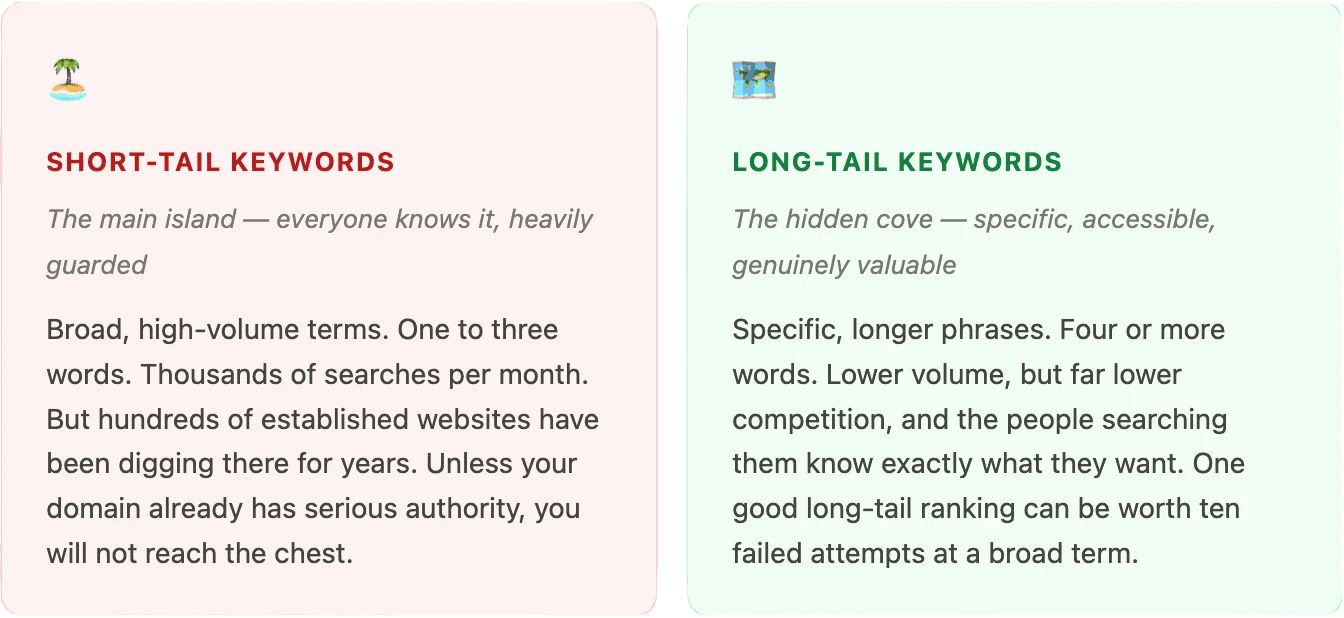
Short-tail keywords attract high traffic but are nearly impossible to rank for unless your domain already has years of authority behind it. Long-tail keywords attract fewer visitors per search, but those visitors are more specific in what they want: higher relevance, lower competition, and better conversion rates.

"Fifty hidden coves beat one heavily-guarded main island. The treasure is just as real and far easier to reach."

This is the logic behind compound SEO. Instead of gambling everything on one high-volume keyword, you build a collection of targeted long-tail wins. Each one is a small, achievable expedition. Together, they compound into something much larger, far more resilient than a strategy staked on a single chest.

Apply this yourself

Look at the five phrases you wrote down. Circle anything that is four or more words long. Those are your long-tail leads. Cross off anything under three words. The main island is not your starting point. The hidden coves are.

What search volume and keyword difficulty actually mean

Every treasure map has two critical pieces of information: how much is buried here, and how many other hunters have already found it. In keyword research, those two numbers are search volume and keyword difficulty.

Search volume is the average number of times a keyword is searched per month. A keyword with 200 searches is not "too small." If those 200 people are exactly your target customer, that is 200 qualified visitors per month at zero ad spend. A small cove can still hold a significant chest.

Keyword difficulty is a score from 0 to 100 estimating how hard it is to rank on page one. For newer or smaller websites, targeting keywords in the 10–30 range is far more realistic than competing at 60+. A cove with one other hunter is a very different situation from one where fifty ships have already anchored.

The combination to look for: meaningful search volume, low-to-medium difficulty, and clear alignment with what your business actually offers. That intersection, specific enough to be achievable, relevant enough to be valuable, is where organic growth begins. Not at the top of a volume chart where the competition has a ten-year head start and a fleet of ships.

Apply this yourself

Take your best long-tail phrase and enter it into the Ahrefs Free Keyword Generator (no account needed). Note the volume and the difficulty score. If the difficulty is under 30, it is a realistic target for a growing site. Keep what fits. Set the rest aside for later. Not every cove needs to be reached on the first expedition.

The best free keyword research tools

A good treasure hunter does not rely on one map. Different maps show different things: coastlines, depth, historical findings, current activity. These five free tools each offer a different view of the same search landscape, and together they cover everything you need to plan your expedition.
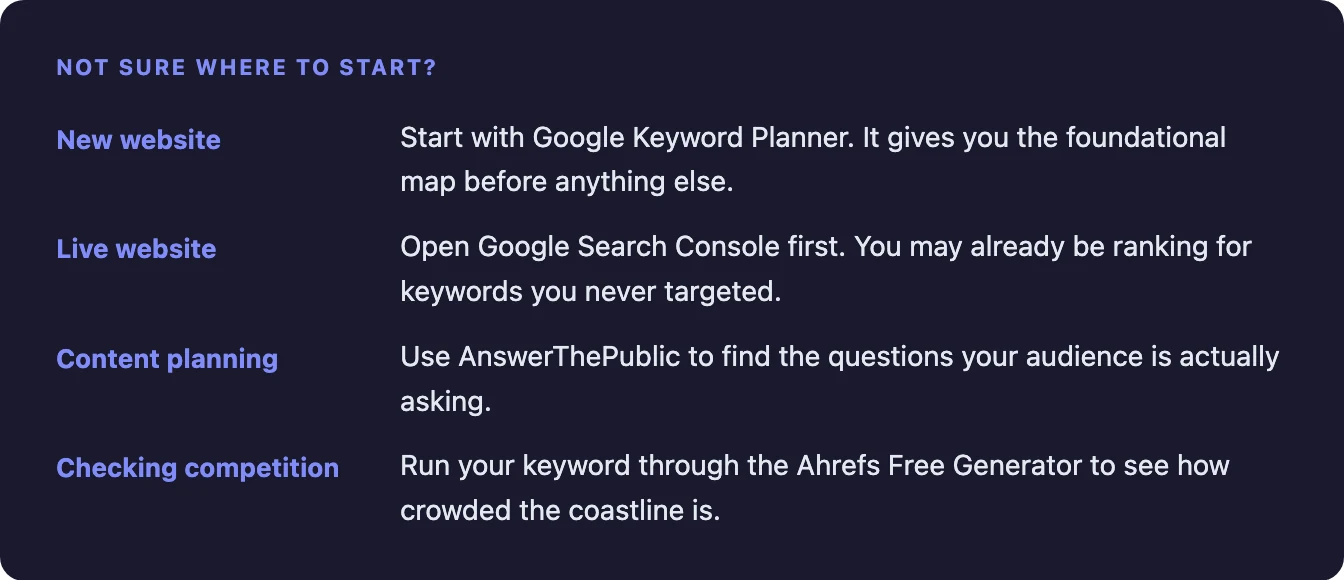
TOOLS

Google Keyword Planner

Free with Google account

The most authoritative map available. Drawn by Google itself, using Google's own data. Originally built for paid ad campaigns, but invaluable for organic research. This is the official chart of the ocean. It shows where people are actually sailing, not where someone estimates they might be.

Best for: finding real search volumes and discovering related keyword territories.

Google Search Console

Free

If your website is already live, this is the most underused tool in most businesses' arsenals. Search Console shows you which keywords your site already ranks for, including keywords you may not have even targeted deliberately. This is not a map of the whole ocean. It is a map of the treasure you have already found, with clues pointing to what lies nearby.

Best for: optimising existing content and uncovering ranking opportunities already within reach.

Google Trends

Free

Shows how interest in a keyword has changed over time and how it compares to related terms. A cove that was rich two years ago might be exhausted today. One that seems small right now might be building toward something significant. Trends tells you which direction the current is moving.

Best for: validating keyword timing and identifying rising search territories before they peak.

Ahrefs Free Keyword Generator

Free, no account needed

Enter any seed keyword and get a list of related terms with search volumes and difficulty scores (no subscription required). One of the quickest ways to check how many other hunters are already working a particular stretch of coastline before you commit to the expedition.

Best for: quick keyword discovery and difficulty assessment without signing up.

AnswerThePublic

Free (limited daily searches)

Rather than showing volumes and difficulty scores, AnswerThePublic maps out every question people ask around any topic: who, what, where, when, why, how. It is less a treasure map and more a guide to what the treasure hunters are actually thinking. Consistently surfaces content angles that volume-focused tools miss entirely.

Best for: understanding the questions your audience is asking before they even reach your content.

Apply this yourself

Start with one tool only. Use the start guide above to pick the right one for your situation. Open it, enter your topic, and write down 10 keyword suggestions before moving on. One map, read thoroughly, is worth more than five maps barely glanced at.

How to do keyword research: planning the expedition

With your maps in hand, here is how to plan the expedition. A good treasure hunter does not dig everywhere at once. They study the maps, identify the most promising coordinates, and move deliberately toward them.

  1. Choose your starting territory. Pick the single subject your business most wants to be associated with. Not a broad ocean. One stretch of coastline. This is your base camp. Everything else radiates from here.

  2. Open Google Keyword Planner and map the area. Enter your seed topic and study the related keywords it surfaces. Note anything that feels specific, intentional, and relevant to what your business actually offers. These are your potential X marks.

  3. Filter by volume and difficulty. Prioritise keywords with a search volume your site can realistically benefit from and a difficulty level you can compete for. For newer websites, that means targeting keywords in the 100–1,000 monthly searches range with low-to-medium competition: the hidden coves, not the main island.

  4. Group your findings into clusters. Related keywords belong together. Each cluster becomes a piece of content. This is how topical authority is built, and how Google begins to recognise your site as a credible source rather than a random collection of pages.

  5. Check what is already at the surface. Before writing anything, search your target keyword in an incognito window. Study what Google already ranks at the top. What format do those pages use? How long are they? What do they cover? This is your competition. Know what you are up against before you start digging.

Before you commit to a keyword

Ask three questions: Is the intent behind this search something my business genuinely serves? Can I realistically compete for it with my current domain authority? Does the content I would write match what Google is already surfacing for this term?

If all three are yes, mark the X. If not, keep looking. The right cove is always worth the extra search.

Apply this yourself

Set aside 30 minutes this week and run one topic through all five steps above. By the end, you should have a shortlist of 5 to 10 keywords with volume and difficulty numbers attached, grouped into at least two clusters. That shortlist is your expedition plan.

How to turn your keywords into content that ranks

Finding the treasure is only half the expedition. Creating content that actually ranks and holds its position requires a different kind of discipline.

Your focus keyword belongs in four specific places: the page title, the H1 heading, the meta description, and naturally within the first hundred words of your content. Not scattered across the page twenty times. Once in each of those critical positions is enough. Keyword stuffing does not improve rankings. It signals to Google that the content was written for an algorithm, not for a person.

Supporting keywords should appear throughout the content organically. If you write a genuinely useful, thorough article on a topic, they will show up naturally on their own. Forcing them in creates writing that reads like a map written by someone who has never sailed: technically complete, but somehow wrong.

The most important alignment is between your keyword and its intent. A keyword like "best free keyword research tools" carries commercial intent — the reader wants recommendations. A keyword like "what is keyword research" carries informational intent — they need an explanation. Writing the wrong type of content for either one is like finding the right location on the map but digging in the wrong spot.

The keyword gets you to the right location. The intent is what tells you exactly where to dig.

Apply this yourself

Take your primary keyword and search it in an incognito window. Look at the top three results. What format do they use? How long are they? What questions do they answer? Write those observations down before you write a single word of your own content. The map tells you where the treasure is. The surface tells you how deep to dig.

Your adventure is about to begin

Keyword research is not a one-time expedition. The ocean shifts — new coves open, old ones get crowded, and what was once uncharted territory becomes the most competitive coastline on the map. The best treasure hunters return to their charts regularly: checking what has changed, spotting what has just opened up, and adjusting their route before the competition does. You now have the tools, the method, and the map. The only thing left is to decide where to dig first.

Found your keywords? The next step is organising them into a structure that builds long-term authority. Our guide to topical authority and content clusters shows you how to turn a list of keywords into a connected content system that grows stronger over time.

Not sure which intent your keywords belong to? Start with our guide to search intent. Understanding the why behind a search is what makes keyword research meaningful.

If you want a keyword strategy built around your specific business and audience, take a look at our SEO services.

Daniel Rojo avatar picture

Daniel Rojo

LinkedIn author:

Meet Wolfy

Triple your productivity with Wolfy, the dedicated Google Ads agent.

Read more

Contents

No headings found

free keyword research tool

Every keyword is an X on a map. But without the map, you are just digging at random.

Somewhere out there, people are typing the exact words that describe what your business offers. Right now. Into Google. The question is not whether the treasure exists. The question is whether you have a map to find it or whether you are still guessing where to dig.

Keyword research is that map. It is the process of finding the specific search terms your audience is already using, and then showing up exactly where they are looking rather than where you assume they are looking.

Most businesses skip this step. They write content based on what they want to say, choose words that sound right, and publish with optimism. The result is content that is well-written, professionally produced, and essentially invisible. Not because it is bad. It is buried in the wrong part of the ocean, far from where anyone is actually searching.

Keyword research changes that. It is not about guessing. It is about reading the map before you pick up the shovel.

What is keyword research and why does every business need it?

Keyword research is the practice of discovering which words and phrases people type into search engines when looking for products, services, or information related to your business. It tells you what your audience is thinking about, what problems they are trying to solve, and (when read alongside search intent) at what stage of the decision process they are searching.

Think of the internet as a vast ocean floor, covered with treasure. Every search query is a person with a metal detector, walking slowly across that ocean floor, listening for a signal. Your content is either buried in a place they will walk over. Or it is not.

Keyword research tells you where people are walking. Without it, you are placing your treasure chest somewhere logical to you, not somewhere logical to the person searching. With it, you put your content exactly where the metal detector is pointed, and the signal goes off every time.

Apply this yourself

Open a blank document and write down how you would search for your own product or service. Not how you would describe it internally: how a stranger would type it. Write down 5 phrases. These are your first seed keywords.

The difference between short-tail and long-tail keywords

Not all treasure maps lead to the same kind of reward. Before opening any tool, there is one distinction that shapes every decision in keyword research.

Short-tail keywords attract high traffic but are nearly impossible to rank for unless your domain already has years of authority behind it. Long-tail keywords attract fewer visitors per search, but those visitors are more specific in what they want: higher relevance, lower competition, and better conversion rates.

"Fifty hidden coves beat one heavily-guarded main island. The treasure is just as real and far easier to reach."

This is the logic behind compound SEO. Instead of gambling everything on one high-volume keyword, you build a collection of targeted long-tail wins. Each one is a small, achievable expedition. Together, they compound into something much larger, far more resilient than a strategy staked on a single chest.

Apply this yourself

Look at the five phrases you wrote down. Circle anything that is four or more words long. Those are your long-tail leads. Cross off anything under three words. The main island is not your starting point. The hidden coves are.

What search volume and keyword difficulty actually mean

Every treasure map has two critical pieces of information: how much is buried here, and how many other hunters have already found it. In keyword research, those two numbers are search volume and keyword difficulty.

Search volume is the average number of times a keyword is searched per month. A keyword with 200 searches is not "too small." If those 200 people are exactly your target customer, that is 200 qualified visitors per month at zero ad spend. A small cove can still hold a significant chest.

Keyword difficulty is a score from 0 to 100 estimating how hard it is to rank on page one. For newer or smaller websites, targeting keywords in the 10–30 range is far more realistic than competing at 60+. A cove with one other hunter is a very different situation from one where fifty ships have already anchored.

The combination to look for: meaningful search volume, low-to-medium difficulty, and clear alignment with what your business actually offers. That intersection, specific enough to be achievable, relevant enough to be valuable, is where organic growth begins. Not at the top of a volume chart where the competition has a ten-year head start and a fleet of ships.

Apply this yourself

Take your best long-tail phrase and enter it into the Ahrefs Free Keyword Generator (no account needed). Note the volume and the difficulty score. If the difficulty is under 30, it is a realistic target for a growing site. Keep what fits. Set the rest aside for later. Not every cove needs to be reached on the first expedition.

The best free keyword research tools

A good treasure hunter does not rely on one map. Different maps show different things: coastlines, depth, historical findings, current activity. These five free tools each offer a different view of the same search landscape, and together they cover everything you need to plan your expedition.

TOOLS

Google Keyword Planner

Free with Google account

The most authoritative map available. Drawn by Google itself, using Google's own data. Originally built for paid ad campaigns, but invaluable for organic research. This is the official chart of the ocean. It shows where people are actually sailing, not where someone estimates they might be.

Best for: finding real search volumes and discovering related keyword territories.

Google Search Console

Free

If your website is already live, this is the most underused tool in most businesses' arsenals. Search Console shows you which keywords your site already ranks for, including keywords you may not have even targeted deliberately. This is not a map of the whole ocean. It is a map of the treasure you have already found, with clues pointing to what lies nearby.

Best for: optimising existing content and uncovering ranking opportunities already within reach.

Google Trends

Free

Shows how interest in a keyword has changed over time and how it compares to related terms. A cove that was rich two years ago might be exhausted today. One that seems small right now might be building toward something significant. Trends tells you which direction the current is moving.

Best for: validating keyword timing and identifying rising search territories before they peak.

Ahrefs Free Keyword Generator

Free, no account needed

Enter any seed keyword and get a list of related terms with search volumes and difficulty scores (no subscription required). One of the quickest ways to check how many other hunters are already working a particular stretch of coastline before you commit to the expedition.

Best for: quick keyword discovery and difficulty assessment without signing up.

AnswerThePublic

Free (limited daily searches)

Rather than showing volumes and difficulty scores, AnswerThePublic maps out every question people ask around any topic: who, what, where, when, why, how. It is less a treasure map and more a guide to what the treasure hunters are actually thinking. Consistently surfaces content angles that volume-focused tools miss entirely.

Best for: understanding the questions your audience is asking before they even reach your content.

Apply this yourself

Start with one tool only. Use the start guide above to pick the right one for your situation. Open it, enter your topic, and write down 10 keyword suggestions before moving on. One map, read thoroughly, is worth more than five maps barely glanced at.

How to do keyword research: planning the expedition

With your maps in hand, here is how to plan the expedition. A good treasure hunter does not dig everywhere at once. They study the maps, identify the most promising coordinates, and move deliberately toward them.

  1. Choose your starting territory. Pick the single subject your business most wants to be associated with. Not a broad ocean. One stretch of coastline. This is your base camp. Everything else radiates from here.

  2. Open Google Keyword Planner and map the area. Enter your seed topic and study the related keywords it surfaces. Note anything that feels specific, intentional, and relevant to what your business actually offers. These are your potential X marks.

  3. Filter by volume and difficulty. Prioritise keywords with a search volume your site can realistically benefit from and a difficulty level you can compete for. For newer websites, that means targeting keywords in the 100–1,000 monthly searches range with low-to-medium competition: the hidden coves, not the main island.

  4. Group your findings into clusters. Related keywords belong together. Each cluster becomes a piece of content. This is how topical authority is built, and how Google begins to recognise your site as a credible source rather than a random collection of pages.

  5. Check what is already at the surface. Before writing anything, search your target keyword in an incognito window. Study what Google already ranks at the top. What format do those pages use? How long are they? What do they cover? This is your competition. Know what you are up against before you start digging.

Before you commit to a keyword

Ask three questions: Is the intent behind this search something my business genuinely serves? Can I realistically compete for it with my current domain authority? Does the content I would write match what Google is already surfacing for this term?

If all three are yes, mark the X. If not, keep looking. The right cove is always worth the extra search.

Apply this yourself

Set aside 30 minutes this week and run one topic through all five steps above. By the end, you should have a shortlist of 5 to 10 keywords with volume and difficulty numbers attached, grouped into at least two clusters. That shortlist is your expedition plan.

How to turn your keywords into content that ranks

Finding the treasure is only half the expedition. Creating content that actually ranks and holds its position requires a different kind of discipline.

Your focus keyword belongs in four specific places: the page title, the H1 heading, the meta description, and naturally within the first hundred words of your content. Not scattered across the page twenty times. Once in each of those critical positions is enough. Keyword stuffing does not improve rankings. It signals to Google that the content was written for an algorithm, not for a person.

Supporting keywords should appear throughout the content organically. If you write a genuinely useful, thorough article on a topic, they will show up naturally on their own. Forcing them in creates writing that reads like a map written by someone who has never sailed: technically complete, but somehow wrong.

The most important alignment is between your keyword and its intent. A keyword like "best free keyword research tools" carries commercial intent — the reader wants recommendations. A keyword like "what is keyword research" carries informational intent — they need an explanation. Writing the wrong type of content for either one is like finding the right location on the map but digging in the wrong spot.

The keyword gets you to the right location. The intent is what tells you exactly where to dig.

Apply this yourself

Take your primary keyword and search it in an incognito window. Look at the top three results. What format do they use? How long are they? What questions do they answer? Write those observations down before you write a single word of your own content. The map tells you where the treasure is. The surface tells you how deep to dig.

Your adventure is about to begin

Keyword research is not a one-time expedition. The ocean shifts — new coves open, old ones get crowded, and what was once uncharted territory becomes the most competitive coastline on the map. The best treasure hunters return to their charts regularly: checking what has changed, spotting what has just opened up, and adjusting their route before the competition does. You now have the tools, the method, and the map. The only thing left is to decide where to dig first.

Found your keywords? The next step is organising them into a structure that builds long-term authority. Our guide to topical authority and content clusters shows you how to turn a list of keywords into a connected content system that grows stronger over time.

Not sure which intent your keywords belong to? Start with our guide to search intent. Understanding the why behind a search is what makes keyword research meaningful.

If you want a keyword strategy built around your specific business and audience, take a look at our SEO services.

Daniel Rojo avatar picture

Daniel Rojo

LinkedIn author:

Meet Wolfy

Triple your productivity with Wolfy, the dedicated Google Ads agent.

Read more

Frequently asked questions

Frequently asked questions

What is the best free keyword research tool for beginners?

How many keywords should I target per page?

Is a keyword with low search volume worth targeting?

How often should I redo my keyword research?

What is the difference between keyword research and SEO?