Search Engine Marketing (SEO)

How businesses get recommended on Google Ask Maps

A casting director sits at a long table with 200 headshots in front of her. She has three roles to fill. She is not reading every bio. She is not scrolling to the bottom of the pile. She picks up a handful, turns the rest face-down, and circles three names.
The other 197 never hear back. Not because they are bad. Because she already found what she needed.
Google Maps just hired a casting director. Her name is Gemini. And she is already reviewing your file.
Google's new AI layer in Maps no longer shows you a list. It picks 3 to 8 businesses and explains why each one made it. Here is how the selection works, and how to make sure your business gets chosen.
Google Ask Maps is currently live in the US and India. Europe is not yet in scope, but the signals it reads are being built right now. The businesses that prepare early will have a head start when it arrives. |
|---|
What is Google Ask Maps?
On March 12, 2026, Google announced what it called the biggest update to Maps in over a decade. Alongside a redesigned navigation experience, it introduced Ask Maps: a conversational AI layer built on Gemini that lets users ask natural language questions instead of typing keywords.
Instead of searching "Italian restaurant Amsterdam" and scrolling through a list of 40 results, a user can now ask: "Where can I take my parents for a nice dinner this Saturday, somewhere quiet, not too far from the centre?" Ask Maps interprets the intent, evaluates the options, and returns a handpicked set of recommendations with a short explanation for each one.
The number of results is not a list. It is a shortlist. Ask Maps typically returns 3 to 8 businesses per query, drawing from a database of over 300 million places and reviews from 500 million contributors. The rest of the map is still there. But the recommendation goes to a select few.

The search interest tells the story. This feature went from unknown to actively researched in a matter of weeks. The businesses that understand it first have a window before the market catches up.
From open audition to casting call
To understand what Ask Maps changes, it helps to understand what it replaces. Traditional Google Maps worked like an open audition: claim your profile, show up in the right category, collect some reviews, and hope the person scrolling finds you. Visibility was about proximity, completeness, and volume.
Ask Maps works differently. For every query, it runs a casting call. The director, Gemini, reviews the available candidates and makes a decision: which businesses are right for this specific role? The query is the role. Your profile is your application. And only a handful get called back.
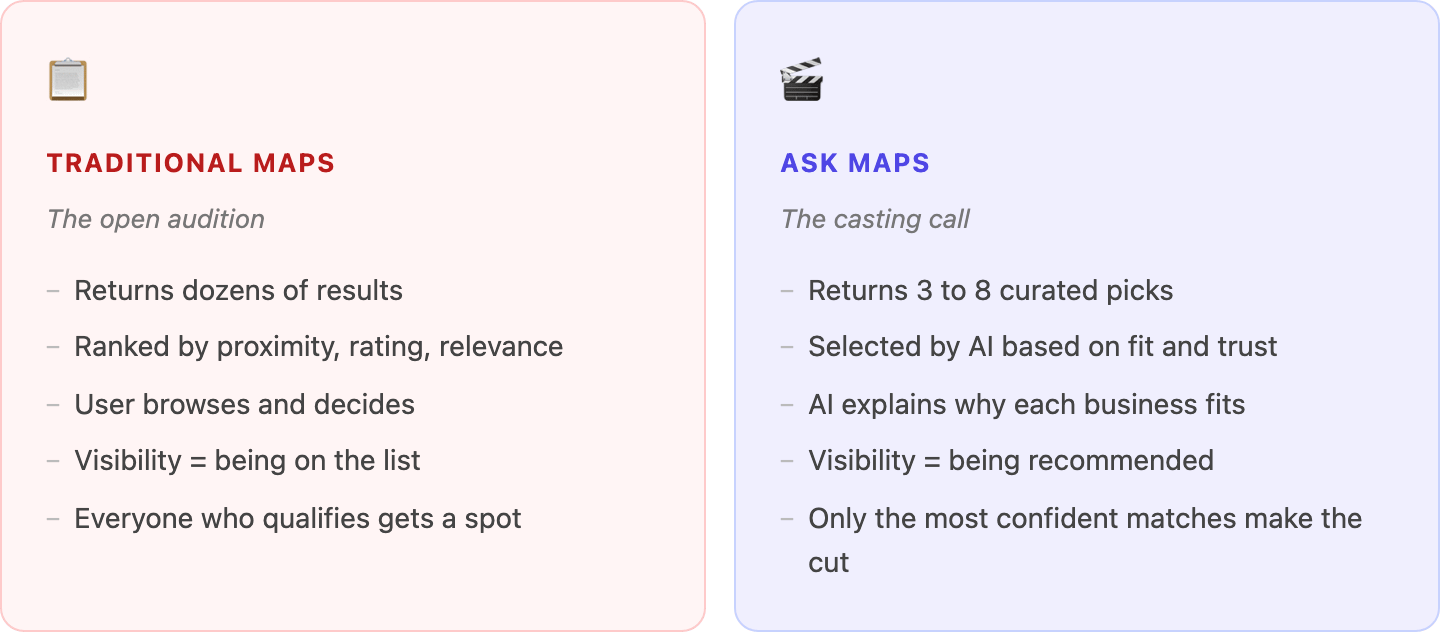
This is not just a change in interface. It is a change in logic. Being present is no longer the goal. Being selected is.
Apply this yourself Search Google Maps right now for what your business offers, from the perspective of a first-time customer. How many results appear? Where do you rank? Now ask yourself: if an AI had to confidently recommend three businesses from that list, would yours make the cut? What would it need to see to feel confident about you? |
|---|
The two stages: eligibility and the callback
Ask Maps does not make a single pass through the available businesses. According to analysis by Search Engine Land, it uses a two-stage filtering process: first it determines eligibility, then it assesses confidence. Most businesses fail at stage one before the AI ever considers recommending them.
Stage one: eligibility. Can this business even play the role? Does it match the category, the location, the opening hours, and the specific services mentioned in the query? A restaurant that closes at 9pm does not qualify for "open late." A shop with no services listed does not qualify for a specific service query. Eligibility is the door. If you do not pass it, you are not considered further.
Stage two: confidence. Of those who qualify, who would Google stake its reputation on recommending? This is where the real selection happens. The AI weighs the strength of your reviews, the depth of your profile, the consistency of your information across sources, and, for more complex queries, the content on your own website.
The type of query determines how far Ask Maps looks:
Simple queries (nearest, cheapest, fastest): Google Business Profile data dominates. Categories, hours, ratings, and location are the deciding factors.
Complex queries (specific atmosphere, situation, or combination of needs): Ask Maps expands its search to include your website content, third-party directories, and other external sources.
Trust-oriented queries (transparent, reliable, fair): the AI looks for signals of integrity. How you respond to reviews, whether your information is accurate, how you handle problems.
Apply this yourself Check your eligibility basics first. Are your opening hours accurate and up to date, including exceptions for holidays? Are your primary and secondary categories the most specific and accurate description of what you do? Are your services and products listed with clear descriptions? These are your eligibility documents. Without them, you are not in the room for stage two. |
|---|
The five signals that earn a callback
Once you pass the eligibility check, the casting director looks at your full file. Research into Ask Maps' behaviour has identified five areas that determine whether a business gets recommended or passed over.
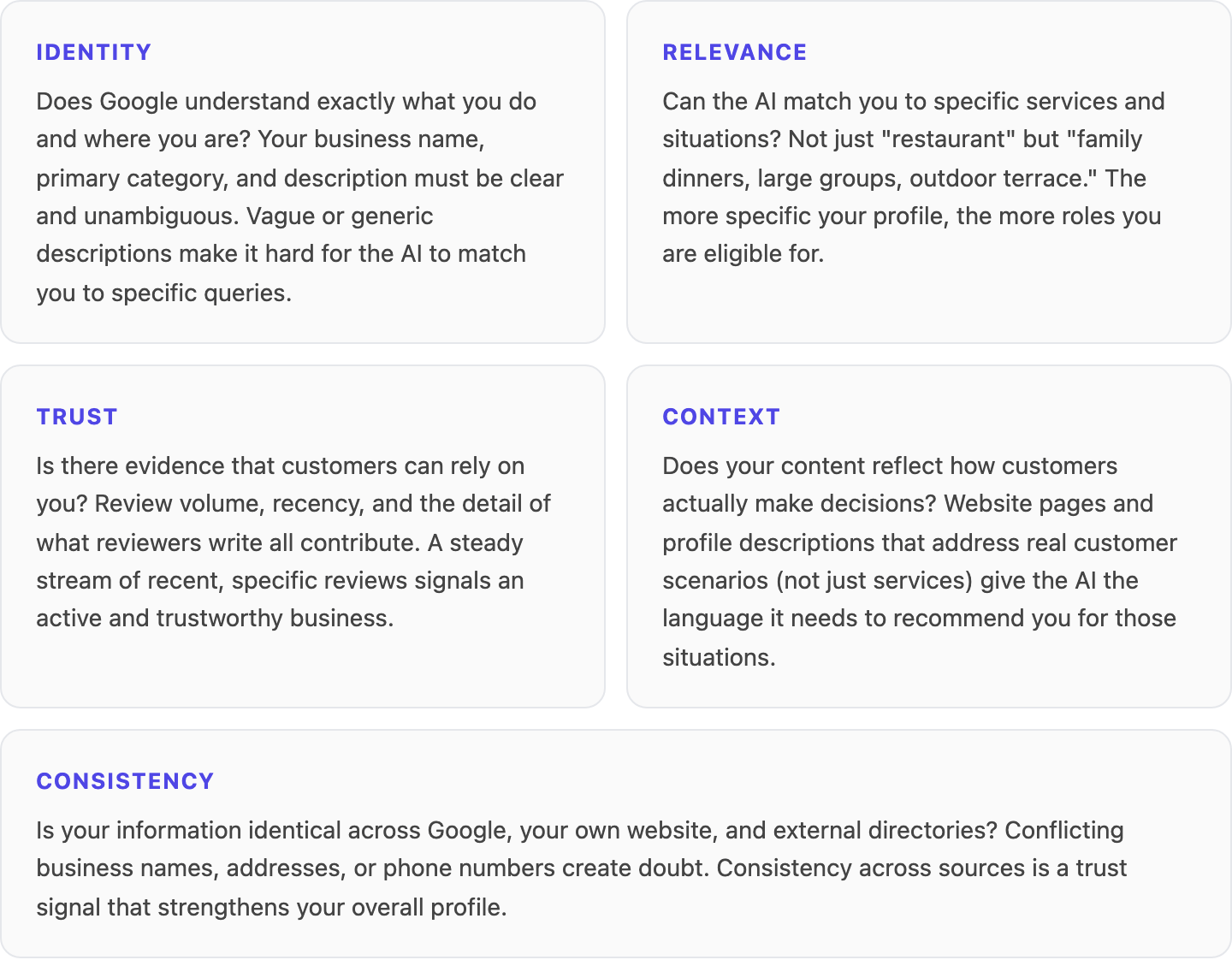
Tip
Reviews are your showreel. Not just the star rating, but the detail in what people write. A review that says "amazing pasta, perfect for a quiet weeknight dinner" tells the casting director far more than "great food, 5 stars." The AI reads the language in your reviews and uses it to match you to queries.
When you ask customers for a review, ask them to describe the situation: what they were looking for, what they found, what made it worth coming back. That language becomes your casting material.
Apply this yourself Read your last ten reviews as if you were an AI trying to understand what your business is good for. What situations do they describe? What words keep coming up? Now look at your Google Business Profile description. Does it reflect the same situations and language? If there is a gap between what customers say and what your profile says, that is where to start. |
|---|
The role determines the audition
One of the most interesting aspects of Ask Maps is that the same business can be recommended for very different queries. But only if its profile speaks to both situations. The more clearly you articulate the situations your business is suited for, the more roles you are eligible to audition for.
A hotel can be recommended for "quiet business trip" and "romantic weekend getaway" and "family holiday with young kids." But not if its profile describes nothing more than room types and a breakfast option. The casting director needs material to work with.
This represents a shift in how to think about your profile. The old logic was keyword optimisation: use the right category, include the right terms. The new logic is scenario optimisation: describe the situations your customers come to you for, in the language they use when they are deciding. This connects directly to how Google Maps has always rewarded local businesses that speak to specific customer intent, a dynamic we covered in depth in our tourism SEO guide.
You are not optimising for a keyword. You are auditioning for a role.
This applies to your Google Business Profile description, your service listings, your Q&A section, and the pages on your own website. Each of these is a line in your audition script. The more specific and situation-driven, the more convincingly you play the part.
Ask Maps also personalises results based on a user's Maps history: places they have saved, searched for, or visited before. That personalisation layer means a business that serves a specific type of customer consistently will over time be recommended more often to that type of customer. Consistency of audience compounds.
Not in your market yet. But the file is already open.
Ask Maps launched on March 12, 2026, and is currently rolling out in the United States and India, on Android and iOS. A desktop version is on the way. Europe, including the Netherlands, is not yet in scope.
That does not mean you have time to wait.
The signals Ask Maps reads are being built right now, whether you pay attention to them or not: your Google Business Profile, your reviews, your website content, your consistency across directories. When the feature does reach your market, it will not start fresh. It will evaluate what is already there.
This is part of a broader pattern. As we covered in our breakdown of Google's March 2026 core update, Google is increasingly rewarding businesses it can confidently recommend, not just those that show up. Ask Maps is the most direct expression of that logic applied to local search.
The businesses that arrive at launch with a complete profile, a steady stream of recent and detailed reviews, and scenario-driven descriptions will have a significant head start over those who begin optimising only once the feature is live. The audition date is not set, but the casting director is already collecting files.
Why act now Reviews take time to accumulate. A profile updated in the month Ask Maps launches is worth far less than one that has been consistently maintained for the preceding year. The window to build that foundation cost-effectively is now, before the competition realises the same thing. |
|---|
Your pre-audition checklist
Based on what we know about how Ask Maps evaluates businesses, here is where to focus your preparation.
Complete every field in your Google Business Profile
Business name, primary category, secondary categories, service areas, opening hours (including exceptions), phone number, website, attributes. Leave nothing blank. Incomplete profiles fail the eligibility check before stage two even begins.Write scenario-based descriptions
Replace generic service lists with descriptions of the situations your customers come to you for. Not just "hair salon" but "colour specialists, bridal appointments, walk-ins welcome on weekdays." Give the AI language to match you to specific queries.Build a steady review pipeline
Volume and recency both matter. Set up a simple, consistent process to ask for reviews after every completed job or visit. More importantly, encourage customers to describe the situation in their review, not just the outcome.Respond to all reviews
Responses signal active management and engagement. For Ask Maps' trust assessment, a business that responds thoughtfully to negative reviews is more credible than one with a perfect rating and no engagement.Audit your consistency across platforms
Check that your business name, address, phone number, and website URL are identical across Google, your own site, and any external directories. Inconsistencies across sources create doubt and weaken your trust signals.Add scenario-driven content to your website
For complex queries, Ask Maps pulls from your website. Pages that address specific customer situations ("planning a corporate event," "emergency plumber available today," "dog-friendly accommodation") make you eligible for those queries in a way that a generic homepage does not.Use Google Business Profile posts and Q&A
Regular posts signal that your profile is actively managed. The Q&A section is an underused opportunity to add situational context: answer the questions a potential customer would ask before visiting, in the exact language they would use to ask them.
Apply this yourself Open your Google Business Profile and read your description out loud. Does it sound like something a real customer would say about you, or does it sound like a category listing? If it sounds generic, rewrite it from the perspective of your best customer: what did they come in for, what did they get, and why would they recommend you to a friend? If you want a full audit of your local search presence as part of a broader SEO strategy, take a look at our SEO services. |
|---|
For years, being on the map was the goal. You claimed your listing, collected a few stars, and counted on proximity to do the rest. Google Maps was a phone book with photos: comprehensive, passive, scrollable.
Ask Maps is not a phone book. It is a casting director with a clear vision and a short list. The businesses it recommends are not the biggest or the nearest. They are the ones it knows well enough to trust. The ones with detailed files, credible showreels, and profiles that speak directly to the roles being cast. The audition is coming. Make sure your file is ready when it arrives.


Frequently asked questions
Explore other blogs






Rotterdam
Bierstraat 123 C
Valencia Carrer del Prof. Beltrán Báguena 5


Flowboost 2026 ~ All rights reserved.