 Daniel Rojo, SEO Expert

Have you ever gone to look at a second-hand car that seemed almost too good to be true? Low mileage for its age, not a scratch on the paintwork, and a salesman who tells you the price is only valid today. When you ask if you can have it checked by an independent garage first, he says there’s no need. He’ll guarantee it himself. At that point, you’d probably start to wonder what he isn’t telling you.
Buying SEO can feel a lot like that. Most business owners can’t look under the bonnet themselves, so they have to trust whoever is selling it. Most SEO specialists and agencies deserve that trust, but not all of them. Some promise quick rankings, send reports that make the results look better than they are (the SEO equivalent of winding back the mileage) and stop responding once things go wrong. And from the outside, a scam and a genuine offer can look surprisingly similar.
That’s why we wrote this guide. We’ll explain what counts as an SEO scam, go through the most common tricks with real examples of SEO abuse and show what to check before you sign anything. If you’ve already been caught out, you’ll also find what to do next and how to report a fraudulent SEO company. Finally, we’ll explain how we work at Flowboost.
Part 1: A bad car or a stolen one? What counts as an SEO scam

Not every disappointing car is a fraud. Sometimes you simply bought an old model that needed more work than you hoped. The same goes for SEO, and it’s worth separating the two before anyone gets accused of anything.
Bad SEO is honest work that doesn’t deliver: a strategy that misjudged the competition, slow progress, a specialist who isn’t very good. Frustrating, but nobody lied to you. SEO genuinely takes time, a point we covered in SEO challenges in 2026.
An SEO scam is different. It involves deception: you’re promised things that can’t be delivered, shown results that aren’t real, sold services that aren’t performed, or exposed to risks nobody told you about. The difference isn’t the outcome; it’s the honesty.
Search engine optimization scams usually fall into three groups:
- Selling the impossible. Guaranteed rankings, instant results, a “special relationship” with Google.
- Faking the work. Reports that look impressive but measure nothing useful, or invoices for work that never happened.
- Hiding the risk. Using shortcuts that break Google’s spam policies, which can earn your site a penalty long after the scammer has moved on.
Google itself warns about this. Its guidance on hiring an SEO notes that some unethical SEOs use overly aggressive marketing or techniques that violate Google’s spam policies, which can lead to a negative adjustment of your site in search or even removal from Google’s index. In other words: you don’t just lose the money you paid, you can lose the visibility you already had.
Part 2: The dodgy dealer’s playbook: common SEO scams
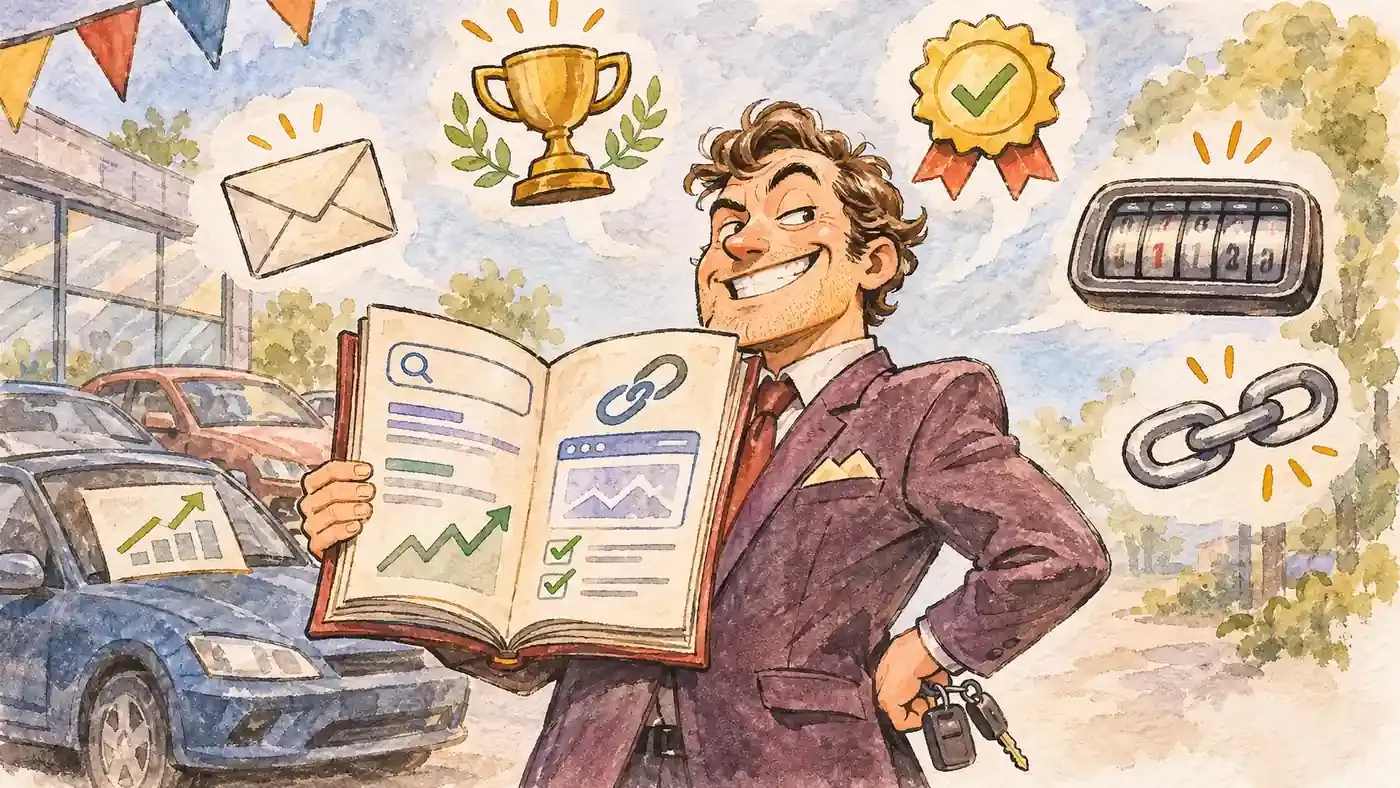
Every dodgy car dealer works from the same handful of tricks, and so do SEO scammers. Once you know them, they’re surprisingly easy to spot. Here are the most common ones, with examples of SEO abuse you may already have seen in your inbox.
1. The salesman who calls you: unsolicited SEO emails
“I was looking at your website and noticed 47 critical errors that are stopping you from ranking on page one.” You never asked. They never mention what the errors are. A good garage doesn’t knock on your door to tell you your car is broken.
Google is blunt about this. In its guidance on hiring an SEO, it advises treating unsolicited emails about search engines with the same suspicion you’d give a miracle diet pill. Most of these mails are sent in bulk to thousands of sites, and the “audit” is a template.
2. The guarantee: “Number one on Google, or your money back”
This is the oldest trick on the forecourt. Google states plainly that no one can guarantee a #1 ranking on Google. Nobody controls the algorithm, and rankings change daily. When someone guarantees a position, they usually mean one of two things: a keyword so obscure that nobody searches for it, or a promise they never intend to keep.
The 2026 version is the AI guarantee: “We’ll make ChatGPT recommend you.” Being visible in AI answers is real and worth working on, as our fake company experiment showed, but nobody can promise what an AI model will say tomorrow. Google now also advises checking that any AI-optimisation (GEO or AEO) advice you receive lines up with Google’s own guidance.
3. The fake dealer badge: “We have a special relationship with Google”
Google warns specifically about SEOs who claim a “special relationship” with Google or offer a “priority submit”. Neither exists for organic search. The same applies to tools sold as “approved” by Google Search: Google says it doesn’t evaluate or endorse third-party SEO tools.
One nuance worth knowing: a Google Partner badge is real, but it relates to Google Ads, not organic rankings. Many legitimate agencies have one (Flowboost included), but it says nothing about special treatment in search results.
4. The rolled-back odometer: reports that measure nothing
The monthly report is full of green arrows. You rank first for 30 keywords! On closer inspection, nobody searches for any of them, or they include your own brand name. Rankings for keywords without searches are the SEO equivalent of a rolled-back odometer: the number looks great, but it tells you nothing about the car. The real questions are whether the right people are finding you and whether that turns into customers, which is exactly what we covered in our guide to setting SEO goals.
5. The cheap engine swap: spam link packages
“1,000 high-authority backlinks for just €49.” These packages almost always come from link farms, spam directories, hacked sites or networks of fake blogs built only to sell links. Google’s spam policies treat buying or selling links for ranking purposes as link spam, and these links are exactly the kind Google is built to ignore or penalise. At best you’ve wasted your money; at worst you’re left with a toxic backlink profile to clean up.
That doesn’t mean every paid placement is a scam. Google itself acknowledges that buying and selling links is a normal part of advertising and sponsorship on the web, as long as it’s done transparently. The difference is quality and honesty: real websites with real readers, relevant context, and no pretending that a thousand links appeared on their own overnight.
6. Keeping the keys: you don’t own your own accounts
This one only shows itself when you try to leave. The agency registered your domain, your Google Business Profile, your Search Console or your Analytics account in its own name. When you want to switch, the car turns out to be registered to the dealer. Some agencies use this to hold clients hostage or charge a “transfer fee”. Legitimate partners work in accounts you own and give you full admin access from day one.
7. The secret recipe: “Our method is proprietary”
Every agency has its own way of working, and that’s fine. But if a specialist refuses to tell you what they actually do on your site, be careful. Behind the secrecy there are sometimes techniques that break Google’s rules: hidden text, doorway pages, cloaking, or content copied from other sites. Those shortcuts can work for a few weeks and then end in a Google penalty that takes months to recover from.
8. The threatening letter: fake penalties and extortion
A rarer but nastier variant: an email claiming your site has received a Google penalty that only they can lift, or a threat to point spam links at your site unless you pay. Google communicates real manual actions through Search Console, not through a stranger’s email. If you receive a message like this, check Search Console yourself and don’t pay anyone.
Part 3: The test drive: what to check before you sign

You wouldn’t buy a car without a test drive and a look at the logbook. Before you sign an SEO contract, do the same. These checks take less than an hour and filter out most SEO scams.
- Ask what they’ll actually do. A legitimate specialist can explain the plan in plain language: which pages, which fixes, which content, and why.
- Ask how success will be measured. Look for business outcomes like leads, sales or qualified traffic, not just rankings or “visibility”.
- Check who owns the accounts. Your domain, Search Console, Analytics and Google Business Profile should be in your name, with the agency added as a user.
- Read the contract for the exit. A reasonable notice period, no hidden transfer fees, and clarity on what happens to content and links if you leave.
- Ask how they build links. If the answer is a high number of links per month for a suspiciously low price, ask where they come from.
- Look for real references. Case studies with named clients, reviews on independent platforms, and people you can actually call.
- Be wary of urgency. “This price is only valid until Friday” is a sales tactic, not a strategy.
Part 4: Already bought a lemon? What to do if you’ve been scammed

If the car has already broken down on the motorway, there’s no point blaming yourself. Plenty of smart business owners have been caught by a convincing salesman. What matters now is limiting the damage and, where possible, making sure the next person isn’t caught too. Work through these steps in order.
Step 1: Take back the keys
Make sure you have full admin access to your domain registrar, hosting, website, Search Console, Google Analytics and Google Business Profile. Remove the agency’s access, change passwords, and transfer ownership of anything registered in their name. If they refuse to hand over accounts that belong to your business, document every request you make.
Step 2: Collect the paperwork
Save everything: the contract, invoices, emails, chat messages, reports and the original sales pitch. Screenshots of promises like “guaranteed first page” are especially useful. You’ll need this if you decide to report the company or take legal action.
Step 3: Have the car inspected
Find out what was actually done to your site. Check Search Console for manual actions and security issues, and look for hidden pages, strange redirects or copied content. If you find a penalty, our Google penalties guide walks you through recovery.
Step 4: Report the fraudulent SEO company
This is the step most people skip, and it’s the one that protects the next business. Since June 2026, Google’s own guidance on hiring an SEO explains where to go if you feel an SEO has deceived you:
- In the United States, the Federal Trade Commission (FTC) handles complaints about deceptive or unfair business practices.
- For a company outside the United States, Google points to econsumer.gov, an international platform for cross-border complaints.
In addition, you can contact your own national consumer or fraud authority, and the police if money was taken under false pretences. If the scammer used spam techniques that affect search results, you can also report that spam to Google through its spam report form.
Step 5: Get proper advice before you go to war
If significant money is involved or the agency refuses to release your accounts, talk to a lawyer before you escalate. We’re SEO specialists, not lawyers, so treat this guide as a starting point rather than legal advice.
Part 5: The honest garage: how we work at Flowboost

The best way to protect yourself from SEO scams is to know what an honest offer looks like. So here’s ours, as plainly as we can put it.
We don’t guarantee rankings, because nobody can. What we do is agree on realistic goals tied to your business, explain what we’ll do to get there, and report on whether it’s working, including when it isn’t.
You own everything. Your domain, your accounts, your data and the content we create belong to your business. We work in your accounts with the access you give us, and you can take that access away whenever you like.
We tell you what we’re doing and why. No secret recipes. If we recommend a change to your site, we explain the reasoning in language you don’t need a technical background to follow.
We’d rather lose a pitch than win it with a promise we can’t keep. That’s not modesty; it’s simply the only way to build a relationship that lasts longer than the first invoice.
An honest car dealer doesn’t mind when you bring a mechanic to look under the bonnet. He hands you the logbook, tells you about the scratch on the back door and lets you take the car for a proper drive. The same goes for SEO: the specialists worth hiring are the ones who welcome your questions.
If you’re not sure whether the SEO you’re paying for is the real deal, or you want a second opinion before signing, take a look at how we approach organic search, or talk to us. We’re happy to look under the bonnet with you.
Frequently asked questions
What are the most common SEO scams?
The most common SEO scams are unsolicited emails offering a free "audit", guaranteed #1 rankings, claims of a special relationship with Google, cheap packages of spam backlinks, and reports full of rankings for keywords nobody searches for. Another common trick is registering a client's domain or accounts in the agency's name, which makes it hard to leave.
Can anyone guarantee a #1 ranking on Google?
No. Google states that no one can guarantee a #1 ranking, and it warns against SEOs who claim to. Rankings depend on many factors outside any agency's control and change constantly. A trustworthy SEO will set realistic goals and explain how progress will be measured instead.
How do I report a fraudulent SEO company?
Google's guidance on hiring an SEO points to the Federal Trade Commission (FTC) for companies in the United States and to econsumer.gov for companies in other countries. You can also contact your national consumer or fraud authority, or the police if money was taken under false pretences. Keep all contracts, invoices and emails as evidence.
Is buying backlinks a scam?
Not automatically. Google's spam policies treat buying or selling links for ranking purposes as link spam, but Google also acknowledges that paid links are a normal part of advertising and sponsorship when they are handled transparently. Cheap bulk packages from link farms or fake blogs are the real risk: they rarely help and can leave you with a toxic backlink profile.
How do I know if my SEO agency is scamming me?
Warning signs include reports that only show rankings for obscure keywords, no clear explanation of what work was done, refusing to give you access to your own accounts, and promises that sound too good to be true. Ask what was done this month, why it matters, and how it connects to your business goals; an honest agency will answer clearly.