It doesn’t start in a spreadsheet.
It doesn’t begin in a strategy deck.
It begins in intent, in a moment where someone feels a problem or a desire but cannot yet name the solution.
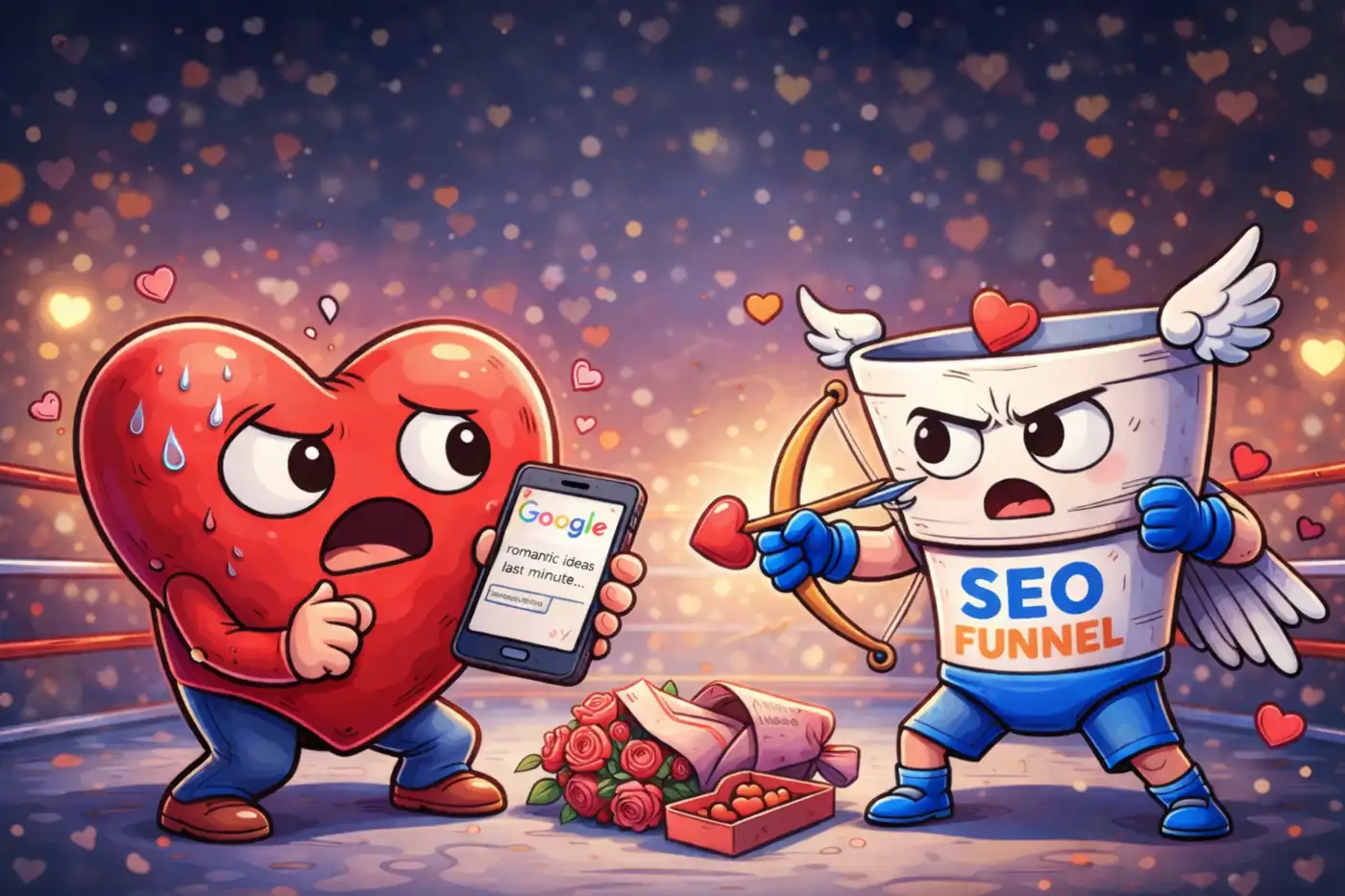
An SEO funnel is a structured content strategy designed to guide someone from that first vague search, through curiosity and comparison, all the way to a confident decision. It aligns content with search intent at every stage of the customer journey, moving naturally from awareness to consideration to conversion.
Because at its core, a marketing funnel is not a diagram. It’s a relationship. A gradual movement from curiosity to trust, from interest to commitment.
SEO is not a one-night stand. It’s chemistry built on consistency.
Phase I: The first glance across the room (TOFU)
Every true love story starts with curiosity, not desperation. No one wakes up on a random Tuesday morning thinking, today I am going to commit to something serious. That is not how attraction works. It starts smaller than that. Softer. You wake up with a feeling. A restlessness. A sense that maybe there is something better out there than what you currently have.
So you open an app. Maybe it is Tinder. Maybe Bumble… (let’s hope you don’t need to pay to gain visibility) Maybe you swear you are above dating apps and convince yourself you are simply grabbing coffee, yet you suddenly find yourself noticing who walks through the door. You are not making decisions yet. You are observing. Curious. Scanning the room without admitting you are doing it.
That is the first phase of dating. And it is exactly how the top of the SEO funnel works.
At the awareness stage of the SEO marketing funnel, nobody is searching for your brand. They are searching for relief. For clarity. For a way to solve something that feels slightly uncomfortable. They may not even have the right words for it yet. All they know is that something is not working. Their website is not performing. Their traffic has dropped (and yes, sometimes size does matter). Their conversions feel disappointing. Or maybe they simply feel like they should be doing better.
So they type something into Google. Not your company name. Not your service page. A question.
When someone searches what is funnel optimization or why is my website not ranking, they are not thinking about who wins awards or who has the most polished branding. They are thinking about their frustration and their uncertainty.
And this is where many brands go wrong. Instead of stepping into that moment gently, they walk in with a spotlight pointed at themselves. They start listing achievements, talking about experience and highlighting credentials. It may sound impressive in a boardroom, but in the context of attraction, it feels self-centered. Because let’s be honest… confidence is attractive. Narcissism is not.
In the first phase of attraction, no one falls for a résumé. They fall for recognition. For the feeling that someone understands them without trying too hard.
That is what awareness content should do inside the SEO funnel. It should not announce how great you are. It should quietly signal that you understand the problem better than anyone else in the room. When someone feels understood, they stay. And when they stay, curiosity turns into interest.
Phase II: The first date (MOFU)
Let’s say something worked. Somebody found your article. They didn’t just skim the headline. They stayed, and maybe even clicked through to another page. That moment may seem small, but it changes everything.
We are no longer in the phase of random curiosity. We are in the phase of possibility. They’ve noticed you. They’ve seen what you can do, and now they’re wondering if you could give them what they’ve been searching for.
Just like in seduction, that first innocent question never stays alone for long. What starts as light interest begins to sharpen. They no longer ask what SEO is. Now they want to know which strategy fits them best. Instead of casually wondering how to get traffic, they start comparing approaches, weighing strengths, testing compatibility. They look for depth. For real connection. For proof that this isn’t just another pretty promise.
This is the middle of the customer funnel, where excitement meets skepticism.
Content at this stage of the SEO funnel must do the same. It needs to be clear, precise and intentional, helping your “date” understand why you might be the right fit. It’s not about saying more or showing off — it’s about saying the right things at the right time. Soft calls to action guide the next step without forcing it.
Phase III: Avoiding the friendzone (Evaluation bridge)
After the first date, comfort settles in. The conversations flow more naturally. There is familiarity now, maybe even real chemistry. But beneath that ease, one quiet question begins to surface: where is this going?
In dating, this is the moment when attraction is no longer enough. You can keep enjoying the attention, or you can define what this is. Because without direction, even strong chemistry slowly fades into something vague, comfortable and safe — the friendzone.
The same happens in the SEO funnel. If your content informs and impresses but never clarifies the path forward, momentum disappears. There is interest, yes. There may even be trust. But without a defined next step, the relationship stalls. Attention without progression turns into hesitation.
At this stage, you don’t ask for blind commitment. You show intention. You invite them to see what this could look like in practice. This is where internal linking becomes strategic, not decorative. Where your informational content connects directly to your service pages. Where your informational articles guide readers toward a page designed to convert.
Phase IV: The romantic Valentine’s night (BOFU)
Your strategy has worked. You may not be entirely sure how every step aligned, but here they are. The table is set, the atmosphere feels intentional, and your landing page must be dressed for the occasion.
By the time someone arrives here, they are no longer casually exploring. They are deciding. Their searches are more direct, sometimes even branded. They are looking for something, and you need to be ready to show them that choosing you makes sense.
This is where things start to heat up. Your landing page needs to seduce them. It must clearly explain your process, define what working together looks like, outline timelines and expectations, and present proof through case studies or testimonials.
This is also where you make the invitation unmistakable. Clear calls to action are essential. They signal confidence and show that you are ready to move forward.
Conversion does not happen by accident. It happens when attraction meets clarity, and clarity meets action.
Make sure you deliver (So it’s not just a one-night stand)
A conversion is exciting. The tension was built, the signals were clear, and the invitation was accepted. But what happens next determines everything.
A great Valentine’s night is not rushed or careless. It requires attention, intention and presence. You don’t hurry through it. You don’t lose focus halfway. You take your time, you listen, you respond. You make sure the experience feels considered and satisfying.
The same applies after someone converts. If expectations were unclear, if onboarding feels chaotic, if what follows the “yes” is underwhelming, the spark fades quickly. Nothing kills momentum faster than overpromising and underdelivering.
If you want this to become something long-term rather than a one-night stand, you have to give it care. Structure. Follow-through. Because a strong SEO funnel is not about closing fast. It is about creating an experience so consistent and intentional that they want to stay.
And maybe even come back for more (always remember to call 😉) .
The reality: most SEO Marketing funnels are situationships
Let’s be honest.
Many businesses believe they have an SEO funnel simply because they have content. They publish articles, create service pages, and organize keywords neatly in a spreadsheet. From the outside, it looks structured. But having pieces is not the same as having direction.
A blog post can attract traffic and explain a concept clearly, but if it does not guide the reader toward the next step, it remains just an interesting conversation. A service page can ask for action immediately, but without prior context, it creates friction. And internal links, when they are not placed with intention, become mixed signals.
That is not a structured SEO funnel. It is a situationship.
There is interaction. There is interest. There is potential. But there is no real progression from awareness to decision. When each piece of content lives in isolation, the journey is not designed — it is improvised. The result is traffic that arrives, consumes, and leaves without moving forward.
A strong funnel does not feel forced. It feels natural. But behind that natural flow is deliberate strategy.
The romantic SEO customer journey
If you want your SEO funnel to actually perform, stop thinking in isolated keywords and start thinking in movement.
Every piece of content should have a clearly defined role within the journey:
Is it generating curiosity at the awareness stage?
Is it helping users compare options during consideration?
Is it removing doubts at the evaluation stage?
Is it guiding logically toward a decision?
Informational content should lead to deeper, more specific resources. Comparison content should connect to proof, authority, and case studies. Service pages should collect that built trust and convert it into action.
This is where internal linking stops being technical housekeeping and becomes strategic architecture. It is not about inserting links. It is about designing progression. You are not pushing users forward; you are showing them the next step so clearly that moving ahead feels natural.
That is real funnel optimization. Not more content. Better connection between stages.